Feed aggregator
Nebula Awards Finalist Announcement
FOR IMMEDIATE RELEASE:
Introducing SFWA’s 61st Annual Nebula Award Winners
Introducing SFWA’s 61st Annual Nebula Award Winners
San Francisco, CA – Saturday, June 6, 2026
The Science Fiction and Fantasy Writers Association (SFWA) is proud to announce its latest Nebula Award winners for works published in 2025, as first presented during the Nebula Awards Ceremony on Saturday, June 6, at the organization’s 61st Annual Nebula Awards Conference at the Crowne Plaza Chicago O’Hare Hotel and Conference Center in Chicago, Illinois.
The Nebula Awards are voted on by SFWA Members in good standing, and they represent the views of professional SFF writers on the state of their industry and recent excellence within it.
Since 1965, SFWA has advocated for writers of science fiction, fantasy, and related genres. From that very first year, the Nebula Awards process has been one of SFWA’s foundational pathways to improving literary community for SFF writers.
This year, SFWA celebrated two inaugural awards: one for Poem, and one for Comic. Like the Ray Bradbury Nebula Award for Outstanding Dramatic Presentation and the Nebula Award for Best Game Writing, these new awards celebrate writers at the heart of productions that also involve editors, artists, publishers, producers, and a wealth of other team members who make the magic happen. When voting opens later this year for work published in 2026, the second of these awards will be listed as Comics Writing.
The Nebula Awards Ceremony also celebrates excellence in science fiction, fantasy, and related genres through the issuance of special awards. This year, under the care and guiding words of Toastmaster Tananarive Due, the organization honored its 42nd Damon Knight Memorial Grand Master, N. K. Jemisin, the seasoned author of the Inheritance Trilogy, the Broken Earth Trilogy, and the Great Cities Duology, among others. SFWA also celebrated the excellent curatorial and community-building work of Kate Wilhelm Solstice Award Recipient David Langford, the tremendous genre commitment of Kevin O’Donnell, Jr. Service to SFWA Recipient Gay Haldeman, and the outstanding legacy of Infinity Award Recipient Roger Zelazny.
SFWA is delighted to announce that its next Nebula Awards Conference and Ceremony will be held in Seattle in June 2027. There is much to do to prepare for Nebula 62, but it all starts and ends with the power and purpose of good writing. Thank you to everyone who votes, writes, reads, and otherwise contributes to the betterment of this genre in all its brilliant forms.
When We Were Real, by Daryl Gregory (Saga)
★ The Buffalo Hunter Hunter, by Stephen Graham Jones (Saga; Titan UK) ★
Katabasis, by R.F. Kuang (Harper Voyager US; Harper Voyager UK)
Death of the Author, by Nnedi Okorafor (Morrow; Gollancz)
The Incandescent, by Emily Tesh (Tor; Orbit UK)
Sour Cherry, by Natalia Theodoridou (Tin House; Wildfire)
Wearing the Lion, by John Wiswell (DAW; Arcadia)
Disgraced Return of the Kap’s Needle, by Renan Bernardo (Dark Matter INK)
★ The River Has Roots, by Amal El-Mohtar (Tordotcom; Arcadia) ★
The Death of Mountains, by Jordan Kurella (Lethe)
Automatic Noodle, by Annalee Newitz (Tordotcom)
But Not Too Bold, by Hache Pueyo (Tordotcom)
“Descent”, by Wole Talabi (Clarkesworld 5/25)
“Our Echoes Drifting Through the Marsh”, by Marie Croke (Beneath Ceaseless Skies 1/9/25)
★ “Uncertain Sons”, by Thomas Ha (Uncertain Sons and Other Stories, Undertow Publications) ★
“We Begin Where Infinity Ends”, by Somto Ihezue (Clarkesworld 2/25)
The Name Ziya, by Wen-Yi Lee (Reactor; Tor Books)
“Never Eaten Vegetables”, by H.H. Pak (Clarkesworld 1/25)
“The Life and Times of Alavira the Great as Written by Titos Pavlou and Reviewed by Two Lifelong Friends”, by Eugenia Triantafyllou (Uncanny 3-4/25)
“Through the Machine”, by P.A. Cornell (Lightspeed 5/25)
“Six People to Revise You”, by J.R. Dawson (Uncanny 1-2/25)
“In My Country”, by Thomas Ha (Clarkesworld 4/25)
“The Tawlish Island Songbook of the Dead”, by E.M. Linden (PodCastle 2/18/25)
“Because I Held His Name Like a Key”, by Aimee Ogden (Strange Horizons 6/16/25)
★ “Laser Eyes Ain’t Everything”, by Effie Seiberg (Diabolical Plots 5/25) ★
The Tower, by David Anaxagoras (Recorded Books)
Gemini Rising, by Jonathan Brazee (Semper Fi Press)
Wishing Well, Wishing Well, by Jubilee Cho (Atthis Arts)
Sunrise on the Reaping, by Suzanne Collins (Scholastic)
★ Into the Wild Magic, by Michelle Knudsen (Candlewick) ★
Goblin Girl, by K.A. Mielke (self-published)
Spire, Surge, and Sea, by Stewart C. Baker (Choice of Games)
★ Clair Obscur: Expedition 33, by Guillaume Broche & Jennifer Svedberg-Yen (Kepler Interactive), Developer: Sandfall Interactive, Sandfall S.A.S. ★
Hollow Knight: Silksong, by Ari Gibson & William Pellen (Team Cherry)*
Dispatch, by Mayanna Berrin, Ashley Jeffalone, Suzee Matson, Chris Rebbert, Chad Rhiness, & Pierre Shorette (AdHoc Studio)
Hades II, by Greg Kasavin (Supergiant Games)
Blue Prince, by Tonda Ros (Raw Fury, Developer: Dogubomb)
KPop Demon Hunters, by Danya Jimenez, Maggie Kang, & Hannah McMechan (Netflix)*
Sinners, by Ryan Coogler (Warner Bros Pictures)*
Severance: “Chikhai Bardo”, by Dan Erickson & Mark Friedman (Apple TV+)*
Pluribus: Season One, by Vince Gilligan (Apple TV+)*
Superman, by James Gunn (Warner Bros Pictures)*
★ Murderbot: Season One, by Paul Weitz and Chris Weitz (Apple TV+) ★
Second Shift, by Kit Anderson (Avery Hill)
Carmilla Volume 3: The Eternal, by Amy Chu (Berger)
Helen of Wyndhorn, by Bilquis Evely and Tom King (Dark Horse)
Fishflies, by Jeff Lemire (Image)
★ Mary Shelley’s School for Monsters: The Killing Stone, by Jessica Maison (Wicked Tree) ★
Strange Bedfellows, by Ariel Slamet Ries (HarperAlley)
The Flip Side, by Jason Walz (Rocky Pond)
The Stoneshore Register, by G. Willow Wilson (Berger)
“Though You Always Are”, by Linda D. Addison & Jamal Hodge (Everything Endless, Raw Dog Screaming Press)
“They Said Robots Are”, by Casey Aimer (Penumbric 6/25)
★ “The World To Come”, by Jennifer Hudak (Strange Horizons 12/22/25) ★
“The Mourning Robot”, by Angela Liu (Uncanny 9-10/25)
“Care for Lightning”, by Mari Ness (Uncanny 1-2/25)
“To Be the Change”, by Nico Martinez Nocito (Strange Horizons 3/10/25)
*No statement on LLM-use received from finalist during final ballot.
The post Nebula Awards Finalist Announcement appeared first on SFWA - The Science Fiction & Fantasy Writers Association.
Categories: Industry News, Industry News Home
2026 Sunburst Award Longlist
The longlist for the 2026 Sunburst Award for Excellence in Canadian Literature of the Fantastic was announced May 25, 2026:
- The Drowned Man's Daughter, C.J. Lavigne (NeWest) amazon / bookshop
- The Works of Vermin, Hiron Ennes (Tor) amazon / bookshop
- Horsefly, Mireille Gagné, tr. Pablo Strauss (Coach House) amazon / bookshop
- Wild Life, Amanda Leduc (Random House Canada)
- The Hunger We Pass Down, Jen Sookfong Lee (McClelland & Stewart) …Read More
The post 2026 Sunburst Award Longlist appeared first on Locus.
Categories: Industry News, Industry News Home
Towards Kindred Futures
By Ana Sun
Ever wonder why we tend to refer to the future in its singular form in everyday speech? Why ‘the future’, and not simply ‘futures’? Considering that we can probably agree that a myriad of futures is possible before one of them falls into the present, this seems to be a mundane but overlooked mystery.
In Futurevision: scenarios for the world in 2040, Richard Watson and Oliver Freeman observed [1]:
There is a problem with most books about the future – and indeed, there is a fatal flaw with almost all of our thinking about what will happen next. This is because of a simple point. The fact is, there is no single future, regardless of our deepest desire that it be so, and there is no heavenly salvation in sight.
As someone who often explores progressive, positive futures within the context of climate change and social justice through science fiction, in particular Solarpunk [2], I’m intrigued: does the common view of a singular future mean we are more likely to believe that climate collapse is inevitable? Do we therefore find it difficult to imagine – and enact – alternatives? Have we inadvertently accepted a destiny described by cyberpunk, a future rocket-boosted by uncaring technology, systems of oppression and power concentrated in the hands of a few? In Zoefuturistic terms, have we simply accepted the ‘being’ and forfeited the ‘becoming’?
There’s some evidence that language can influence how we perceive time and our relationship with the future… or, rather, futures [3]. Our bodies are limited in conscious capacity, our brains constrained by how our memories are formed [4] [5] [6].
Unlike futurists and futurologists, thinking about the long-term future in its simultaneous multiplicities, especially when it comes to a complex issue such as climate change, is not something that most of us are able to conceptualise easily [7]. Sure, we may deal well enough with the immediate future, such as considering different possible routes we might take between two locations, or how we might fill the hours between morning and night on a given day. Beyond a certain timeframe, the future can resemble a different place; this afternoon, tonight, or tomorrow can easily seem like disembodied worlds beyond our reach [27]. And yet, the next second appears on the near horizon in the shadow of the following minute, then the hour thereafter – all rapidly pouring into the now, one liquid moment flowing into the next.
Perhaps there are deeper reasons for why we struggle with notions of futures in our everyday lives, and that’s worth examining.
Caught in destiny’s netSometime in the early summer of 2025, after an event on climate change resilience, a frustrated attendee next to me mumbled words to the effect, “So all of it is going to end, isn’t it?”
At the time, her blunt nihilism shocked me into silence, but that feeling of impotence is all too familiar: what’s the use of fighting if all will be destroyed in the end? If we were to believe that an impending climate collapse is destiny, we’d have already been defeated before we even began.
One winter morning, I asked a question to an audience of about two hundred people in the middle of a talk I was giving: how did they visualise critical environmental thresholds – what we commonly call ‘climate tipping points’? The majority believed these to be a cliff-edge for survival: once we topple over the side, it’s game over. No surprise; I certainly did too, once.
In August 2025, updated analysis showed an increased risk of the Atlantic meridional overturning circulation (AMOC) collapsing when researchers examined data modelling that ran for a longer timeframe until 2300 and 2500 [8]. Separately, a seventh planetary boundary – out of the nine environmental limits that demarcate the planet’s health – has been breached this year, according to the annual assessment by Potsdam Institute for Climate Impact Research, as ocean acidification transgresses the critical safe threshold for marine ecosystems [9].
All these are alarming signals designed to induce a sense of urgency and a drive to action, but taken alone without accompanying solutions, these types of headlines incite panic and breed disempowerment [10], rendering us helpless and stripped of agency while an inevitable future barrels down upon us.
The AMOC tipping point is particularly worrying because the change to humanity as we know it would be drastic. If we don’t succeed in lowering our CO2 emissions in line with the Paris Agreement, the current estimation is that we might pass this particular tipping point within a few decades.
There still remains deep uncertainty whether the AMOC may weaken partially or result in a full collapse, and over what timeframe. Likely, we have at least a few decades at hand to act to avert the worst outcomes. Johan Rockström, Director of Potsdam Institute for Climate Impact Research, said of the seventh planetary boundary breach [11]:
We’re not yet in the high-risk zone of irreversible, unmanageable change of the planet, which suggests that we can still turn this around. The window is still open even though it’s closing fast, and we have so much evidence of scalable solutions across all sectors from the food sector to the built environment to the energy transition that we can bend the curves and bring ourselves back within a safe operating space within the next decades.
Seaver Wang, the Director of Climate and Energy at The Breakthrough Institute wrote comprehensively about the misnomer of ‘tipping points’:
First, the word ‘tipping’ implies the rapidity of an unbalanced cart toppling over. […] Second, the word ‘point,’ too, is bound to confuse. It implies a single, precise, known critical threshold beyond which Earth system components tip. [12]
The reality is that environmental tipping points are far more complex [13]. The Global Tipping Points Report 2023 emphasises that their assessment ‘does not suggest that crossing major tipping points could lead to runaway warming, with mitigation to prevent further tipping points being worthwhile even if some tipping points are reached. [14]’.
We also spend so little time focusing on positive tipping points – such as those scalable solutions that Johan Rockström refers to [11] [15]. If my sample of two hundred or so attendees was anything to go by, solutions that have a positive impact aren’t something that typically crosses our minds. While our media coverage would have us imagine apocalyptic scenarios where the Earth drowns under several metres of seawater – a scenario that, in reality, is highly unlikely in the near future – the current estimates suggest that the Greenland and West Antarctic ice sheets would likely take hundreds to thousands of years to melt after their tipping points are breached [16]. The complexity in predicting circulation and heat transfers in the ocean means much is unknown; current projections, even in our worst case scenario, project sea level rise of up to 180mm by 2050 [17].
We shouldn’t be under the impression that all is well – but there’s time to act, to reverse the damage if we could collectively grasp our agency.
Unfortunately, few narrative tools exist to remind us we are not rolling downhill off the far side of Freytag’s Pyramid into fated tragedy. Just how well science fiction is placed to shift collective imagination is still a nascent experiment [18].
Science fiction: from imaginary prediction to unintended blueprintIt might sometimes look like cyberpunk has predicted our current trajectory: a world where AI is poised to displace us, where an elite, privileged few exploit political institutions to concentrate their power, preying on people and planet to enrich themselves.
Ursula K. Le Guin famously declared [19], ‘Science fiction is not predictive; it is descriptive.’ Istvan Csicsery-Ronay discusses this at length in The Seven Beauties of Science Fiction [20]: ‘SF is imaginary prediction, drawing on the same sort of historical-projective suspension of disbelief as the real thing, if only to explore, to problematize, and to play with it.’
In other words, science fiction originally took on the mantle of holding up a mirror to our present from a possible future. Until recently, SF has often been written in past tense, presenting narratives as if a particular future has already happened so we could project ourselves forward in time. But how did we get from those glorious imaginary predictions to what Simon McNeil recounts as the ‘future horrors Silicon Valley merchants of human misery are trying to produce’ [21]? How did we get from Star Trek to a world where technology is threatening humanity, at the very same time as our obsession with economic growth means the planet can no longer sustain all of us?
In his epic essay The Men Who Sold the Moon, Eden Kupernmintz explains how we our current situation might have transpired [22]:
[..] if you want to read about militarism in Heinlein’s work, you can find countless articles online on the topic, as well as on the fascism of Campbell and the many, many awful passages of Vance’s career. But consider the supposedly more progressive works of authors like Simak, Asimov, Pohl Anderson, Blish, or Roddenberry. Most, if not all, of their ideas and values are realized through individualist, liberal lenses. They are mostly concerned with heroes who uphold values such as compassion, honor, duty, and virtue. They very rarely, if ever, engage with meaningful, systematic criticisms of society. Indeed, they are perfect examples of “suburban science fiction”, importing much of the underlying, and thus powerful, presuppositions of our own society into the future. Their heroes are almost invariably male, white, abled, and dripping with machismo and “charisma”. Solutions to problems revolve around rationalism and scientism at best and downright calls for technocracy at worst. The idea of the supremacy of science, without engaging in its colonial roots, without engaging with ideas and problems like eugenics, without any meaningful critiques of its role in serving capitalism, is one of the main motivating powers of much of the careers cited above.
Kupernmintz goes on to suggest that the heroes portrayed in the Golden Age of science fiction created the archetypes upon which powerful people such as Elon Musk, Jeff Bezos or Peter Thiel could comfortably model themselves. A challenging stance, certainly, to flatten such rich visions of the future. However, even the post-scarcity utopia depicted in Star Trek would have assumed that we continue extractive practices on Earth’s finite resources – such as precious metals and fossil fuels – for us to get there [23].
Science fiction as a genre has never set out to predict any specific future and yet here we are, witnessing what should have been cautionary tales become ingrained blueprints for the potential destruction of humanity and our living planet – adding to already debilitating helplessness, tempting us to give in to seemingly inescapable destiny.
In recent years, we’ve seen a more significant shift of how we discuss science fiction as a mirror of our present to a vehicle for intentional imagination and activism. Roger Luckhurst in his review of Uneven Futures [24] calls it ‘a move from SF as noun to SF as verb, a set of actions, […] a move from static textual study to motivated activity that follows on from the reading of texts.’ Alongside genres such as Afrofuturism and Solarpunk, we can also observe increasing use of applied science fiction to anticipate policy risks and opportunities [25].
Even then, the question continues to plague me: might stories alone be enough? Would words on a page ultimately change how we behave, as individuals living within systems that are often out of our control? A question worth asking, considering our human physiology proves a disadvantage when it comes to thinking about the future – because of our struggle with the concept of time.
Wibbly wobbly, timey wimeyIn a book that’s equal parts science, philosophy and poetry, The Death of Forever, Darryl Reanney explains how time as we would commonly think of it – as a force external to us – is likely an illusion [6]:
Superficially, time is something we create when we measure it, dividing it into seconds, minutes, hours, days, etc. […] Our experience of time is of something that moves, that sweeps upon its breast like a river forever moving at a constant rate from past to future.
Our sense of how time passes directly correlates to the number of instances our brains encode as new experiences; these are also how memories are formed. This is why sometimes a month can speed by, but a minute can feel eternal [26].
My favourite understanding of what happens to our sense of time – from moments to memories – comes from Daniel Kahnemann, who describes the distinction between the ‘experiencing self’ and the ‘remembering self’ [5]. The experiencing self is the part of us that lives in the continuous present and knows only of the now. However, these actual moments get discarded, filtered through the ‘remembering self’, which leaves us with a cohesive picture of who we are. Kahnemann says:
Now, the remembering self is a storyteller. And that really starts with a basic response of our memories – it starts immediately. We don’t only tell stories when we set out to tell stories. Our memory tells us stories, that is, what we get to keep from our experiences is a story.”
Suppose a collection of these stories is how we make sense of our past, but scientists have discovered the neural pathways we use to remember the past are identical to ones we use for imagining the future.
Professors Martin A. Conway and Catherine Loveday articulated the remembering-imagining system as a window where we can access everyday memories of the recent past and the near future [27]. In their research, they found that events that lie further in the future are more abstract, just as memories in the remote past become more generic; they likened it to a ‘fish-eye lens’. Interesting challenges arise when we need to think beyond the visible future [28]:
Just as in certain areas of physics, for example, quantum mechanics, it is not possible to precisely predict a future state of a system, so with people the future is only probable. However, once a future state has come into being, it may be possible, to at least some extent, to work back to previous states. […]
Nevertheless, retrospectively reversible or not, given that there are an infinite number of indeterminate possible futures, this poses a major adaptive problem for goal-driven organisms. This is particularly so as the end point of all unrealized goals lies somewhere in the future. Indeed, in order to have a goal a future state has to be anticipated and often consciously imagined.”
While their research refers specifically to individual memory forming and goal creation, I can’t help wondering what this would mean on a collective level. More on that later.
Firstly, our actual experiences are fleeting. The moment passes and our brains form a narrative about what we thought happened – and no, it’s not necessarily reliable. Secondly, cognitive science suggests that we can only look as far into the future clearly as we are able to recall the past; beyond a certain point, the future becomes less certain and more conjecture, just as the past becomes fuzzier in our memory. If we want to determine a goal that’s beyond the boundary of the remembering-imagining system, we need to consciously imagine what we want our futures to be. But that assumes we have free will and therein lies another pitfall, a conundrum possibly best summarised by S. Pahl and colleagues [29]:
If evidence for climate change events is difficult to retrieve from memory, climate risks will be underestimated (or biased toward very salient information or images). Moreover, information about climate change faces stiff competition from the media barrage and other daily issues that are simply more salient, compelling and urgent in demanding our attention. […] In addition, research in cognitive psychology has indicated that individuals experience less emotive mental imagery with respect to generalized long-term goals (such as living more healthily or sustainably) compared to short-term goals (such as eating a doughnut or driving to the shop), because the former are less engaging and may lack specific cues in our daily environment that trigger appropriate action (whereas a doughnut might be displayed in a shop we walk past, with additional multi-sensory cues such as smell).
In her excellent book Consciousness: A Very Short Introduction, Susan Blackmore discusses the famous Libet experiments – which imply an intention to act exists before the brain is conscious of the action, therefore potentially suggesting that ‘free will’ is an illusion [4]. The idea that we don’t have free will is so antithetical to our experience that the debate surrounding interpretation of these experiments endures. However, Libet discovered that what we do have is an overriding mechanism. In Blackmore’s words, “although we do not have free will, we do have ‘free won’t’.”
On an individual level, this means we have a severe cognitive disadvantage in connecting a climate-crisis-free future to our immediate present in a way that drives positive action. The question then: how might we exercise our ‘free won’t?’
In her final chapter, Blackmore gives us a potential clue:
Some people argue that the addition of language completely transforms minds, bringing about the essentials of consciousness, including the sense of self, theory of mind and the ability to think about past and future.
The power of language, the power of becomingYou might well call to mind Ted Chiang’s Story of Your Life, or its film adaptation Arrival. I doubt we’d remember the future without some alien assistance in this world; however, evidence shows language can influence our perception of time, including how we might visualise time as directions. Some languages contain the sense of time in their grammar: past tense (“I went”), present tense (“I go”) and a future tense (“I will go”). English does not have conjugations, but Romance languages such as French, Italian, Spanish and Portuguese do. Other languages could be said to be ‘futureless’, where a qualifier (e.g. tomorrow, last night), when tagged onto a phrase, clarifies the sense of time; in languages such as Mandarin and German, we would say “I go tomorrow”, and it refers to a future time [3].
In a 2013 study, Keith Chen, a behavioural economist at UCLA, concludes that speakers of ‘futureless languages’ such as German, Chinese, Japanese, Dutch and the Scandinavian languages engaged more with the future in terms of financial savings and maintained better health, behaviours he attributes to how they don’t view the future as something separate from the present [30]. While we should be conscious that correlation never implies causation, the results are nonetheless fascinating.
We would have to make greater logical leaps to conclude if understanding our own linguistic biases would reframe our relationship to the perceived destiny of the climate crisis – and to conjure up viable alternatives. However, the field of futures anthropology might provide some useful vocabulary to unpack how we experience and envision the future, revealing how we might act in the present. Unlike Dr. Louise Banks, perhaps we don’t have to know the future to make our choices.
From the outset of this essay, I raised the question of whether we might be treating environmental collapse as destiny, a deliberate word choice. ‘Destiny’ is one of the six orientations that Rebecca Bryant and Daniel M. Knight proposed in The Anthropology of the Future, enabling us to examine our relationship with the future – or futures – with richer nuance [31]. Other orientations include anticipation, expectation, speculation, potentiality and hope.
I used the word destiny as we might do in common parlance, but also as an orientation: how a future would come to pass regardless of what happens in between, despite how we might get from here to there. The intention had been to provoke: have we simply accepted that an inequitable AI future coupled with the climate emergency would happen? Are we content to let it happen?
The nuances of these words warrant a closer look. Expectation has a close but different nuance to anticipation:
One may, for instance, expect rain and take an umbrella when going out ‘just in case.’ The expectation of rain, is, in this instance, still on the horizon and is tempered by, for example, weather reports that have failed in the past. […] Expectation may be viewed as a conservative teleology, one that gives thickness to the present through its reliance on the past. To anticipate rain, however, is to feel and smell it in the air, to close one’s windows and cover lawn furniture while imagining the future in the present. Anticipation slims the present, often breaking entirely with the past as it draws present and future into the same activity timespace [31].
Anticipation has a forward pull; expectation implies an action that often coincides with a notion of ‘ought’ or ‘should’. We expect that if we install solar panels, we should reduce our reliance on fossil fuels; we expect it because we’ve seen this happen before. To anticipate a world running on renewables has a forward-looking nuance, it may mean we focus on developing technologies across different types of energy generators to manage consistent power. Anticipating this kind of future gives me goosebumps.
Speculation happens in the gap between what we expect and what we anticipate – when the end point is not clear, and when the information is partial or unavailable. For example, if the rollout of solar farms did not necessarily reduce reliance on fossil fuels, we might speculate that something has gone quite wrong with our energy governance. Or we might speculate whether we would have better success had we decided to prioritise, say, bladeless turbines. At the time of writing, the UK government is building policies on speculation: to ensure long-term energy resilience, we would need a combination of sources, including nuclear, geothermal, solar and wind [33]. The power of speculation could be that first step that creates hypotheses and assumptions against which we can create models or gather existing evidence – enabling us to make solutions real.
Just the other day, while on a train to North Wales, I’d been struck by the number of solar farms en route; this is a new thing. Potentiality is rooted in the present, a sense that things have been set in motion, lending possibility to certain futures. Based on the view out my train window, and the offshore wind farms when I look out to the English Channel closer to home, a world running solely on a diverse range of renewables is a potentiality.
Finally, hope — a word used so often, we probably take its meaning for granted. Hope: a forward-driving force, fed by potentiality, resting on anticipation. Bryant and Knight describe hope as an orientation that ‘emerges in the gap between the potential and the actual, between matter and its not-yet form’. But my preferred definition comes the stirring words of Rebecca Solnit [34]:
Hope locates itself in the premises that we don’t know what will happen and in that spaciousness of uncertainty is room to act. […] Hope is not like a lottery ticket you can sit on the sofa and clutch, feeling lucky. I say it because hope is an ax you break down doors with in an emergency; because hope should shove you out the door, because it will take everything you have to steer the future away from endless war, from the annihilation of the earth’s treasures and the grinding down of the poor and marginal. Hope just means another world might be possible, not promised, not guaranteed. Hope calls for action; action is impossible without hope.
In order to evade undesirable destinies, of all the orientations available to us, I consider hope our primary vehicle. But individual hope is rarely enough – how might we bolster collective hope for collective action?
Making future memories to rememberSummer had come early that day in May, rendering the communal meeting space warmer inside than out. As part of the cultural work around the Rights of River Charter for the Ouse, about twenty of us gathered and explored how we might strengthen our relationship to the river and channel its voice through conversation and collaborative art. In the centre of the room, an old metal bucket had been filled with river water earlier that morning; throughout the entire day, a part of the Ouse remained with us.
The inspiration and exhilaration from that one day gave birth to collective and individual memories that have since continued. Ideas flowed, creativity flourished, connections between humans and human-to-water rejuvenated. For me, the workshop sowed seeds of imagination, evoking emotions that would later make it into my writing, into the edits for my short story collection [2] that I’d been working on at the time.
In this instance, collective memory has been instrumental in building a future-facing, positive relationship with a body of water that we have neglected for too long. Of course, collective memory could be traumatic too, as evidenced by the events around Covid-19 [35] – a global pandemic which had long been a potentiality most of us somehow ignored. To imagine desired futures, we would need to be intentional about creating collective memories so we can have rich pasts to carry forward into new futures.
Rob Hopkins, the founder of the Transition Movement, wrote in his recent book How to Fall in Love with the Future [36]:
Researchers use the term ‘mental time travel’ to describe our capacity to imagine the future – or the past – and how that capacity impacts our present-day experiences and decisions. While a lot of research has focused on individual future thought, more recently researchers have been expanding the focus of their attention to collective memory and collective future thought, or what they term ‘collective mental time travel’.
[…] When we ‘time travel’ to the future, we dip into the cupboards of our memory, rummage around for snippets that might be useful, and then combine these snippets to create novel and unique ideas about the future. In other words, we assemble visions of the future from the resources of our past.’
Researchers have also found that social interaction with knowledge can shape outcomes: it could induce forgetfulness but also reinforce insights [37]. At the end of his book, Hopkins generously shares his ‘Time Machine Blueprint’ – tools to help a collective group of people mentally travel into the future. Science-fiction writers would recognise the worldbuilding; improv theatre types would recognise the set ups.
We already have the skills and the tools to evade a destiny we don’t want. We already know how to form collective memories; we celebrate festivals, commune for conventions. As storytellers, we know what matters less is when the story is being told because our experiencing selves will forget it all. It’s about what happens after it ends – what our remembering selves will keep.
Participating in making collective memories – the conscious decision to take words off a page into our real world – charts a way forward to creating kindred futures: futures enabling us to reclaim our agency from the illusion of destiny, futures that care for people and planet.
References- R. Watson and O. Freeman, Futurevision: scenarios for the world in 2040. Scribe Publications, 2012.
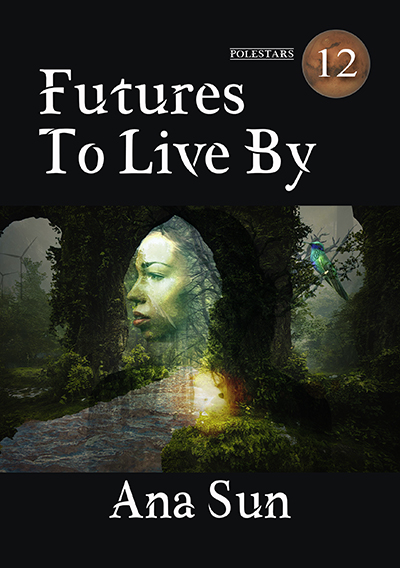
- A. Sun, Futures to Live By. United Kingdom: Newcon Press, 2025.
- M. Frankel and M. Warren. “The weird way language affects our sense of time and space.” BBC Future, Nov. 2022, https://www.bbc.co.uk/future/article/20221103-how-language-warps-the-way-you-perceive-time-and-space (accessed Sep. 29, 2025).
- S. Blackmore. Consciousness: A very Short Introduction (2nd Ed.) United Kingdom: Oxford University Press, 2017.
- D. Kahnemann. “The Riddle of Experience vs. Memory.” TED 2010. https://www.ted.com/talks/daniel_kahneman_the_riddle_of_experience_vs_memory
- D. Reanney, The Death of Forever. Melbourne, Australia: Longman, 1991.
- M. Bertoli, M. De Cesaris, S. Bonventre, and M. Brunetti. “Cognition in Climate Change: Is It Just a Matter of Time?” WIREs Cognitive Science: Vol. 16, Issue 5, September/October 2025, Oct. 2025, (accessed May 11, 2026) https://pmc.ncbi.nlm.nih.gov/articles/PMC12489530/
- D. Carrington. “Collapse of critical Atlantic current is no longer low-likelihood, study finds.” The Guardian, Aug. 2025, https://www.theguardian.com/environment/2025/aug/28/collapse-critical-atlantic-current-amoc-no-longer-low-likelihood-study (accessed Sep. 29, 2025).
- Planetary Health Check. https://www.planetaryhealthcheck.org/ (accessed Sep. 29, 2025).
- W. Ejaz, M. Mukherjee, R. Fletcher and R. K. Nielsen. “Climate change and news audiences report 2022: Analysis of news use and attitudes in eight countries.” Reuters Institute for the Study of Journalism, Dec. 2022, https://reutersinstitute.politics.ox.ac.uk/climate-change-and-news-audiences-report-2022-analysis-news-use-and-attitudes-eight-countries (accessed Sep. 29, 2025).
- J. Rockström. “Official Planetary Health Check 2025 with Johan Rockström.” Planetary Boundaries Science. https://www.youtube.com/watch?v=ndPVcg6uSZc (accessed Sep. 29, 2025).
- S. Wang. “There Is No Climate Tipping Point.” The Breakthrough Institute Journal, Apr. 2023, https://thebreakthrough.org/journal/climate-change-banned-words/climate-tipping-point-real
- T. M. Lenton, et al. “Key Concepts.” Global Tipping Points Report 2023. https://report-2023.global-tipping-points.org/introduction/key-concepts/ (accessed Sep. 29, 2025).
- D. I. Armstrong McKay and S. Loriani. “Key Messages.” Global Tipping Points Report 2023. https://report-2023.global-tipping-points.org/section1/1-earth-system-tipping-points/1-7-earth-system-tipping-points-synthesis/1-7-1-key-messages/ (accessed Sep. 29, 2025).
- T. M. Lenton. “Why some tipping points may be positive for the planet.” Chatham House, Sep. 2025, https://www.chathamhouse.org/publications/the-world-today/2025-09/why-some-tipping-points-may-be-positive-planet (accessed Sep. 29, 2025).
- W. Zuckerman et al. “Have We Crossed the Climate Tipping Point?” Science Vs. (podcast), Sep. 2024, https://uk-podcasts.co.uk/podcast/science-vs/have-we-crossed-the-climate-tipping-point (accessed Sep. 29, 2025).
- S.A. Kulp, B.H. Strauss. “New elevation data triple estimates of global vulnerability to sea-level rise and coastal flooding.” Nature Communications 10, 4844 (2019). https://www.nature.com/articles/s41467-019-12808-z (accessed May 19, 2026)
- J. L. Walton and P. Levontin. “Vector editors at COP26”, Vector Magazine, Nov 2021, https://vector-bsfa.com/2021/11/02/vector-editors-at-cop26/ (accessed May 19, 2026)
- U. K. Le Guin, The Left Hand of Darkness. Great Britain: Gollanz, 2017. (UK SF Masterworks Edition.)
- I. Csicsery-Ronay, The Seven Beauties of Science Fiction. Middletown, U.S.A. Wesleyan University Press, 2008.
- S. McNeil. “Nobody Wants to Buy The Future: Why Science Fiction Literature is Vanishing.” Typebar Magazine, March 2024, http://typebarmagazine.com/2024/03/24/nobody-wants-to-buy-the-future-why-science-fiction-literature-is-vanishing/ (accessed Sep. 29, 2025).
- E. Kupernmintz. “The Men Who Sold The Moon.” https://www.notthesky.com/posts/essays/the-men-who-sold-the-moon/ (accessed Sep. 29, 2025).
- N. Hagens, T. Murphy and DJ White. “The Fantasy of Space Colonization: The Spaceship We’re Already On.” Feb 24, 2026, https://www.thegreatsimplification.com/episode/reality-roundtable-24 (accessed May 22, 2026).
- R. Luckhurst. “Science Fiction as Mode of Action: On MIT Press’s ‘Uneven Futures.’” Los Angeles Review of Books, April 2023. https://lareviewofbooks.org/article/article-science-fiction-as-mode-of-action-on-mit-presss-uneven-futures/ (accessed May 17, 2026).
- B. Quinn. “UK Ministry of Defence enlists sci-fi writers to prepare for dystopian futures.” The Guardian, January 2025. https://www.theguardian.com/uk-news/2025/jan/19/ministry-of-defence-enlists-sci-fi-writers-to-prepare-for-dystopian-futures (accessed May 17, 2026).
- J. M. Broadway and B. Sandoval. “Why Does Time Seem to Speed Up with Age?” Scientific American, July 2016. https://www.scientificamerican.com/article/why-does-time-seem-to-speed-up-with-age/ (accessed Sep. 29, 2025).
- M. A. Conway and C. Loveday. “Remembering, imagining, false memories & personal meanings,” Consciousness and Cognition, 2015, http://dx.doi.org/10.1016/j.concog.2014.12.002
- M. A. Conway, C. Loveday and S. N. Cole. “The Remembering–Imagining System,” Memory Studies Vol. 9 (3) 256 –265, 2016, https://doi.org/10.1177/1750698016645231
- S. Pahl, S. Sheppard, C. Boomsma, and C. Groves. “Perceptions of time in relation to climate change.” WIREs Clim Change, Vol. 5, Issue 3: 375-388, May/June 2014. https://wires.onlinelibrary.wiley.com/doi/full/10.1002/wcc.272
- M. K. Chen. “The Effect of Language on Economic Behavior: Evidence from Savings Rates, Health Behaviors, and Retirement Assets,” American Economic Review, vol. 103, no. 2, April 2013 (pp. 690–731), https://doi.org/10.1257/aer.103.2.690
- R. Bryant and D. M. Knight, Anthropology of the Future. United Kingdom: Cambridge University Press, 2019.
- UK Department for Energy Security & Net Zero. “Unlocking the benefits of the clean energy economy.” https://www.gov.uk/government/publications/carbon-budget-and-growth-delivery-plan/unlocking-the-benefits-of-the-clean-energy-economy-accessible-webpage (accessed May 13, 2026).
- G. Gharde, S. Mander, C. McLachlan, C. Jones and A. Larkin. “UK energy experts call for wider range of plausible futures for decarbonisation scenarios.” Tyndall Centre for Climate Change Research, March 2026. https://tyndall.ac.uk/news/uk-energy-experts-call-for-wider-range-of-plausible-futures-for-decarbonisation-scenarios/ (accessed May 19, 2026).
- R. Solnit,. Hope in the Dark. Great Britain: Canongate Books, 2016.
- N. Rouhania et al. “Collective events and individual affect shape autobiographical memory,” Proc. Natl. Acad. Sci. U.S.A. 120 (29) e2221919120, 2023, https://doi.org/10.1073/pnas.2221919120
- R. Hopkins, How to Fall in Love with the Future. White River Junction, VT, U.S.A. : Chelsea Green Publishing, 2025.
- C. Merck, M. N. Topcu and W. Hirst. “Collective mental time travel: Creating a shared future through our shared past,” Memory Studies, vol. 9(3) 284 –294, 2016, https://doi.org/10.1177/1750698016645236
Categories: Industry News
Towards Kindred Futures
By Ana Sun
Ever wonder why we tend to refer to the future in its singular form in everyday speech? Why ‘the future’, and not simply ‘futures’? Considering that we can probably agree that a myriad of futures is possible before one of them falls into the present, this seems to be a mundane but overlooked mystery.
In Futurevision: scenarios for the world in 2040, Richard Watson and Oliver Freeman observed [1]:
There is a problem with most books about the future – and indeed, there is a fatal flaw with almost all of our thinking about what will happen next. This is because of a simple point. The fact is, there is no single future, regardless of our deepest desire that it be so, and there is no heavenly salvation in sight.
As someone who often explores progressive, positive futures within the context of climate change and social justice through science fiction, in particular Solarpunk [2], I’m intrigued: does the common view of a singular future mean we are more likely to believe that climate collapse is inevitable? Do we therefore find it difficult to imagine – and enact – alternatives? Have we inadvertently accepted a destiny described by cyberpunk, a future rocket-boosted by uncaring technology, systems of oppression and power concentrated in the hands of a few? In Zoefuturistic terms, have we simply accepted the ‘being’ and forfeited the ‘becoming’?
There’s some evidence that language can influence how we perceive time and our relationship with the future… or, rather, futures [3]. Our bodies are limited in conscious capacity, our brains constrained by how our memories are formed [4] [5] [6].
Unlike futurists and futurologists, thinking about the long-term future in its simultaneous multiplicities, especially when it comes to a complex issue such as climate change, is not something that most of us are able to conceptualise easily [7]. Sure, we may deal well enough with the immediate future, such as considering different possible routes we might take between two locations, or how we might fill the hours between morning and night on a given day. Beyond a certain timeframe, the future can resemble a different place; this afternoon, tonight, or tomorrow can easily seem like disembodied worlds beyond our reach [27]. And yet, the next second appears on the near horizon in the shadow of the following minute, then the hour thereafter – all rapidly pouring into the now, one liquid moment flowing into the next.
Perhaps there are deeper reasons for why we struggle with notions of futures in our everyday lives, and that’s worth examining.
Caught in destiny’s netSometime in the early summer of 2025, after an event on climate change resilience, a frustrated attendee next to me mumbled words to the effect, “So all of it is going to end, isn’t it?”
At the time, her blunt nihilism shocked me into silence, but that feeling of impotence is all too familiar: what’s the use of fighting if all will be destroyed in the end? If we were to believe that an impending climate collapse is destiny, we’d have already been defeated before we even began.
One winter morning, I asked a question to an audience of about two hundred people in the middle of a talk I was giving: how did they visualise critical environmental thresholds – what we commonly call ‘climate tipping points’? The majority believed these to be a cliff-edge for survival: once we topple over the side, it’s game over. No surprise; I certainly did too, once.
In August 2025, updated analysis showed an increased risk of the Atlantic meridional overturning circulation (AMOC) collapsing when researchers examined data modelling that ran for a longer timeframe until 2300 and 2500 [8]. Separately, a seventh planetary boundary – out of the nine environmental limits that demarcate the planet’s health – has been breached this year, according to the annual assessment by Potsdam Institute for Climate Impact Research, as ocean acidification transgresses the critical safe threshold for marine ecosystems [9].
All these are alarming signals designed to induce a sense of urgency and a drive to action, but taken alone without accompanying solutions, these types of headlines incite panic and breed disempowerment [10], rendering us helpless and stripped of agency while an inevitable future barrels down upon us.
The AMOC tipping point is particularly worrying because the change to humanity as we know it would be drastic. If we don’t succeed in lowering our CO2 emissions in line with the Paris Agreement, the current estimation is that we might pass this particular tipping point within a few decades.
There still remains deep uncertainty whether the AMOC may weaken partially or result in a full collapse, and over what timeframe. Likely, we have at least a few decades at hand to act to avert the worst outcomes. Johan Rockström, Director of Potsdam Institute for Climate Impact Research, said of the seventh planetary boundary breach [11]:
We’re not yet in the high-risk zone of irreversible, unmanageable change of the planet, which suggests that we can still turn this around. The window is still open even though it’s closing fast, and we have so much evidence of scalable solutions across all sectors from the food sector to the built environment to the energy transition that we can bend the curves and bring ourselves back within a safe operating space within the next decades.
Seaver Wang, the Director of Climate and Energy at The Breakthrough Institute wrote comprehensively about the misnomer of ‘tipping points’:
First, the word ‘tipping’ implies the rapidity of an unbalanced cart toppling over. […] Second, the word ‘point,’ too, is bound to confuse. It implies a single, precise, known critical threshold beyond which Earth system components tip. [12]
The reality is that environmental tipping points are far more complex [13]. The Global Tipping Points Report 2023 emphasises that their assessment ‘does not suggest that crossing major tipping points could lead to runaway warming, with mitigation to prevent further tipping points being worthwhile even if some tipping points are reached. [14]’.
We also spend so little time focusing on positive tipping points – such as those scalable solutions that Johan Rockström refers to [11] [15]. If my sample of two hundred or so attendees was anything to go by, solutions that have a positive impact aren’t something that typically crosses our minds. While our media coverage would have us imagine apocalyptic scenarios where the Earth drowns under several metres of seawater – a scenario that, in reality, is highly unlikely in the near future – the current estimates suggest that the Greenland and West Antarctic ice sheets would likely take hundreds to thousands of years to melt after their tipping points are breached [16]. The complexity in predicting circulation and heat transfers in the ocean means much is unknown; current projections, even in our worst case scenario, project sea level rise of up to 180mm by 2050 [17].
We shouldn’t be under the impression that all is well – but there’s time to act, to reverse the damage if we could collectively grasp our agency.
Unfortunately, few narrative tools exist to remind us we are not rolling downhill off the far side of Freytag’s Pyramid into fated tragedy. Just how well science fiction is placed to shift collective imagination is still a nascent experiment [18].
Science fiction: from imaginary prediction to unintended blueprintIt might sometimes look like cyberpunk has predicted our current trajectory: a world where AI is poised to displace us, where an elite, privileged few exploit political institutions to concentrate their power, preying on people and planet to enrich themselves.
Ursula K. Le Guin famously declared [19], ‘Science fiction is not predictive; it is descriptive.’ Istvan Csicsery-Ronay discusses this at length in The Seven Beauties of Science Fiction [20]: ‘SF is imaginary prediction, drawing on the same sort of historical-projective suspension of disbelief as the real thing, if only to explore, to problematize, and to play with it.’
In other words, science fiction originally took on the mantle of holding up a mirror to our present from a possible future. Until recently, SF has often been written in past tense, presenting narratives as if a particular future has already happened so we could project ourselves forward in time. But how did we get from those glorious imaginary predictions to what Simon McNeil recounts as the ‘future horrors Silicon Valley merchants of human misery are trying to produce’ [21]? How did we get from Star Trek to a world where technology is threatening humanity, at the very same time as our obsession with economic growth means the planet can no longer sustain all of us?
In his epic essay The Men Who Sold the Moon, Eden Kupernmintz explains how we our current situation might have transpired [22]:
[..] if you want to read about militarism in Heinlein’s work, you can find countless articles online on the topic, as well as on the fascism of Campbell and the many, many awful passages of Vance’s career. But consider the supposedly more progressive works of authors like Simak, Asimov, Pohl Anderson, Blish, or Roddenberry. Most, if not all, of their ideas and values are realized through individualist, liberal lenses. They are mostly concerned with heroes who uphold values such as compassion, honor, duty, and virtue. They very rarely, if ever, engage with meaningful, systematic criticisms of society. Indeed, they are perfect examples of “suburban science fiction”, importing much of the underlying, and thus powerful, presuppositions of our own society into the future. Their heroes are almost invariably male, white, abled, and dripping with machismo and “charisma”. Solutions to problems revolve around rationalism and scientism at best and downright calls for technocracy at worst. The idea of the supremacy of science, without engaging in its colonial roots, without engaging with ideas and problems like eugenics, without any meaningful critiques of its role in serving capitalism, is one of the main motivating powers of much of the careers cited above.
Kupernmintz goes on to suggest that the heroes portrayed in the Golden Age of science fiction created the archetypes upon which powerful people such as Elon Musk, Jeff Bezos or Peter Thiel could comfortably model themselves. A challenging stance, certainly, to flatten such rich visions of the future. However, even the post-scarcity utopia depicted in Star Trek would have assumed that we continue extractive practices on Earth’s finite resources – such as precious metals and fossil fuels – for us to get there [23].
Science fiction as a genre has never set out to predict any specific future and yet here we are, witnessing what should have been cautionary tales become ingrained blueprints for the potential destruction of humanity and our living planet – adding to already debilitating helplessness, tempting us to give in to seemingly inescapable destiny.
In recent years, we’ve seen a more significant shift of how we discuss science fiction as a mirror of our present to a vehicle for intentional imagination and activism. Roger Luckhurst in his review of Uneven Futures [24] calls it ‘a move from SF as noun to SF as verb, a set of actions, […] a move from static textual study to motivated activity that follows on from the reading of texts.’ Alongside genres such as Afrofuturism and Solarpunk, we can also observe increasing use of applied science fiction to anticipate policy risks and opportunities [25].
Even then, the question continues to plague me: might stories alone be enough? Would words on a page ultimately change how we behave, as individuals living within systems that are often out of our control? A question worth asking, considering our human physiology proves a disadvantage when it comes to thinking about the future – because of our struggle with the concept of time.
Wibbly wobbly, timey wimeyIn a book that’s equal parts science, philosophy and poetry, The Death of Forever, Darryl Reanney explains how time as we would commonly think of it – as a force external to us – is likely an illusion [6]:
Superficially, time is something we create when we measure it, dividing it into seconds, minutes, hours, days, etc. […] Our experience of time is of something that moves, that sweeps upon its breast like a river forever moving at a constant rate from past to future.
Our sense of how time passes directly correlates to the number of instances our brains encode as new experiences; these are also how memories are formed. This is why sometimes a month can speed by, but a minute can feel eternal [26].
My favourite understanding of what happens to our sense of time – from moments to memories – comes from Daniel Kahnemann, who describes the distinction between the ‘experiencing self’ and the ‘remembering self’ [5]. The experiencing self is the part of us that lives in the continuous present and knows only of the now. However, these actual moments get discarded, filtered through the ‘remembering self’, which leaves us with a cohesive picture of who we are. Kahnemann says:
Now, the remembering self is a storyteller. And that really starts with a basic response of our memories – it starts immediately. We don’t only tell stories when we set out to tell stories. Our memory tells us stories, that is, what we get to keep from our experiences is a story.”
Suppose a collection of these stories is how we make sense of our past, but scientists have discovered the neural pathways we use to remember the past are identical to ones we use for imagining the future.
Professors Martin A. Conway and Catherine Loveday articulated the remembering-imagining system as a window where we can access everyday memories of the recent past and the near future [27]. In their research, they found that events that lie further in the future are more abstract, just as memories in the remote past become more generic; they likened it to a ‘fish-eye lens’. Interesting challenges arise when we need to think beyond the visible future [28]:
Just as in certain areas of physics, for example, quantum mechanics, it is not possible to precisely predict a future state of a system, so with people the future is only probable. However, once a future state has come into being, it may be possible, to at least some extent, to work back to previous states. […]
Nevertheless, retrospectively reversible or not, given that there are an infinite number of indeterminate possible futures, this poses a major adaptive problem for goal-driven organisms. This is particularly so as the end point of all unrealized goals lies somewhere in the future. Indeed, in order to have a goal a future state has to be anticipated and often consciously imagined.”
While their research refers specifically to individual memory forming and goal creation, I can’t help wondering what this would mean on a collective level. More on that later.
Firstly, our actual experiences are fleeting. The moment passes and our brains form a narrative about what we thought happened – and no, it’s not necessarily reliable. Secondly, cognitive science suggests that we can only look as far into the future clearly as we are able to recall the past; beyond a certain point, the future becomes less certain and more conjecture, just as the past becomes fuzzier in our memory. If we want to determine a goal that’s beyond the boundary of the remembering-imagining system, we need to consciously imagine what we want our futures to be. But that assumes we have free will and therein lies another pitfall, a conundrum possibly best summarised by S. Pahl and colleagues [29]:
If evidence for climate change events is difficult to retrieve from memory, climate risks will be underestimated (or biased toward very salient information or images). Moreover, information about climate change faces stiff competition from the media barrage and other daily issues that are simply more salient, compelling and urgent in demanding our attention. […] In addition, research in cognitive psychology has indicated that individuals experience less emotive mental imagery with respect to generalized long-term goals (such as living more healthily or sustainably) compared to short-term goals (such as eating a doughnut or driving to the shop), because the former are less engaging and may lack specific cues in our daily environment that trigger appropriate action (whereas a doughnut might be displayed in a shop we walk past, with additional multi-sensory cues such as smell).
In her excellent book Consciousness: A Very Short Introduction, Susan Blackmore discusses the famous Libet experiments – which imply an intention to act exists before the brain is conscious of the action, therefore potentially suggesting that ‘free will’ is an illusion [4]. The idea that we don’t have free will is so antithetical to our experience that the debate surrounding interpretation of these experiments endures. However, Libet discovered that what we do have is an overriding mechanism. In Blackmore’s words, “although we do not have free will, we do have ‘free won’t’.”
On an individual level, this means we have a severe cognitive disadvantage in connecting a climate-crisis-free future to our immediate present in a way that drives positive action. The question then: how might we exercise our ‘free won’t?’
In her final chapter, Blackmore gives us a potential clue:
Some people argue that the addition of language completely transforms minds, bringing about the essentials of consciousness, including the sense of self, theory of mind and the ability to think about past and future.
The power of language, the power of becomingYou might well call to mind Ted Chiang’s Story of Your Life, or its film adaptation Arrival. I doubt we’d remember the future without some alien assistance in this world; however, evidence shows language can influence our perception of time, including how we might visualise time as directions. Some languages contain the sense of time in their grammar: past tense (“I went”), present tense (“I go”) and a future tense (“I will go”). English does not have conjugations, but Romance languages such as French, Italian, Spanish and Portuguese do. Other languages could be said to be ‘futureless’, where a qualifier (e.g. tomorrow, last night), when tagged onto a phrase, clarifies the sense of time; in languages such as Mandarin and German, we would say “I go tomorrow”, and it refers to a future time [3].
In a 2013 study, Keith Chen, a behavioural economist at UCLA, concludes that speakers of ‘futureless languages’ such as German, Chinese, Japanese, Dutch and the Scandinavian languages engaged more with the future in terms of financial savings and maintained better health, behaviours he attributes to how they don’t view the future as something separate from the present [30]. While we should be conscious that correlation never implies causation, the results are nonetheless fascinating.
We would have to make greater logical leaps to conclude if understanding our own linguistic biases would reframe our relationship to the perceived destiny of the climate crisis – and to conjure up viable alternatives. However, the field of futures anthropology might provide some useful vocabulary to unpack how we experience and envision the future, revealing how we might act in the present. Unlike Dr. Louise Banks, perhaps we don’t have to know the future to make our choices.
From the outset of this essay, I raised the question of whether we might be treating environmental collapse as destiny, a deliberate word choice. ‘Destiny’ is one of the six orientations that Rebecca Bryant and Daniel M. Knight proposed in The Anthropology of the Future, enabling us to examine our relationship with the future – or futures – with richer nuance [31]. Other orientations include anticipation, expectation, speculation, potentiality and hope.
I used the word destiny as we might do in common parlance, but also as an orientation: how a future would come to pass regardless of what happens in between, despite how we might get from here to there. The intention had been to provoke: have we simply accepted that an inequitable AI future coupled with the climate emergency would happen? Are we content to let it happen?
The nuances of these words warrant a closer look. Expectation has a close but different nuance to anticipation:
One may, for instance, expect rain and take an umbrella when going out ‘just in case.’ The expectation of rain, is, in this instance, still on the horizon and is tempered by, for example, weather reports that have failed in the past. […] Expectation may be viewed as a conservative teleology, one that gives thickness to the present through its reliance on the past. To anticipate rain, however, is to feel and smell it in the air, to close one’s windows and cover lawn furniture while imagining the future in the present. Anticipation slims the present, often breaking entirely with the past as it draws present and future into the same activity timespace [31].
Anticipation has a forward pull; expectation implies an action that often coincides with a notion of ‘ought’ or ‘should’. We expect that if we install solar panels, we should reduce our reliance on fossil fuels; we expect it because we’ve seen this happen before. To anticipate a world running on renewables has a forward-looking nuance, it may mean we focus on developing technologies across different types of energy generators to manage consistent power. Anticipating this kind of future gives me goosebumps.
Speculation happens in the gap between what we expect and what we anticipate – when the end point is not clear, and when the information is partial or unavailable. For example, if the rollout of solar farms did not necessarily reduce reliance on fossil fuels, we might speculate that something has gone quite wrong with our energy governance. Or we might speculate whether we would have better success had we decided to prioritise, say, bladeless turbines. At the time of writing, the UK government is building policies on speculation: to ensure long-term energy resilience, we would need a combination of sources, including nuclear, geothermal, solar and wind [33]. The power of speculation could be that first step that creates hypotheses and assumptions against which we can create models or gather existing evidence – enabling us to make solutions real.
Just the other day, while on a train to North Wales, I’d been struck by the number of solar farms en route; this is a new thing. Potentiality is rooted in the present, a sense that things have been set in motion, lending possibility to certain futures. Based on the view out my train window, and the offshore wind farms when I look out to the English Channel closer to home, a world running solely on a diverse range of renewables is a potentiality.
Finally, hope — a word used so often, we probably take its meaning for granted. Hope: a forward-driving force, fed by potentiality, resting on anticipation. Bryant and Knight describe hope as an orientation that ‘emerges in the gap between the potential and the actual, between matter and its not-yet form’. But my preferred definition comes the stirring words of Rebecca Solnit [34]:
Hope locates itself in the premises that we don’t know what will happen and in that spaciousness of uncertainty is room to act. […] Hope is not like a lottery ticket you can sit on the sofa and clutch, feeling lucky. I say it because hope is an ax you break down doors with in an emergency; because hope should shove you out the door, because it will take everything you have to steer the future away from endless war, from the annihilation of the earth’s treasures and the grinding down of the poor and marginal. Hope just means another world might be possible, not promised, not guaranteed. Hope calls for action; action is impossible without hope.
In order to evade undesirable destinies, of all the orientations available to us, I consider hope our primary vehicle. But individual hope is rarely enough – how might we bolster collective hope for collective action?
Making future memories to rememberSummer had come early that day in May, rendering the communal meeting space warmer inside than out. As part of the cultural work around the Rights of River Charter for the Ouse, about twenty of us gathered and explored how we might strengthen our relationship to the river and channel its voice through conversation and collaborative art. In the centre of the room, an old metal bucket had been filled with river water earlier that morning; throughout the entire day, a part of the Ouse remained with us.
The inspiration and exhilaration from that one day gave birth to collective and individual memories that have since continued. Ideas flowed, creativity flourished, connections between humans and human-to-water rejuvenated. For me, the workshop sowed seeds of imagination, evoking emotions that would later make it into my writing, into the edits for my short story collection [2] that I’d been working on at the time.
In this instance, collective memory has been instrumental in building a future-facing, positive relationship with a body of water that we have neglected for too long. Of course, collective memory could be traumatic too, as evidenced by the events around Covid-19 [35] – a global pandemic which had long been a potentiality most of us somehow ignored. To imagine desired futures, we would need to be intentional about creating collective memories so we can have rich pasts to carry forward into new futures.
Rob Hopkins, the founder of the Transition Movement, wrote in his recent book How to Fall in Love with the Future [36]:
Researchers use the term ‘mental time travel’ to describe our capacity to imagine the future – or the past – and how that capacity impacts our present-day experiences and decisions. While a lot of research has focused on individual future thought, more recently researchers have been expanding the focus of their attention to collective memory and collective future thought, or what they term ‘collective mental time travel’.
[…] When we ‘time travel’ to the future, we dip into the cupboards of our memory, rummage around for snippets that might be useful, and then combine these snippets to create novel and unique ideas about the future. In other words, we assemble visions of the future from the resources of our past.’
Researchers have also found that social interaction with knowledge can shape outcomes: it could induce forgetfulness but also reinforce insights [37]. At the end of his book, Hopkins generously shares his ‘Time Machine Blueprint’ – tools to help a collective group of people mentally travel into the future. Science-fiction writers would recognise the worldbuilding; improv theatre types would recognise the set ups.
We already have the skills and the tools to evade a destiny we don’t want. We already know how to form collective memories; we celebrate festivals, commune for conventions. As storytellers, we know what matters less is when the story is being told because our experiencing selves will forget it all. It’s about what happens after it ends – what our remembering selves will keep.
Participating in making collective memories – the conscious decision to take words off a page into our real world – charts a way forward to creating kindred futures: futures enabling us to reclaim our agency from the illusion of destiny, futures that care for people and planet.
References- R. Watson and O. Freeman, Futurevision: scenarios for the world in 2040. Scribe Publications, 2012.
- A. Sun, Futures to Live By. United Kingdom: Newcon Press, 2025.
- M. Frankel and M. Warren. “The weird way language affects our sense of time and space.” BBC Future, Nov. 2022, https://www.bbc.co.uk/future/article/20221103-how-language-warps-the-way-you-perceive-time-and-space (accessed Sep. 29, 2025).
- S. Blackmore. Consciousness: A very Short Introduction (2nd Ed.) United Kingdom: Oxford University Press, 2017.
- D. Kahnemann. “The Riddle of Experience vs. Memory.” TED 2010. https://www.ted.com/talks/daniel_kahneman_the_riddle_of_experience_vs_memory
- D. Reanney, The Death of Forever. Melbourne, Australia: Longman, 1991.
- M. Bertoli, M. De Cesaris, S. Bonventre, and M. Brunetti. “Cognition in Climate Change: Is It Just a Matter of Time?” WIREs Cognitive Science: Vol. 16, Issue 5, September/October 2025, Oct. 2025, (accessed May 11, 2026) https://pmc.ncbi.nlm.nih.gov/articles/PMC12489530/
- D. Carrington. “Collapse of critical Atlantic current is no longer low-likelihood, study finds.” The Guardian, Aug. 2025, https://www.theguardian.com/environment/2025/aug/28/collapse-critical-atlantic-current-amoc-no-longer-low-likelihood-study (accessed Sep. 29, 2025).
- Planetary Health Check. https://www.planetaryhealthcheck.org/ (accessed Sep. 29, 2025).
- W. Ejaz, M. Mukherjee, R. Fletcher and R. K. Nielsen. “Climate change and news audiences report 2022: Analysis of news use and attitudes in eight countries.” Reuters Institute for the Study of Journalism, Dec. 2022, https://reutersinstitute.politics.ox.ac.uk/climate-change-and-news-audiences-report-2022-analysis-news-use-and-attitudes-eight-countries (accessed Sep. 29, 2025).
- J. Rockström. “Official Planetary Health Check 2025 with Johan Rockström.” Planetary Boundaries Science. https://www.youtube.com/watch?v=ndPVcg6uSZc (accessed Sep. 29, 2025).
- S. Wang. “There Is No Climate Tipping Point.” The Breakthrough Institute Journal, Apr. 2023, https://thebreakthrough.org/journal/climate-change-banned-words/climate-tipping-point-real
- T. M. Lenton, et al. “Key Concepts.” Global Tipping Points Report 2023. https://report-2023.global-tipping-points.org/introduction/key-concepts/ (accessed Sep. 29, 2025).
- D. I. Armstrong McKay and S. Loriani. “Key Messages.” Global Tipping Points Report 2023. https://report-2023.global-tipping-points.org/section1/1-earth-system-tipping-points/1-7-earth-system-tipping-points-synthesis/1-7-1-key-messages/ (accessed Sep. 29, 2025).
- T. M. Lenton. “Why some tipping points may be positive for the planet.” Chatham House, Sep. 2025, https://www.chathamhouse.org/publications/the-world-today/2025-09/why-some-tipping-points-may-be-positive-planet (accessed Sep. 29, 2025).
- W. Zuckerman et al. “Have We Crossed the Climate Tipping Point?” Science Vs. (podcast), Sep. 2024, https://uk-podcasts.co.uk/podcast/science-vs/have-we-crossed-the-climate-tipping-point (accessed Sep. 29, 2025).
- S.A. Kulp, B.H. Strauss. “New elevation data triple estimates of global vulnerability to sea-level rise and coastal flooding.” Nature Communications 10, 4844 (2019). https://www.nature.com/articles/s41467-019-12808-z (accessed May 19, 2026)
- J. L. Walton and P. Levontin. “Vector editors at COP26”, Vector Magazine, Nov 2021, https://vector-bsfa.com/2021/11/02/vector-editors-at-cop26/ (accessed May 19, 2026)
- U. K. Le Guin, The Left Hand of Darkness. Great Britain: Gollanz, 2017. (UK SF Masterworks Edition.)
- I. Csicsery-Ronay, The Seven Beauties of Science Fiction. Middletown, U.S.A. Wesleyan University Press, 2008.
- S. McNeil. “Nobody Wants to Buy The Future: Why Science Fiction Literature is Vanishing.” Typebar Magazine, March 2024, http://typebarmagazine.com/2024/03/24/nobody-wants-to-buy-the-future-why-science-fiction-literature-is-vanishing/ (accessed Sep. 29, 2025).
- E. Kupernmintz. “The Men Who Sold The Moon.” https://www.notthesky.com/posts/essays/the-men-who-sold-the-moon/ (accessed Sep. 29, 2025).
- N. Hagens, T. Murphy and DJ White. “The Fantasy of Space Colonization: The Spaceship We’re Already On.” Feb 24, 2026, https://www.thegreatsimplification.com/episode/reality-roundtable-24 (accessed May 22, 2026).
- R. Luckhurst. “Science Fiction as Mode of Action: On MIT Press’s ‘Uneven Futures.’” Los Angeles Review of Books, April 2023. https://lareviewofbooks.org/article/article-science-fiction-as-mode-of-action-on-mit-presss-uneven-futures/ (accessed May 17, 2026).
- B. Quinn. “UK Ministry of Defence enlists sci-fi writers to prepare for dystopian futures.” The Guardian, January 2025. https://www.theguardian.com/uk-news/2025/jan/19/ministry-of-defence-enlists-sci-fi-writers-to-prepare-for-dystopian-futures (accessed May 17, 2026).
- J. M. Broadway and B. Sandoval. “Why Does Time Seem to Speed Up with Age?” Scientific American, July 2016. https://www.scientificamerican.com/article/why-does-time-seem-to-speed-up-with-age/ (accessed Sep. 29, 2025).
- M. A. Conway and C. Loveday. “Remembering, imagining, false memories & personal meanings,” Consciousness and Cognition, 2015, http://dx.doi.org/10.1016/j.concog.2014.12.002
- M. A. Conway, C. Loveday and S. N. Cole. “The Remembering–Imagining System,” Memory Studies Vol. 9 (3) 256 –265, 2016, https://doi.org/10.1177/1750698016645231
- S. Pahl, S. Sheppard, C. Boomsma, and C. Groves. “Perceptions of time in relation to climate change.” WIREs Clim Change, Vol. 5, Issue 3: 375-388, May/June 2014. https://wires.onlinelibrary.wiley.com/doi/full/10.1002/wcc.272
- M. K. Chen. “The Effect of Language on Economic Behavior: Evidence from Savings Rates, Health Behaviors, and Retirement Assets,” American Economic Review, vol. 103, no. 2, April 2013 (pp. 690–731), https://doi.org/10.1257/aer.103.2.690
- R. Bryant and D. M. Knight, Anthropology of the Future. United Kingdom: Cambridge University Press, 2019.
- UK Department for Energy Security & Net Zero. “Unlocking the benefits of the clean energy economy.” https://www.gov.uk/government/publications/carbon-budget-and-growth-delivery-plan/unlocking-the-benefits-of-the-clean-energy-economy-accessible-webpage (accessed May 13, 2026).
- G. Gharde, S. Mander, C. McLachlan, C. Jones and A. Larkin. “UK energy experts call for wider range of plausible futures for decarbonisation scenarios.” Tyndall Centre for Climate Change Research, March 2026. https://tyndall.ac.uk/news/uk-energy-experts-call-for-wider-range-of-plausible-futures-for-decarbonisation-scenarios/ (accessed May 19, 2026).
- R. Solnit,. Hope in the Dark. Great Britain: Canongate Books, 2016.
- N. Rouhania et al. “Collective events and individual affect shape autobiographical memory,” Proc. Natl. Acad. Sci. U.S.A. 120 (29) e2221919120, 2023, https://doi.org/10.1073/pnas.2221919120
- R. Hopkins, How to Fall in Love with the Future. White River Junction, VT, U.S.A. : Chelsea Green Publishing, 2025.
- C. Merck, M. N. Topcu and W. Hirst. “Collective mental time travel: Creating a shared future through our shared past,” Memory Studies, vol. 9(3) 284 –294, 2016, https://doi.org/10.1177/1750698016645236
Categories: Industry News
2026 Seiun Awards Winners
Hellcon, the 64th Japan Science Fiction Convention, has announced the winners of the 2026 Seiun Awards (the Japanese equivalent of the Hugo Awards), honoring the best original and translated works published last year in Japan.
Best Translated Novel
- WINNER: Eversion, Alastair Reynolds, tr. Naoya Nakahara (Tokyo Sogensha)
- WINNER:Babel, R.F. Kuang, tr. Yoshimichi Furusawa (Tokyo Sogensha)
- The Cautious Traveller's Guide to the Wastelands, Sarah Brooks, tr. Yasuko Kawano …Read More
The post 2026 Seiun Awards Winners appeared first on Locus.
Categories: Industry News, Industry News Home
2026 Prix Imaginales Winners
The winners have been announced for the 2026 Prix Imaginales, honoring the best works of fantasy published in France.
French Novel
- WINNER: Festin de larmes, Morgane Caussarieu & Vincent Tassy (ActuSF)
- La Nuit ravagée, Jean-Baptiste Del Amo (Gallimard)
- Aatea, Anouck Faure (Argyll)
- Le Solstice des ombres, Sœurs de haine, tome 1, Benjamin Lupu (Mnémos)
- La Fille du feu, Aurélie Wellenstein (Outre Fleuve)
Foreign Novel Translated …Read More
The post 2026 Prix Imaginales Winners appeared first on Locus.
Categories: Industry News, Industry News Home
A 23-Button Stenography Keyboard: All Gain, Zero Pain
by J.D. Henning
Read by the authorLook at your keyboard. If you’re on a phone, pull it up for a sec. You’re probably looking at a QWERTY layout. Even with the unlimited theoretical possibilities of a touchscreen, this is what the vast majority of English users see.
But it’s crap. And we’ve known it’s crap for more than a century.
This all became painfully personal to me in the winter of 2021 when my hands went on strike. As a film editor and screenwriter, my life revolves around my computer. Samurai had their swords, and I have my keyboard. But my hands burned like fire, and my most trusted tool turned out to be the culprit. Repetitive stress injuries are no fun at all. And the horrible part is that a QWERTY keyboard is essentially made to encourage RSIs.
How We Got HereAt their advent in the 1870s, keyboards were ingeniously designed boxes of buttons and levers with actual physical bits of metal slamming against actual physical paper, imprinting ink every time a writer (for the sake of this example, you) hit a key. Problem was, if you really got on a roll—your Dracula/Moby-Dick mashup started to get really juicy—you might jam the typewriter. One lever would interrupt another, and Dracula could not look deeply into the White Whale’s eyes until your machine was serviced.
Unacceptable.
The industrious designers at Remington & Sons—yes, the rootin’ tootin’ gunmakers—rearranged the keyboard to lessen the likelihood of a jam. This also slowed down your typing speed. So, they intentionally put letters in spots bad for you and good for the machine, because slowly sucking the blood of a whale is better than not sucking it at all. Mr. Remington’s keyboard layout quickly became the standard. And, because we, as humans, don’t like to learn new things, the QWERTY layout stayed in use even when all the mechanical reasons for the QWERTY format disappeared. Hence, your iPhone defaults to it even now, despite making no ergonomic sense at all. We have, by the way, known of its fatiguing nature since the 1910s.
I needed something else for my writing. Something that was made to give priority to the human doing the typing rather than the factory making the tool. Something that wouldn’t make my hands feel like burning charcoal briquettes. Enter stenography.
A specialized keyboard used by stenographers for shorthand. The stenotype keyboard has far fewer keys than a conventional alphanumeric keyboard. Image courtesy of Wikipedia. Stenotype Fights BackThe stenotype machine came about not long after the typewriter, and was, itself, an evolution of shorthand. Heard of Charles Dickens, Agatha Christie, or George Bernard Shaw? They all used shorthand. The invention of a machine further standardized the shorthand system, and the advent of electronic stenotype simplified the process even further. Hobbyists have since come along and created free programs to allow anyone to stenotype on their computers.
So, why doesn’t everyone use it?
Remember how I threw shade at the whole human race for not wanting to learn new things? Several paragraphs later, that’s still true. And it goes in spades for stenography.
How Stenography WorksStenotype is fundamentally different from a typical keyboard. At its root, it’s phonetic. The 23 keys roughly correspond to the sounds in our English language. A word like ‘though’ only needs the phonetic sounds TH and the long O sound. Thus, “though” becomes “THOE.” Add in that these letters are all pressed at the same time and are ergonomically clustered together, and suddenly, my hands have stopped talking about unionizing.
Of course, the complexity of stenotype rises quickly, as there are plenty of homophones and other weird quirks of the English language. This is where another critical element of machine stenography comes in. It’s basically an enormous list of shortcuts, called outlines. The phonetic base exists for many words, but for all the many, many exceptions to these rules, you have outlines.
Outlines work for phrases as well as words. If, for example, there is a phrase that comes up all the time in your current project, such as “Alucrad gazed at the white whale, trembling with delight,” you could add an outline for the whole thing. Maybe A*GD. If your hands are as finicky as mine, the ergonomic benefits pile up quite quickly: You’re hitting four rather than 56 keys, and the ones you are pressing don’t require your hands to contort to press them. It’s also much faster, both for this phrase and as a whole.
How fast? It varies based on experience, but to qualify as a stenotype court reporter, you need to get to 225 words per minute. And just think: Court reporters do this all day, every day. If ever there was a job serious about ergonomics, it would be this one.
A modern hobbyist level machine. Image courtesy of StenoKeyboards, maker of this and many other fine stenography machines. Is Stenography for You?The process of learning steno is probably closest to learning to play a musical instrument. This is another way of saying that it is difficult, though how difficult will depend on the person. Is it worth it for the average writer? Probably not, especially if a good old QWERTY keyboard is working fine for you. Learning to stenotype would be like deciding to learn the guitar if you want to master music composition. Will it be helpful? Probably. Is it strictly necessary? No.
It can, though, be a lifesaver for someone with RSI or other hand mobility issues.
The basics of learning stenography are the same as most skills: practice, persistence, and patience. I followed a free guide (available here) and worked my way through it over two years. That’s a long time, but my wife and I also had two children during that time. Unless you plan on popping out progeny at the same rate, your timeframe will likely differ from mine.
I can now steno quickly enough for day-to-day work (I’m stenotyping right now). For my next big writing project, I plan to mostly stenotype. I’m still slower at this than QWERTY, but I want to write for a lifetime. And an ergonomic, sustainable writing method is, like that great white whale, a goal certainly worth pursuing.
Editor’s note: To learn more about stenography, see How Steno Works At 200 WPM.
Explore more articles from Writing by Other Means
J.D. Henning is a writer and filmmaker. Best known for writing and executive producing Portal Runner, a New York Times recommended sci-fi film, J.D. also recently took home the prize at the 2025 Worldcon film festival for his short film Superior Subject. J.D. can’t escape an incessant need to write in genre, whether it be spies, spaceships, or zombies. He’s the father of two young children. He, his wife, kids, and cat can be found cross-country skiing in his home state of Montana (well…maybe not the cat). You can learn more about his work at henningworks.com.
The post A 23-Button Stenography Keyboard: All Gain, Zero Pain appeared first on SFWA - The Science Fiction & Fantasy Writers Association.
Categories: Industry News, Industry News Home
Nuremberg Worldcon Bid Withdraws
The Nuremberg 2028 Worldcon bid has announced its withdrawal from the race after a decision by a crew-committee assembly.
This decision comes from a mix of personal, organisational and timing reasons. Since our introduction at Smofcon in November, we have received wonderful support from volunteers, artists, experienced conrunners and communities across Central Europe. We are deeply grateful for that.
But as site selection begins, we have to be honest: we …Read More
The post Nuremberg Worldcon Bid Withdraws appeared first on Locus.
Categories: Industry News, Industry News Home
2026 Locus Awards Winners
The Locus Science Fiction Foundation announced the winners in each category of the 2026 Locus Awards on May 30, 2026, during the Bay Area Book Festival. Tananarive Due, Stephen Graham Jones, and Nnedi Okoraforwere Guests of Honor, withFeatured Local Artist Alyssa Winans. Additional weekend events included readings, panels with leading authors, and a catered reception.
SCIENCE FICTION NOVEL
- WINNER:Death of the Author, Nnedi Okorafor (Morrow; Gollancz)amazon/bookshop
- …Read More
The post 2026 Locus Awards Winners appeared first on Locus.
Categories: Industry News, Industry News Home
A fishpunk game: Station to Station
By Goblin Futures.
Station to Station is a fishpunk game of building a better world. It is a hybrid card/tabletop role-playing game (TTRPG) in the vein of works such as Avery Alder and Mark Diaz Truman’s The Deep Forest, a favourite of ours. While fishpunk is its truest descriptor, categories like solarpunk and weirdhope shed some light on its nature.
“Sometimes when you lose, you win” (Sun Ra, Space Is the Place)
“Whatever you win, you’ve lost” (Lao Tzu, Tao Te Ching, trans. Ursula K. Le Guin)
We designed Station to Station in response to the themes of The Lost Bay discord server’s Build a Better World TTRPG jam and Vector’s Zoefuturism call. Our mechanical starting points were that the game would require tarot cards as physical components, include dynamic use of oracles to bridge rules and storytelling, and its endgame would give meaning to anything players ‘lost’ as they played. Our worlding starting point was that the game would take place in an archipelago, a landscape type that has fascinated us since childhoods spent reading Ursula K. Le Guin and messing around with computer game map editors. As places where land and sea flow across each other, archipelagos are sites of life and relationality, where attempts at imposing rigid boundaries will always fail. Our next realisation was that the game would revolve around travel aboard sentient bio-trains that are huge and ancient, and may only be travelled on if they willingly agree. In our playthroughs, both in testing and following release, we have noticed that players are drawn to explore the nature of their kinship with their group’s train, with these strange entities playing prominent roles in storytelling as agents unto themselves.
The game builds on our longstanding interest in oracular game design. The use of aleatory resolution methods such as dice, cards, or coins in games echoes divinatory practices; tarot historically was used for gameplay before it became a cartomantic tool. Equally, the use of tables of outcomes as storytelling procedures in TTRPGs resonates with manuals for fortune-telling, with indie game designers such as Perplexing Ruins and Alfred Valley foregrounding oracle tables in their work. Station to Station pushes things just a little further, whereby its Coral Oracle blends variance with player choice, at times creating productive tensions between storytelling and mechanically optimal gameplay. A second oracle, The Lost and Found Oracle, gives life to the sacrifices made along the way to building a better world. The game’s rooting in oracularity grounds players in a sense that they are influencing and responding to an ongoing stream of strange encounters, losses, and becomings.
“Heaven and earth aren’t humane” (Lao Tzu, Tao Te Ching, trans. Ursula K. Le Guin)
Underlying the game’s use of oracles and incorporation of tarot are a set of Attitudes – confrontation, manipulation, scarcity, abundance – that pertain equally to the game’s world and its player characters. These Attitudes are not rendered in terms of anthropocentric moralising, which seeks to divide the world into forced binaries, but as neutral approaches that become specific and grounded through context. Story prompts cover a range of possibilities of flourishing and struggle, and repeatedly centre on symbiosis, life, and transformation. This carries over to the endgame, with playthroughs culminating at heterotopian destinations whose communities have their own unresolved contradictions. Player characters will both adjust to these tensions and help change them, with the distinction between group and destination ultimately melting away. As this happens, some of what was lost along the way will come back, be healed, or come to be seen in a more hopeful light. And for groups who do not get to the endgame, all is not lost. The sea gives and takes, and you can always play again.
“We are contaminated by our encounters; they change who we are as we make way for others. As contamination changes world-making projects, mutual worlds—and new directions—may emerge. Everyone carries a history of contamination; purity is not an option. One value of keeping precarity in mind is that it makes us remember that changing with circumstances is the stuff of survival.” (Anna L. Tsing, The Mushroom at the End of the World: On the Possibility of Life in Capitalist Ruins)
We hope you enjoy Station to Station! Stay fishpunk.
– GOBLIN FUTURES
Categories: Industry News
A fishpunk game: Station to Station
By Goblin Futures.
Station to Station is a fishpunk game of building a better world. It is a hybrid card/tabletop role-playing game (TTRPG) in the vein of works such as Avery Alder and Mark Diaz Truman’s The Deep Forest, a favourite of ours. While fishpunk is its truest descriptor, categories like solarpunk and weirdhope shed some light on its nature.
“Sometimes when you lose, you win” (Sun Ra, Space Is the Place)
“Whatever you win, you’ve lost” (Lao Tzu, Tao Te Ching, trans. Ursula K. Le Guin)
We designed Station to Station in response to the themes of The Lost Bay discord server’s Build a Better World TTRPG jam and Vector’s Zoefuturism call. Our mechanical starting points were that the game would require tarot cards as physical components, include dynamic use of oracles to bridge rules and storytelling, and its endgame would give meaning to anything players ‘lost’ as they played. Our worlding starting point was that the game would take place in an archipelago, a landscape type that has fascinated us since childhoods spent reading Ursula K. Le Guin and messing around with computer game map editors. As places where land and sea flow across each other, archipelagos are sites of life and relationality, where attempts at imposing rigid boundaries will always fail. Our next realisation was that the game would revolve around travel aboard sentient bio-trains that are huge and ancient, and may only be travelled on if they willingly agree. In our playthroughs, both in testing and following release, we have noticed that players are drawn to explore the nature of their kinship with their group’s train, with these strange entities playing prominent roles in storytelling as agents unto themselves.
The game builds on our longstanding interest in oracular game design. The use of aleatory resolution methods such as dice, cards, or coins in games echoes divinatory practices; tarot historically was used for gameplay before it became a cartomantic tool. Equally, the use of tables of outcomes as storytelling procedures in TTRPGs resonates with manuals for fortune-telling, with indie game designers such as Perplexing Ruins and Alfred Valley foregrounding oracle tables in their work. Station to Station pushes things just a little further, whereby its Coral Oracle blends variance with player choice, at times creating productive tensions between storytelling and mechanically optimal gameplay. A second oracle, The Lost and Found Oracle, gives life to the sacrifices made along the way to building a better world. The game’s rooting in oracularity grounds players in a sense that they are influencing and responding to an ongoing stream of strange encounters, losses, and becomings.
“Heaven and earth aren’t humane” (Lao Tzu, Tao Te Ching, trans. Ursula K. Le Guin)
Underlying the game’s use of oracles and incorporation of tarot are a set of Attitudes – confrontation, manipulation, scarcity, abundance – that pertain equally to the game’s world and its player characters. These Attitudes are not rendered in terms of anthropocentric moralising, which seeks to divide the world into forced binaries, but as neutral approaches that become specific and grounded through context. Story prompts cover a range of possibilities of flourishing and struggle, and repeatedly centre on symbiosis, life, and transformation. This carries over to the endgame, with playthroughs culminating at heterotopian destinations whose communities have their own unresolved contradictions. Player characters will both adjust to these tensions and help change them, with the distinction between group and destination ultimately melting away. As this happens, some of what was lost along the way will come back, be healed, or come to be seen in a more hopeful light. And for groups who do not get to the endgame, all is not lost. The sea gives and takes, and you can always play again.
“We are contaminated by our encounters; they change who we are as we make way for others. As contamination changes world-making projects, mutual worlds—and new directions—may emerge. Everyone carries a history of contamination; purity is not an option. One value of keeping precarity in mind is that it makes us remember that changing with circumstances is the stuff of survival.” (Anna L. Tsing, The Mushroom at the End of the World: On the Possibility of Life in Capitalist Ruins)
We hope you enjoy Station to Station! Stay fishpunk.
– GOBLIN FUTURES
Categories: Industry News
2025 Shirley Jackson Awards Nominees
The 2025 Shirley Jackson Awards nominees for outstanding achievement in horror, psychological suspense, and dark fantasy fiction have been announced.
Novel
- Bat Eater and Other Names for Cora Zeng, Kylie Lee Baker (Hanover Square)
- Old Soul, Susan Barker (G.P. Putnam's Sons)
- How to Fake a Haunting, Christa Carmen (Thomas & Mercer)
- Witchcraft for Wayward Girls, Grady Hendrix (Berkley)
- Moonflow, Bitter Karella (Run For It)
- The Lamb, Lucy Rose (HarperCollins)
The post 2025 Shirley Jackson Awards Nominees appeared first on Locus.
Categories: Industry News, Industry News Home
Phillips Wins 2026 Climate Fiction Prize
Hum by Helen Phillips (Marysue Rucci) [amazon / bookshop] has been announced as the winner of the second annual Climate Fiction Prize. Founded by Leo Barasi, Rose Goddard, and Imran Khan, and supported by Climate Spring, the prize seeks to celebrate the most inspiring novels tackling the climate crisis.
Other shortlisted titles and authors of genre interest include:
- Dusk, Robbie Arnott (Astra House US; Chatto & Windus UK; …Read More
The post Phillips Wins 2026 Climate Fiction Prize appeared first on Locus.
Categories: Industry News, Industry News Home
Lalana Dararutana AKA Piper J. Drake (1976-2026)
Lalana Dararutana, 49, died May 18, 2026. She had cervical cancer.
Dararutana was born September 15, 1976 in Syracuse NY. In her childhood she was a caregiver to her younger sister and brother. She began publishing books in her thirties after attending a writing conference in 2009. As an author, Dararutana went by Piper J. Drake and PJ Schnyder and published many works of fantasy, paranormal, and SF romance. She …Read More
The post Lalana Dararutana AKA Piper J. Drake (1976-2026) appeared first on Locus.
Categories: Industry News, Industry News Home
2026 British Fantasy Awards Shortlists
The British Fantasy Society (BFS) has announced the shortlists for the 2026 British Fantasy Awards:
Best Fantasy Novel (the Robert Holdstock Award)
- A Song of Legends Lost, M.H. Ayinde (Orbit)
- The Outcast Mage, Annabel Campbell (Orbit)
- Magic, Maps, and Mischief, David Green (self-published)
- Daughters of Nicnevin, Shona Kinsella (Flame Tree)
- Grave Empire, Richard Swan (Orbit)
- Upon a Starlit Tide, Kell Woods (Tor US; Titan UK)
Best Horror Novel …Read More
The post 2026 British Fantasy Awards Shortlists appeared first on Locus.
Categories: Industry News, Industry News Home
Managing Your Story Portfolio
by Laurence Raphael Brothers
Read by Misha Grifka WanderYou’ve been writing for a while now. You’ve got a story folder, you’ve been submitting to magazines and anthologies, and then—Nice work! Congratulations on the publication! And commiserations, too, because there have undoubtedly been a lot of rejections along the way to that first sale.
This post is about the secretarial side of writing, and in particular, how to manage your stories over time. It’s a complicated subject, and everyone has different goals. Here are some points to consider.
Safeguard Your WorkBack everything up frequently. Cloud services are great, but it’s risky to rely on a single service provider. If all you have is a Microsoft account and Microsoft decides to suspend your account, what recourse do you have? It’s prudent to archive your work across multiple providers. Common choices include Google, Apple, and Dropbox, but there are many others to choose from. You can save your entire writing folder into a single zip or other archive file and then post the archive to your secondary providers. Losing a manuscript can be an excruciating experience, but losing access to your entire writing history would be far worse.
Track Submissions and PublicationsI recommend using both spreadsheets and submission trackers to record submissions. Here’s an excerpt from one of my own spreadsheets:
Each row in this table is a submission. Tracking is a link to the market’s submission manager, if they have one. Ans Date is the date of their response. Pub Link is the published online link to the story. Strike it through or delete it if the publisher goes out of business or takes down the story. Rep Date is the date your contract says the story will be available for reprinting. You might also want to add a Fee column to track your income, a Rights column to indicate which rights were sold, and a Contact column for the market’s email.
I also use The Submission Grinder to manage my story portfolio. You could rely on them (or Duotrope, the Grinder’s for-pay competitor) exclusively, but I prefer to use my own spreadsheet, not only because something could happen to the site or my account, but because with my own spreadsheet, I can add custom columns and data.
Manage Your ContractsYou should retain all contracts associated with your publications. Contracts are the ultimate reference for exclusivity periods, rights sold, reversion terms, fees, and all the other minutiae associated with publication. Simply archiving your email is great, but if that’s your only reference, you might wind up wasting a lot of time looking for the email with a particular attached contract. One simple method is to drop all contracts into a single folder, with the contract files renamed using a standard convention that includes the story title. Another approach is to create a folder for every story, into which you can put manuscripts, revisions, edits, contracts, and anything else relevant to the publication.
Submit ReprintsReprints can offer you fresh readers for your stories, restore a story that is no longer online to greater availability, and they can even make you money. Submitting a reprint is just like submitting a story for the first time, with a few important provisos.
- Make sure the rights are available. Some publications demand a lengthy period of exclusivity before reprint rights. If you are submitting to a “best of” anthology, most editors will be happy to grant you a special exception to their exclusivity period if you ask, and many contracts have this exception already written into the terms.
- Declare the story’s status. Always tell the new editor you’re submitting a reprint in the cover letter. Always name the original market and the date or issue of publication. It’s extremely unprofessional to conceal a past publication, and may be a civil offense, to boot.
- Set your expectations. While there are some markets that pay the same fee for reprints as for first publication, for the most part, even markets that pay relatively well for original publications will only pay token rates for a reprint. That said, sometimes you can get lucky. My top-earning short story generated four payments of $500 apiece, one first publication, one award payment, and two reprint fees, all coincidentally the same number.
- Best-of anthologies. I mentioned these anthologies above, and they’re easy to forget about because you can’t submit to them until the story sells, and then you have to do so during a one-year period. You can find some of them by searching The Submission Grinder for “best” in the name field.
While many readers of this article are not native English speakers, it’s still the case that an English-language bias exists for SFF writing (though various Chinese markets are coming on strong). The sad fact is that the satisfaction of knowing your English-language submission was accepted for translation and published abroad may be your only payment. That said, there are occasional exceptions to the rule that pay well, and when your story’s exclusivity period ends, it’s worth considering markets worldwide for reprint submissions. One note of caution is that if there is a dispute over rights, payment, or other contract terms, you may have little recourse outside your own country.
Short-Story CollectionsUnfortunately, most agents and traditional publishers won’t consider short-story collections except from established authors. Not only is self-publishing an option, but some small presses accept submissions of story collections, either in book-length volumes or in chapbook form. If you’re interested in testing the self-publishing waters and you don’t have a novel in hand, publishing your own short story collection may provide an opportunity to learn the ropes. Such collections also provide some of the benefits of reprints sold to magazines.
Film and Video OptionsFor the most part, this is only available to writers with agents. However, on rare occasions, even unagented authors may receive solicitations from someone who read their story and wants to know if options are available. Unfortunately, there are many shady operators out there, so always look at such communications with a jaundiced eye. If the soliciting party seems legitimate, now would be a great time to get an agent, because agents will look favorably on a writer with an offer in hand.
Managing your portfolio isn’t all that much work, but it can pay many dividends as you continue to write and sell your stories.
Explore more articles from Back to Basics
Laurence Raphael Brothers is a writer and a technologist. He has published over 50 short stories in such magazines as Nature, Galaxy’s Edge, and The New Haven Review. He has worked in Internet and AI R&D for Bellcore, Verizon, and Google, written professionally for Toptal, and is currently employed as a US patent examiner. Check out his books and stories at http://laurencebrothers.com/bibliography. Pronouns: he/him.
The post Managing Your Story Portfolio appeared first on SFWA - The Science Fiction & Fantasy Writers Association.
Categories: Industry News, Industry News Home
The Afterlives of Greek Drama in Science Fiction Theatre
The Afterlives of Greek Drama in Science Fiction Theatre: A Review on the Occasion of the 10-Year Anniversary of TALOS V
By Yichun Zhang
You are not just watching the fifth Talos Science Fiction Theatre Festival—you are in it. One moment you are a sailor aboard Odysseus’s ship, another you are playing an interactive survival game in a retrofuturistic city. Next, diaries are read alongside ancient Greek monstresses in the midst of a cabaret. With its immersive method, Talos V brings together Greek mythology, speculative futures, and urgent contemporary politics. The festival reaches into many dimensions to present an international group of works that are as evocative as they are unpredictable.
Organised by Artistic Director Christos Callow Jr (of the Greek theatre company Cyborphic & University of Derby) and Associate Producer Colleen Bowes (Central School of Speech & Drama), Talos V took place from 11–13 December 2025 at The Bread & Roses Theatre.
A total of five productions were selected for the 2025 festival: Odysseus, Not Your Hero, Assigned Earth at Birth, Babel Beast, The Failure of the Century (WIP), and Occasionally Gleeful Worms in Hell: PALESTINE BENEFIT EDITION. Each piece creatively incorporates sci-fi elements or engages with speculative ideas. To varying degrees, each piece also reflects on, deconstructs, or subverts established traditions, from ancient Greek myth, to patriarchal cultural structures, to the notion of the classic or Western canon itself.
The Failure of the Century, a play by Nick MamatasThe festival opens with Odysseus, Not Your Hero, written by Christos Callow Jr, directed by Emma Kopf, and with tech/production assistance from Colleen Bowes. Set after the Trojan War, the story follows Odysseus (played by Yiannis Sykovaris) after he almost drowned on his journey home. Upon waking, the God of the Sea, Poseidon (played by Stephanie Christodoulidou), who later transforms into the forms of the Sirens and Cyclops, puts him to three trials to decide whether he deserves the title of a “hero” and is worthy of returning home.
This Odysseus, however, surely does not conform to the stereotype of an ancient Greek hero at all. Apart from a heavy beard that may loosely signal the image, he appears in a black-and-white vest printed with a six-pack and a pair of tapered tracksuit bottoms. One could easily feel the unseriousness as he occasionally nibbles at stage props. The trials set by the god also add to the comic effect: in the ‘cooking contest’, he is forced to turn a crew (audience) member into steamed meat; in the encounter with the siren monsters, he sacrifices half his crew through a ‘democratic,’ audience participation process. The play reaches its climax with the final question: will he choose to return home and become a nobody, or will he become a “hero”?
One of the pleasures of watching Odysseus is its live, on-stage soundscape. The performers make sound in real time with everyday objects such as delivery boxes, sauce jars, crisp packets, to mimic the sounds of storms, seagulls, monsters and waves on the spot with sound software. While the sound-making on stage had some challenges, its low-budget execution adds to the piece’s playful deconstruction, making the limitations feel deliberate and conceptually engaging.
Odysseus, Not Your Hero, written by Christos Callow JrThe play is full of playful jabs at the British habit of adapting ancient Greek drama—like the way so many versions of Odysseus end up with English accents. It looks back on the epic tradition,twisting it in unexpected ways, and re-examines the complex relationship between the appropriation of classics and their global circulation.
The second show, Assigned Earth at Birth, takes a very different route. It explores the question of how individuals, within the context of the Anthropocene, confront fatalistic imaginaries and nihilistic tendencies. It follows a queer woman—assigned to Earth by an alien anthropologist for fieldwork—who becomes increasingly disheartened by humanity through Zoom discussions on patriarchy, queer identity, and climate change.
Directed by Zoyander Street and with D. Squinkifer as lead developer, the production revolves around their custom theatrical software, Intrapology. With this software, the script could show up in real time for the actors, while the audience contributes by writing dialogue or voting on the next course of action. Although the video call format is visually somewhat restrained for an in-person performance, the work is strikingly queer-futurist with a lot of potential in its interactive form. It invites the audience to embrace the fluidity of queer identity and actively think about imagining an inclusive and sustainable future.
Babel Beast was written and performed by Sofia Natoli, an Italian theatre artist who grew up in France and London. The show brings the audience into the monstrous, glittering world of ancient Greece’s Mount Olympus. The show moves with a fluid, cross-genre energy, sliding effortlessly between performance styles that range from striptease to burlesque. Along the way, it explores ideas of multiculturalism, identity, and exoticism, and questions what defines monstrosity.
The most compelling aspect of the show is the visual and symbolic tension created by the use of props. Sofia draws on the familiar cabaret vocabulary of corsets, stockings, and angel wings, but also disrupts it with the jarring inclusion of boxing gloves and a beaked mask. These humorous intrusions work to shatter the sexualised fantasies projected onto the bodies of foreign women within patriarchal narratives.
The show is delivered largely in monologue form, but this does not prevent its multilingual strategy from inviting English-speaking audiences to experience the disorienting vulnerability of being in-between cultural spaces. This is already evident in the earlier sonic collage: an overwhelming blend of French, Italian, and British pop music. It is echoed again in the performance’s later moments, where Sofia guides and corrects the audience’s pronunciation as they are asked to read non-English texts aloud with discomfort.
Occasionally Gleeful Worms in Hell: Palestine Benefit Edition is written and performed by Erica Masserano and Francis Gene-Rowe. As researchers and creative practitioners in game writing, they bring a philosophical and poetic texture to their work. The show opens with a satirical, viscerally grotesque depiction of Blenheim Palace, which takes an immediately absurd turn when Mr. Blobby appears on stage. There is surely a poetics of displacement that emerges through the musical language of two people reading poems out loud in a creative performance. This creates a chant-like repetition and a collective voice that breaks through the system.
One of the recurring themes is the class struggle and the inequality and precariousness of subaltern life in a hyper-technological society: a theme familiar in many apocalyptic narratives. Everything continues in a degraded, hyper-capitalist form, and the audience is invited to take part in an urban survival game in this retrofuturistic city. This stands in stark contrast to the show’s evocation of futuristic space travel and the ideological promise of a “beautiful new world” to come.
Occasionally Gleeful Worms in Hell: Palestine Benefit Edition is written and performed by Erica Masserano and Francis Gene-Rowe.The last show, The Failure of the Century, is a play by writer Nick Mamatas and director Kira E. Wiggins and made its debut as a work-in-progress performance at the festival. Inspired by A Christmas Carol, the performance is structured by a sequence of absurd ghostly visitations to Lovecraft’s study. It is simply structured by encounters between H. P. Lovecraft (played by Kazuo Salazar) and figures drawn from both his life and his fiction, Frank Belknap Long, Sonia Greene, and Nyarlathotep (all played by Lou Belser).
The play is full of sharp, intelligent references to both Dickens and Lovecraft, and the dialogues are layered and thought-provoking. What I like about it is how the writer links Lovecraft’s thoughts on cosmic horror to the idea of failure, and that grants his ideas new resonance when set against the anxieties of wartime and post-war crises. The title “The Failure of the Century” is smart and works on many levels. Lovecraft is exhausted, financially strained, and creatively blocked. His personal struggles echo the wider chaos of a world on the brink of war. Beneath the weariness that permeates the performance, the comic moments stand out, particularly the ideological “contamination” suggested by the physical presence of Hitler’s book in Lovecraft’s study.
The lighting and sound design is simple but effective. They both help to shift dynamics and bridge dialogue. Without going into too much detail, the image of Lovecraft alone in a dim studio typing quickly establishes a mood of isolation, which is unsettled by the spectral arrivals of these figures. The play also cleverly intertwines the past, present and future. This is especially evident when Nyarlathotep urges Lovecraft to continue writing, insisting that the twentieth century demands it.
Overall, Talos V is a lively platform for young theatre artists to explore the boundaries of sci-fi on stage. What I really love about the festival is that, even on limited budgets, it provides a platform for these inventive and playful small productions to successfully combine the science fictional, the classical, and Greek theatre organically rather than forcing the blend. While it could benefit from more funding, the most important thing is that it remains the UK’s first and only festival devoted to sci-fi theatre. With these enthusiastic young writers and theatre artists dedicated to this unusual genre, I look forward to seeing more new productions in the years to come.
Categories: Industry News
The Afterlives of Greek Drama in Science Fiction Theatre
The Afterlives of Greek Drama in Science Fiction Theatre: A Review on the Occasion of the 10-Year Anniversary of TALOS V
By Yichun Zhang
You are not just watching the fifth Talos Science Fiction Theatre Festival—you are in it. One moment you are a sailor aboard Odysseus’s ship, another you are playing an interactive survival game in a retrofuturistic city. Next, diaries are read alongside ancient Greek monstresses in the midst of a cabaret. With its immersive method, Talos V brings together Greek mythology, speculative futures, and urgent contemporary politics. The festival reaches into many dimensions to present an international group of works that are as evocative as they are unpredictable.
Organised by Artistic Director Christos Callow Jr (of the Greek theatre company Cyborphic & University of Derby) and Associate Producer Colleen Bowes (Central School of Speech & Drama), Talos V took place from 11–13 December 2025 at The Bread & Roses Theatre.
A total of five productions were selected for the 2025 festival: Odysseus, Not Your Hero, Assigned Earth at Birth, Babel Beast, The Failure of the Century (WIP), and Occasionally Gleeful Worms in Hell: PALESTINE BENEFIT EDITION. Each piece creatively incorporates sci-fi elements or engages with speculative ideas. To varying degrees, each piece also reflects on, deconstructs, or subverts established traditions, from ancient Greek myth, to patriarchal cultural structures, to the notion of the classic or Western canon itself.
The Failure of the Century, a play by Nick MamatasThe festival opens with Odysseus, Not Your Hero, written by Christos Callow Jr, directed by Emma Kopf, and with tech/production assistance from Colleen Bowes. Set after the Trojan War, the story follows Odysseus (played by Yiannis Sykovaris) after he almost drowned on his journey home. Upon waking, the God of the Sea, Poseidon (played by Stephanie Christodoulidou), who later transforms into the forms of the Sirens and Cyclops, puts him to three trials to decide whether he deserves the title of a “hero” and is worthy of returning home.
This Odysseus, however, surely does not conform to the stereotype of an ancient Greek hero at all. Apart from a heavy beard that may loosely signal the image, he appears in a black-and-white vest printed with a six-pack and a pair of tapered tracksuit bottoms. One could easily feel the unseriousness as he occasionally nibbles at stage props. The trials set by the god also add to the comic effect: in the ‘cooking contest’, he is forced to turn a crew (audience) member into steamed meat; in the encounter with the siren monsters, he sacrifices half his crew through a ‘democratic,’ audience participation process. The play reaches its climax with the final question: will he choose to return home and become a nobody, or will he become a “hero”?
One of the pleasures of watching Odysseus is its live, on-stage soundscape. The performers make sound in real time with everyday objects such as delivery boxes, sauce jars, crisp packets, to mimic the sounds of storms, seagulls, monsters and waves on the spot with sound software. While the sound-making on stage had some challenges, its low-budget execution adds to the piece’s playful deconstruction, making the limitations feel deliberate and conceptually engaging.
Odysseus, Not Your Hero, written by Christos Callow JrThe play is full of playful jabs at the British habit of adapting ancient Greek drama—like the way so many versions of Odysseus end up with English accents. It looks back on the epic tradition,twisting it in unexpected ways, and re-examines the complex relationship between the appropriation of classics and their global circulation.
The second show, Assigned Earth at Birth, takes a very different route. It explores the question of how individuals, within the context of the Anthropocene, confront fatalistic imaginaries and nihilistic tendencies. It follows a queer woman—assigned to Earth by an alien anthropologist for fieldwork—who becomes increasingly disheartened by humanity through Zoom discussions on patriarchy, queer identity, and climate change.
Directed by Zoyander Street and with D. Squinkifer as lead developer, the production revolves around their custom theatrical software, Intrapology. With this software, the script could show up in real time for the actors, while the audience contributes by writing dialogue or voting on the next course of action. Although the video call format is visually somewhat restrained for an in-person performance, the work is strikingly queer-futurist with a lot of potential in its interactive form. It invites the audience to embrace the fluidity of queer identity and actively think about imagining an inclusive and sustainable future.
Babel Beast was written and performed by Sofia Natoli, an Italian theatre artist who grew up in France and London. The show brings the audience into the monstrous, glittering world of ancient Greece’s Mount Olympus. The show moves with a fluid, cross-genre energy, sliding effortlessly between performance styles that range from striptease to burlesque. Along the way, it explores ideas of multiculturalism, identity, and exoticism, and questions what defines monstrosity.
The most compelling aspect of the show is the visual and symbolic tension created by the use of props. Sofia draws on the familiar cabaret vocabulary of corsets, stockings, and angel wings, but also disrupts it with the jarring inclusion of boxing gloves and a beaked mask. These humorous intrusions work to shatter the sexualised fantasies projected onto the bodies of foreign women within patriarchal narratives.
The show is delivered largely in monologue form, but this does not prevent its multilingual strategy from inviting English-speaking audiences to experience the disorienting vulnerability of being in-between cultural spaces. This is already evident in the earlier sonic collage: an overwhelming blend of French, Italian, and British pop music. It is echoed again in the performance’s later moments, where Sofia guides and corrects the audience’s pronunciation as they are asked to read non-English texts aloud with discomfort.
Occasionally Gleeful Worms in Hell: Palestine Benefit Edition is written and performed by Erica Masserano and Francis Gene-Rowe. As researchers and creative practitioners in game writing, they bring a philosophical and poetic texture to their work. The show opens with a satirical, viscerally grotesque depiction of Blenheim Palace, which takes an immediately absurd turn when Mr. Blobby appears on stage. There is surely a poetics of displacement that emerges through the musical language of two people reading poems out loud in a creative performance. This creates a chant-like repetition and a collective voice that breaks through the system.
One of the recurring themes is the class struggle and the inequality and precariousness of subaltern life in a hyper-technological society: a theme familiar in many apocalyptic narratives. Everything continues in a degraded, hyper-capitalist form, and the audience is invited to take part in an urban survival game in this retrofuturistic city. This stands in stark contrast to the show’s evocation of futuristic space travel and the ideological promise of a “beautiful new world” to come.
Occasionally Gleeful Worms in Hell: Palestine Benefit Edition is written and performed by Erica Masserano and Francis Gene-Rowe.The last show, The Failure of the Century, is a play by writer Nick Mamatas and director Kira E. Wiggins and made its debut as a work-in-progress performance at the festival. Inspired by A Christmas Carol, the performance is structured by a sequence of absurd ghostly visitations to Lovecraft’s study. It is simply structured by encounters between H. P. Lovecraft (played by Kazuo Salazar) and figures drawn from both his life and his fiction, Frank Belknap Long, Sonia Greene, and Nyarlathotep (all played by Lou Belser).
The play is full of sharp, intelligent references to both Dickens and Lovecraft, and the dialogues are layered and thought-provoking. What I like about it is how the writer links Lovecraft’s thoughts on cosmic horror to the idea of failure, and that grants his ideas new resonance when set against the anxieties of wartime and post-war crises. The title “The Failure of the Century” is smart and works on many levels. Lovecraft is exhausted, financially strained, and creatively blocked. His personal struggles echo the wider chaos of a world on the brink of war. Beneath the weariness that permeates the performance, the comic moments stand out, particularly the ideological “contamination” suggested by the physical presence of Hitler’s book in Lovecraft’s study.
The lighting and sound design is simple but effective. They both help to shift dynamics and bridge dialogue. Without going into too much detail, the image of Lovecraft alone in a dim studio typing quickly establishes a mood of isolation, which is unsettled by the spectral arrivals of these figures. The play also cleverly intertwines the past, present and future. This is especially evident when Nyarlathotep urges Lovecraft to continue writing, insisting that the twentieth century demands it.
Overall, Talos V is a lively platform for young theatre artists to explore the boundaries of sci-fi on stage. What I really love about the festival is that, even on limited budgets, it provides a platform for these inventive and playful small productions to successfully combine the science fictional, the classical, and Greek theatre organically rather than forcing the blend. While it could benefit from more funding, the most important thing is that it remains the UK’s first and only festival devoted to sci-fi theatre. With these enthusiastic young writers and theatre artists dedicated to this unusual genre, I look forward to seeing more new productions in the years to come.
Categories: Industry News
2026 Anthony Awards Nominees
Bouchercon has announced the nominees for the 2026 Anthony Awards, honoring the best in crime fiction. Authors and works of genre interest include:
Best Hardcover Novel
- King of Ashes, S.A. Cosby (Flatiron)
- All This Could Be Yours, Hank Phillippi Ryan (Minotaur)
Best First Novel
- Mask of the Deer Woman, Laurie L. Dove (Berkley)
Best Juvenile/YA Novel
- Well-Behaved Children Seldom Make History, Chris Chan (Level Best)
The post 2026 Anthony Awards Nominees appeared first on Locus.
Categories: Industry News, Industry News Home
Shaams Wins 2026 A.C. Bose Grant
Shahriar Shaams is the recipient of the 2026 A.C. Bose Grant for South Asian Speculative Literature, presented by the Speculative Literature Foundation (SLF) and DesiLit.
The $1,000 grant is given annually to a South Asian / South Asian diaspora writer developing speculative fiction. Shaams's winning work is A Night With the Spy.
For more information, see the SLF website. …Read More
The post Shaams Wins 2026 A.C. Bose Grant appeared first on Locus.
Categories: Industry News, Industry News Home