
Vector [BSFA] Blog

Jean-Paul L. Garnier interviews James Machell
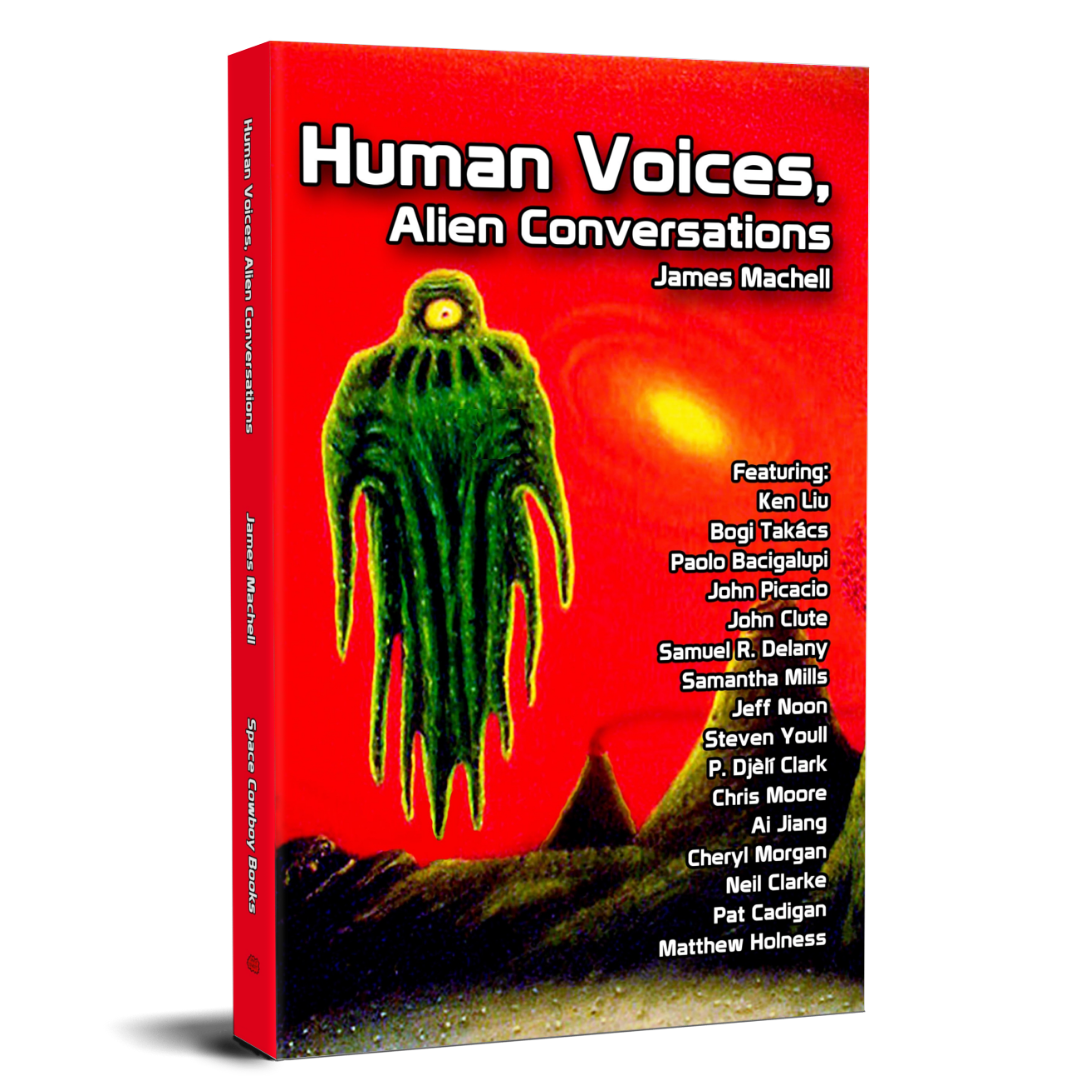
Jean-Paul L. Garnier: What inspired you to conduct the series of interviews in Human Voices, Alien Conversations, and how do you go about selecting interviewees?
James Machell: Several of the interviews had appeared in Utopia Science Fiction Magazine and Electronic Brain. What I wanted to do with Human Voices, Alien Conversations was pull them together into one narrative, and additional interviews were conducted to fill what I perceived to be the gaps in the collection as an overview of SF in the 21st Century. In order to show this with a bird’s eye, I couldn’t just focus on writing when there’s art, editing, performance, and adaptation. I also wanted to explore understated significance. Samuel R. Delany, for example, is nowhere near as well known as Andy Weir, but his influence, even at the time of composing his major works, has been much more profound. Similarly, Chris Moore, with his prog-rock styled art for the SF Masterworks Series, created some of the most recognisable images in the history of SF but did so quietly, never chasing awards or drawing attention to himself: he let his art speak. Cyberpunk, almost exclusively associated with William Gibson, was developed by a “team” of writers in the ‘80s: I thought it would be much more interesting to speak with Pat Cadigan, who is frequently dubbed the “queen” of the subgenre. But I couldn’t just focus on the legends when their contributions to SF are constantly evolving through their influence on younger writers. Interviewees, therefore, vary greatly in age, juxtaposing the perspectives of those blossoming into the SF landscape with those who loosened the soil. Bogi Takács, Samantha Mills, and Ai Jiang, also included in Human Voices, Alien Conversations, are writers we should be looking out for. The final interview is with Matthew Holness, co-writer, co-director, and star of Garth Marenghi’s Darkplace, which gets my vote as the most underappreciated use of SF in visual media. As Holness is now working on the third in a series of spin-off novels, he was ideal to pull everything together.
JPG: How do you go about researching your subjects in preparation for interviews?
JM: Most of the interviewees were selected because I’d been enjoying their work for years. The questions came easily. The Internet Speculative Fiction Database and The Encyclopedia of Science Fiction, however, were excellent resources for pinning down dates and discovering aspects of their careers which may have eluded even the most die-hard fan.
JPG: What do you see as some of the main concerns and themes in early 21st Century science fiction?
JM: I might cheat here and offer two answers because I think the answer differs based on whether we’re talking about long or short form SF. With novels, the main concerns are harder to pinpoint, in major Western ones of this century, including M. John Harrison’s Light, China Mieville’s Perdido Street Station, Paolo Bacigalupi’s The Windup Girl, Ann Leckie’s Ancillary Justice, N. K. Jemisin’s The Fifth Season, Arkady Martine’s A Memory Called Empire, and Jeff VanderMeer’s Annihilation. These books deal with the climate, colonisation, technology (developing with unprecedented strangeness), and the uncanny, but none of this is new. I think concerns may have shifted but the passions of the writer and tastes of the reader have roughly been continuous since the ‘60s. There’s a reason the Modernist period lasted all of forty years and the postmodern sees no sign of ending. Naturally, we live on a different planet now, but I don’t believe the cognitive shift from Donald Trump’s presidency or the rise of AI has been as profound as the First World War or Civil Rights Movement, at least among readers. Characters were having conversations with their automatic computers in the ‘50s and we can go all the way back to Sinclair Lewis’s 1935 dystopia, It Can’t Happen Here, for premonitions of Trumpism.
The underlying revolution in 21st century SF is the shift in emphasis from sexuality to gender. Ellen Datlow waved goodbye to the 20th with her anthologies, Alien Sex and Off Limits: Tales of Alien Sex, perhaps the last time to shock an audience who would become mentally hardened by the internet. Some of the most striking stories to emerge during the last five years include Blue Neustifter’s “Unknown Number” which is told through a series of texts between a transgender woman and an alternate universe version of herself in which she didn’t physically transition, and Samantha Mills’ “Rabbit Test,” which contrasts the future of invasive procedures on women’s bodies with the history of abortion and pregnancy tests. In both cases, the author is examining the self of their protagonists in correlation to the world around them. This is a far cry from H. P. Lovecraft, Harlan Ellison, or Clive Barker menacing their readers with abominations. The notion of the self is evolving and magazines, with a small but dedicated audience, provide a space for writers to explore this in different settings. Enormous strides have been made in the last 26 years regarding the understanding of gender fluidity and trans* identity. “What does it mean to be a woman?” is a question posed and answered since at least Simone de Beauvoir. My prediction for the next quarter of this century is that we’ll see further examinations of masculinity. Louis Theroux’s recent documentary on the “manosphere” has highlighted the prevalence of toxic manhood being marketed to young people. SF writers from the targeted age group will no doubt reflect on the so-called “red pill” philosophy and what it means to be a man in the mid-21st century.
JPG: In your introductions and interviews, authors such as J. G. Ballard and Thomas Pynchon are regularly referenced. What is your attraction to these difficult, genre-defying works?
JM: My attraction stems largely from seeing myself in their work. As much as I enjoy Leo Tolstoy’s Anna Karenina, I am less passionate about aristocrats discovering the joy of “simple living” as characters feeling anxious and being right to do so. J. G. Ballard’s Crash is a photorealistic portrait of evil. Here, he examines a dystopian gang of car crash fetishists. Now, I’ve never been turned on by a car (I can’t even drive) but this aligns with my experience of real-world villains. They are weird, which is also to say, unpredictable. (One of the themes I’d like to explore more in my own writing is the exhaustion of constantly having to figure out the thought process and motivations of those who’d cut off their own finger to rob a stranger of their hand.) With Pynchon, this applies as well, but he delves deeper (partly because his works tend to be much longer) into the propulsion that stems from threat. His characters are rarely still; they search for peace, but their loud worlds have been shaken. At the risk of sounding gloomy here, I’ll add that I also find myself in Charles Dickens and D. H. Lawrence, but there’s even less to be said about these authors in 2026.
Part of the reason for Ballard and Pynchon coming up in Human Voices, Alien Conversations is that the interviewees tend to share a passion for them. Several list a Ballard novel among their favourite works of SF. This isn’t a coincidence. The likes of Jeff Noon will have found the same things to enjoy in Ballard as I have in his Vurt Series. The other writers that come up most frequently in my writing include Alfred Bester, Theodore Sturgeon, and Samuel R. Delany. In Human Voices, Alien Conversations, Delany lists Bester and Sturgeon as the writers of his favourite SF novels. You can find his key mainstream influences in there as well.
JPG: What do you think are some of today’s biggest differences in science fiction coming from the UK and US?
JM: The central difference, to my mind, between British and American writers, is their self-consciousness as writers of genre fiction. This, in the UK, goes back to Olaf Stapledon, David Lindsay, C. S. Lewis, and G. K. Chesterton, who were writing novels about other planets and the future, but I doubt “science fiction” was a term often used. They were writing allegories and warnings. Edgar Rice Burroughs and E. E. “Doc” Smith, however, were firmly aware of their roots in pulp, brazenly (and gloriously) escapist. This trend extends beyond the Golden Age. Compare J. G. Ballard’s grey dystopias with Philip K. Dick’s plastic realities. One seems to follow Kafka’s route into the speculative, while the other invigorates SF canon tropes. Kazuo Ishiguro’s Never Let Me Go, China Mieville’s The City & The City, and David Mitchell’s Cloud Atlas are among the most loved contemporary works of British SF, but none of these revel in their speculative setting. John Scalzi’s Old Man’s War, however, is a novel that could only be written by an American. (There are, of course, exceptions to this rule, Michael Moorcock being a prime example of a writer who managed to fuse a British and American way of thinking.)
JPG: You are also a writer for The Encyclopedia of Science Fiction. How did that come about, and how has writing for the encyclopedia affected your approach to interviewing SF writers, editors, and artists?
JM: This actually came about after an interview.
I had been reading The Encyclopedia of Science Fiction since I was a student and as someone who now writes about SF, the SFE is an inescapable reference work. It’s not just useful as a source of information, but opinion. You’ll see in Pat Cadigan’s Human Voices, Alien Conversations interview that she has a very interesting response to the SFE’s take on her career. As John Clute (its co-editor with David Langford) has supplied a Brobdingnagian number of entries, I thought he would be an interesting person to interview for Utopia Science Fiction Magazine. We carried on talking and following some of my own entries, we met in person. The one featured in Human Voices, Alien Conversations was our second, and was conducted at his dining table while I anxiously ensured that my phone was still recording. I’m still impressed by the speed with which he was able to formulate opinions, and it explains how he came to publish more words than perhaps any other critic. We’ve since started an SFE Substack, which currently features essays by John, me, and Gary Westfahl, but we’re open to new contributors. Topics thus far have included Brexit, The Wind and the Willows, Gormenghast, and autism as a product of human evolution.
In terms of influencing my interviewing technique, it’s shown me that non-fiction can be both informative and challenging. Dr. Simon Malpas, who is a senior lecturer at The University of Edinburgh, said quite a few nice things about Human Voices, Alien Conversations, but the one I most appreciated was that it is “occasionally provocative.” I think the same could be said of the SFE in that it gives a balanced view of quality and in contrast to Wikipedia, isn’t afraid to make debatable assertions about SF history. It does, however, get some disgruntled emails, predominantly from insecure authors, which I see as a sign of doing something right.
JPG: Can you share your thoughts on the interview as an artform and its role in genre fiction?
JM: Alfred Bester (better known for The Demolished Man and The Stars My Destination) is a great example of an interviewer who turned conversations into art. “Woody [Allen] isn’t a funny man in real life,” he writes in an introduction. He makes his own presence felt so that the reader doesn’t perceive questions as appearing from dark corners, nor is the interviewee professing their responses like an influencer with a smartphone. I particularly enjoyed his exchange with Isaac Asimov because, although the focus was on the Foundation author, there was a real sense of being in a room with two characters. The best interviews tell a story. Of course, they’re opportunities for interviewees to promote their work, but they’re also vehicles of discovery as to how they got there. And you make that discovery through the lens of the interviewer. This is why Human Voices, Alien Conversations opens autobiographically, giving the reader a sense of who I am and how I came to be posing questions. In terms of the role it plays in genre fiction, I think it serves the same role as it does in the literary sphere: consumers of art want to feel a connection with the artist. I wonder if The Beatles would have achieved half their success if they recorded anonymously, never appeared on an album cover, and never advertised the personality in their music.
JPG: Do you have any advice for interviewers and non-fiction genre adjacent writers?
JM: The big thing I learned from Human Voices, Alien Conversations is to think of SF as something that’s happening now rather than the current period as a link in a chain that goes back to Mary Shelley. When thinking of SF editors, the first ones that come to mind are Hugo Gernsback, August Derleth, John W. Campbell, Isaac Asimov, Robert Silverberg, and Michael Moorcock, all prolific authors themselves. When I asked Neil Clarke about why his focus was on editing rather than writing, his response was that it wasn’t unusual, giving Ellen Datlow and Jonathan Strahan as examples. Had I been thinking more in 21st Century terms, Clarke would not have struck me as unique, as while there are many contemporary editors who write their own fiction, I can think of about as many who don’t. It is a question, however, that I chose to keep in, anticipating that many readers of the collection may also approach SF with a similar mindset.
Secondly, I’d advise newer non-fiction writers to diversify. I began interviewing for Utopia Science Fiction Magazine because I’d previously published prose, poetry, and an article there (I was at the time and may still be the first to do all three). There are lots of people who want people to read what they write, but there are many gaps in the fence.
Keep trying to squeeze through the same one: you may get through, or you may get stuck.
###
Bios:
James Machell is a British writer. He contributes to The Encyclopedia of Science Fiction and curates its Substack. He also serves as Outreach Manager for Utopia Science Fiction Magazine and was the 2025 Contest Chair for the Science Fiction and Fantasy Poetry Association. Find him on Bluesky @jamesmachell.bsky.social or YouTube @Fell-Purpose. https://jamesmachell.com/
#
Jean-Paul L. Garnier is the owner of Space Cowboy Books bookstore and publishing house, producer of Simultaneous Times Podcast (2023/25 Laureate Award Winner, 2024 BSFA, Ignyte, and British Fantasy Award Finalist), and was the editor of the SFPA’s Star*Line magazine from 2021-2025. He is also Editor-in-Chief of Electronic Brain magazine. In 2024 he won the Laureate Award for Best Editor. He has written many books of poetry and science fiction. https://spacecowboybooks.com/
Categories: Industry News
Jean-Paul L. Garnier interviews James Machell
Jean-Paul L. Garnier: What inspired you to conduct the series of interviews in Human Voices, Alien Conversations, and how do you go about selecting interviewees?
James Machell: Several of the interviews had appeared in Utopia Science Fiction Magazine and Electronic Brain. What I wanted to do with Human Voices, Alien Conversations was pull them together into one narrative, and additional interviews were conducted to fill what I perceived to be the gaps in the collection as an overview of SF in the 21st Century. In order to show this with a bird’s eye, I couldn’t just focus on writing when there’s art, editing, performance, and adaptation. I also wanted to explore understated significance. Samuel R. Delany, for example, is nowhere near as well known as Andy Weir, but his influence, even at the time of composing his major works, has been much more profound. Similarly, Chris Moore, with his prog-rock styled art for the SF Masterworks Series, created some of the most recognisable images in the history of SF but did so quietly, never chasing awards or drawing attention to himself: he let his art speak. Cyberpunk, almost exclusively associated with William Gibson, was developed by a “team” of writers in the ‘80s: I thought it would be much more interesting to speak with Pat Cadigan, who is frequently dubbed the “queen” of the subgenre. But I couldn’t just focus on the legends when their contributions to SF are constantly evolving through their influence on younger writers. Interviewees, therefore, vary greatly in age, juxtaposing the perspectives of those blossoming into the SF landscape with those who loosened the soil. Bogi Takács, Samantha Mills, and Ai Jiang, also included in Human Voices, Alien Conversations, are writers we should be looking out for. The final interview is with Matthew Holness, co-writer, co-director, and star of Garth Marenghi’s Darkplace, which gets my vote as the most underappreciated use of SF in visual media. As Holness is now working on the third in a series of spin-off novels, he was ideal to pull everything together.
JPG: How do you go about researching your subjects in preparation for interviews?
JM: Most of the interviewees were selected because I’d been enjoying their work for years. The questions came easily. The Internet Speculative Fiction Database and The Encyclopedia of Science Fiction, however, were excellent resources for pinning down dates and discovering aspects of their careers which may have eluded even the most die-hard fan.
JPG: What do you see as some of the main concerns and themes in early 21st Century science fiction?
JM: I might cheat here and offer two answers because I think the answer differs based on whether we’re talking about long or short form SF. With novels, the main concerns are harder to pinpoint, in major Western ones of this century, including M. John Harrison’s Light, China Mieville’s Perdido Street Station, Paolo Bacigalupi’s The Windup Girl, Ann Leckie’s Ancillary Justice, N. K. Jemisin’s The Fifth Season, Arkady Martine’s A Memory Called Empire, and Jeff VanderMeer’s Annihilation. These books deal with the climate, colonisation, technology (developing with unprecedented strangeness), and the uncanny, but none of this is new. I think concerns may have shifted but the passions of the writer and tastes of the reader have roughly been continuous since the ‘60s. There’s a reason the Modernist period lasted all of forty years and the postmodern sees no sign of ending. Naturally, we live on a different planet now, but I don’t believe the cognitive shift from Donald Trump’s presidency or the rise of AI has been as profound as the First World War or Civil Rights Movement, at least among readers. Characters were having conversations with their automatic computers in the ‘50s and we can go all the way back to Sinclair Lewis’s 1935 dystopia, It Can’t Happen Here, for premonitions of Trumpism.
The underlying revolution in 21st century SF is the shift in emphasis from sexuality to gender. Ellen Datlow waved goodbye to the 20th with her anthologies, Alien Sex and Off Limits: Tales of Alien Sex, perhaps the last time to shock an audience who would become mentally hardened by the internet. Some of the most striking stories to emerge during the last five years include Blue Neustifter’s “Unknown Number” which is told through a series of texts between a transgender woman and an alternate universe version of herself in which she didn’t physically transition, and Samantha Mills’ “Rabbit Test,” which contrasts the future of invasive procedures on women’s bodies with the history of abortion and pregnancy tests. In both cases, the author is examining the self of their protagonists in correlation to the world around them. This is a far cry from H. P. Lovecraft, Harlan Ellison, or Clive Barker menacing their readers with abominations. The notion of the self is evolving and magazines, with a small but dedicated audience, provide a space for writers to explore this in different settings. Enormous strides have been made in the last 26 years regarding the understanding of gender fluidity and trans* identity. “What does it mean to be a woman?” is a question posed and answered since at least Simone de Beauvoir. My prediction for the next quarter of this century is that we’ll see further examinations of masculinity. Louis Theroux’s recent documentary on the “manosphere” has highlighted the prevalence of toxic manhood being marketed to young people. SF writers from the targeted age group will no doubt reflect on the so-called “red pill” philosophy and what it means to be a man in the mid-21st century.
JPG: In your introductions and interviews, authors such as J. G. Ballard and Thomas Pynchon are regularly referenced. What is your attraction to these difficult, genre-defying works?
JM: My attraction stems largely from seeing myself in their work. As much as I enjoy Leo Tolstoy’s Anna Karenina, I am less passionate about aristocrats discovering the joy of “simple living” as characters feeling anxious and being right to do so. J. G. Ballard’s Crash is a photorealistic portrait of evil. Here, he examines a dystopian gang of car crash fetishists. Now, I’ve never been turned on by a car (I can’t even drive) but this aligns with my experience of real-world villains. They are weird, which is also to say, unpredictable. (One of the themes I’d like to explore more in my own writing is the exhaustion of constantly having to figure out the thought process and motivations of those who’d cut off their own finger to rob a stranger of their hand.) With Pynchon, this applies as well, but he delves deeper (partly because his works tend to be much longer) into the propulsion that stems from threat. His characters are rarely still; they search for peace, but their loud worlds have been shaken. At the risk of sounding gloomy here, I’ll add that I also find myself in Charles Dickens and D. H. Lawrence, but there’s even less to be said about these authors in 2026.
Part of the reason for Ballard and Pynchon coming up in Human Voices, Alien Conversations is that the interviewees tend to share a passion for them. Several list a Ballard novel among their favourite works of SF. This isn’t a coincidence. The likes of Jeff Noon will have found the same things to enjoy in Ballard as I have in his Vurt Series. The other writers that come up most frequently in my writing include Alfred Bester, Theodore Sturgeon, and Samuel R. Delany. In Human Voices, Alien Conversations, Delany lists Bester and Sturgeon as the writers of his favourite SF novels. You can find his key mainstream influences in there as well.
JPG: What do you think are some of today’s biggest differences in science fiction coming from the UK and US?
JM: The central difference, to my mind, between British and American writers, is their self-consciousness as writers of genre fiction. This, in the UK, goes back to Olaf Stapledon, David Lindsay, C. S. Lewis, and G. K. Chesterton, who were writing novels about other planets and the future, but I doubt “science fiction” was a term often used. They were writing allegories and warnings. Edgar Rice Burroughs and E. E. “Doc” Smith, however, were firmly aware of their roots in pulp, brazenly (and gloriously) escapist. This trend extends beyond the Golden Age. Compare J. G. Ballard’s grey dystopias with Philip K. Dick’s plastic realities. One seems to follow Kafka’s route into the speculative, while the other invigorates SF canon tropes. Kazuo Ishiguro’s Never Let Me Go, China Mieville’s The City & The City, and David Mitchell’s Cloud Atlas are among the most loved contemporary works of British SF, but none of these revel in their speculative setting. John Scalzi’s Old Man’s War, however, is a novel that could only be written by an American. (There are, of course, exceptions to this rule, Michael Moorcock being a prime example of a writer who managed to fuse a British and American way of thinking.)
JPG: You are also a writer for The Encyclopedia of Science Fiction. How did that come about, and how has writing for the encyclopedia affected your approach to interviewing SF writers, editors, and artists?
JM: This actually came about after an interview.
I had been reading The Encyclopedia of Science Fiction since I was a student and as someone who now writes about SF, the SFE is an inescapable reference work. It’s not just useful as a source of information, but opinion. You’ll see in Pat Cadigan’s Human Voices, Alien Conversations interview that she has a very interesting response to the SFE’s take on her career. As John Clute (its co-editor with David Langford) has supplied a Brobdingnagian number of entries, I thought he would be an interesting person to interview for Utopia Science Fiction Magazine. We carried on talking and following some of my own entries, we met in person. The one featured in Human Voices, Alien Conversations was our second, and was conducted at his dining table while I anxiously ensured that my phone was still recording. I’m still impressed by the speed with which he was able to formulate opinions, and it explains how he came to publish more words than perhaps any other critic. We’ve since started an SFE Substack, which currently features essays by John, me, and Gary Westfahl, but we’re open to new contributors. Topics thus far have included Brexit, The Wind and the Willows, Gormenghast, and autism as a product of human evolution.
In terms of influencing my interviewing technique, it’s shown me that non-fiction can be both informative and challenging. Dr. Simon Malpas, who is a senior lecturer at The University of Edinburgh, said quite a few nice things about Human Voices, Alien Conversations, but the one I most appreciated was that it is “occasionally provocative.” I think the same could be said of the SFE in that it gives a balanced view of quality and in contrast to Wikipedia, isn’t afraid to make debatable assertions about SF history. It does, however, get some disgruntled emails, predominantly from insecure authors, which I see as a sign of doing something right.
JPG: Can you share your thoughts on the interview as an artform and its role in genre fiction?
JM: Alfred Bester (better known for The Demolished Man and The Stars My Destination) is a great example of an interviewer who turned conversations into art. “Woody [Allen] isn’t a funny man in real life,” he writes in an introduction. He makes his own presence felt so that the reader doesn’t perceive questions as appearing from dark corners, nor is the interviewee professing their responses like an influencer with a smartphone. I particularly enjoyed his exchange with Isaac Asimov because, although the focus was on the Foundation author, there was a real sense of being in a room with two characters. The best interviews tell a story. Of course, they’re opportunities for interviewees to promote their work, but they’re also vehicles of discovery as to how they got there. And you make that discovery through the lens of the interviewer. This is why Human Voices, Alien Conversations opens autobiographically, giving the reader a sense of who I am and how I came to be posing questions. In terms of the role it plays in genre fiction, I think it serves the same role as it does in the literary sphere: consumers of art want to feel a connection with the artist. I wonder if The Beatles would have achieved half their success if they recorded anonymously, never appeared on an album cover, and never advertised the personality in their music.
JPG: Do you have any advice for interviewers and non-fiction genre adjacent writers?
JM: The big thing I learned from Human Voices, Alien Conversations is to think of SF as something that’s happening now rather than the current period as a link in a chain that goes back to Mary Shelley. When thinking of SF editors, the first ones that come to mind are Hugo Gernsback, August Derleth, John W. Campbell, Isaac Asimov, Robert Silverberg, and Michael Moorcock, all prolific authors themselves. When I asked Neil Clarke about why his focus was on editing rather than writing, his response was that it wasn’t unusual, giving Ellen Datlow and Jonathan Strahan as examples. Had I been thinking more in 21st Century terms, Clarke would not have struck me as unique, as while there are many contemporary editors who write their own fiction, I can think of about as many who don’t. It is a question, however, that I chose to keep in, anticipating that many readers of the collection may also approach SF with a similar mindset.
Secondly, I’d advise newer non-fiction writers to diversify. I began interviewing for Utopia Science Fiction Magazine because I’d previously published prose, poetry, and an article there (I was at the time and may still be the first to do all three). There are lots of people who want people to read what they write, but there are many gaps in the fence.
Keep trying to squeeze through the same one: you may get through, or you may get stuck.
###
Bios:James Machell is a British writer. He contributes to The Encyclopedia of Science Fiction and curates its Substack. He also serves as Outreach Manager for Utopia Science Fiction Magazine and was the 2025 Contest Chair for the Science Fiction and Fantasy Poetry Association. Find him on Bluesky @jamesmachell.bsky.social or YouTube @Fell-Purpose. https://jamesmachell.com/
#
Jean-Paul L. Garnier is the owner of Space Cowboy Books bookstore and publishing house, producer of Simultaneous Times Podcast (2023/25 Laureate Award Winner, 2024 BSFA, Ignyte, and British Fantasy Award Finalist), and was the editor of the SFPA’s Star*Line magazine from 2021-2025. He is also Editor-in-Chief of Electronic Brain magazine. In 2024 he won the Laureate Award for Best Editor. He has written many books of poetry and science fiction. https://spacecowboybooks.com/
Categories: Industry News
Vector interviews Rachel Feder
Vector (ed. Polina Levontin): As a literary scholar, you have written both about motherhood in Frankenstein and theorised the gothic genre in Dracula, a book you edited. How does writing and ‘research as practice’ intersect in The Turn?
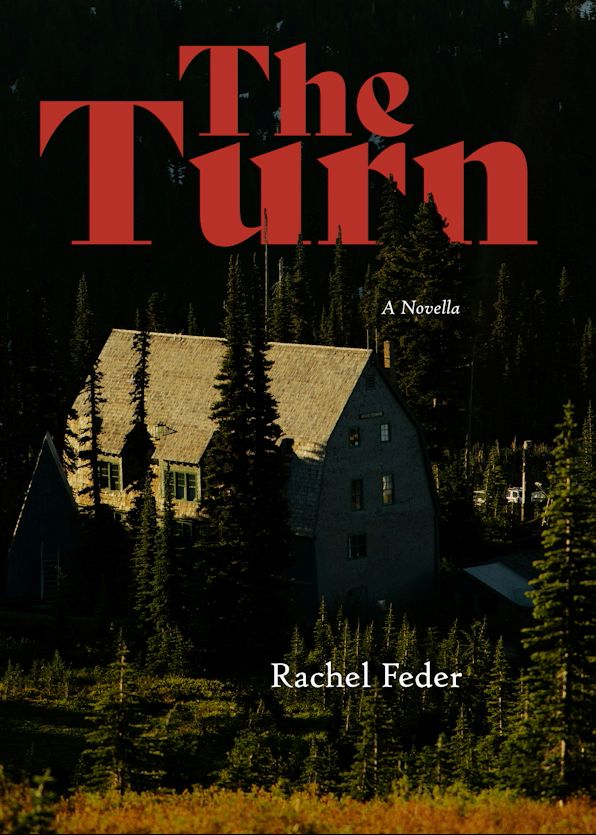
Rachel Feder: One of my mentors in graduate school, Yopie Prins, once described herself as “promiscuous” in her scholarly interests. This stuck with me, and I like to say that I’m a slut for genre. I’m interested in genre as a form of experiment, one that calls a certain imagined readership into being. I’m interested in how genre hopping might allow me to imagine and, hopefully, connect with different communities of readers.
The Gothic is a really interesting test case, here. A text I think about a lot is Mary Wollstonecraft’s unfinished Gothic novel, The Wrongs of Woman, or Maria, which is, in my opinion, her most radically proto-feminist work. When Wollstonecraft enters political-theoretical discussions—which it’s actually incredible that she was able to do so effectively, given both her gender and her class and family background—she writes to the readership that was already established for that discourse field. She offers almost chiropractic adjustments to patriarchy. But then we get this raw, unfinished Gothic novel (edited and mediated by Godwin, who burned her drafts, sure), and suddenly we’re talking directly about abuse, assault, abortion, and suicide, in highly political ways. The femme-coded nature of the Gothic—which has always been a trade, or even pulp, genre—lets Wollstonecraft imagine talking directly to the victims of patriarchy. One of the most invested readers of that text was Mary Shelley—it really haunts her work—so Wollstonecraft’s feminist intervention in the Gothic informs the history of science fiction, too.
Personally, I’m interested in how the Gothic reveals totalities. When I want to understand forces that feel invisible, totally oppressive, or inevitable in our world, playing with fiction lets me take a hard look at my subject. When someone runs out of a haunted house, you get to see the house, if only for a moment.
And the follow-up question is the converse: writing from experience rather than theory, about motherhood, academic life, academic life as a mother… To me, who is also both, The Turn spoke directly. Genre fiction is precisely the mode to talk about the politics of care, both childcare and care as a creator more generally. Was reaching for the Gothic motivated by the desire to convey the real problems in the most visceral way?RF: Across genres, I would say that my writing mind and my parental mind are inseparable. I like to joke that I made my kids strange baby books—I began working in earnest on my monograph, Harvester of Hearts: Motherhood Under the Sign of Frankenstein, almost immediately postpartum with my older child, and started writing The Turn while home with a new baby during the pandemic. One argument I make in Harvester is that there is no such thing as writing from theory rather than experience. Our experiences—including our familial and embodied experiences, and our experiences of giving and receiving care—are always going to inform how we understand theory.
And then of course, there are external events. The pandemic. Did it really happen? Apparently, forgetting – a global amnesia – seems to be one of our responses. The memory gaps, of course, play a key part in the plot. Is this a random connection? When, in relation to the pandemic, did you begin writing this novella? Did you have to overcome forgetting?RF: In the summer of 2020, my husband and kids and I were staying at my childhood home in Boulder. (The house in The Turn is not based on my childhood home, but rather on the home of my friend, the writer, scholar, and lawyer Natalie Brown.) I awoke one morning to a strange dream, the dream Baxter has at the beginning of the novella. In the dream, I walked out into my childhood living room and looked out the window to find the house was a ship floating on the sea.
My first attempt at this project was a story serialized in the online literary journal Luna Luna Magazine. The editors there were so generously willing to take a chance on something I had yet to write, and very kind to me when, for various reasons, I was unable to keep going. But Baxter stayed with me, and, with some distance, I was finally able to come back to her story, and bring her home.
It’s interesting to me that you bring up forgetting. I’m a very inductive writer, so I didn’t imagine the memory gaps in the story as such when I was first drafting—I was just learning things at the same time Baxter did. But forgetting is such a crucial component of the way, for example, Mary Shelley imagines motherhood in relation to the Gothic. In terms of The Turn, I think the question for me has more to do with the fraught connection between cognitive and embodied knowledge.
One of the horror/realism aspects in The Turn is how gendered parental roles are. Fathers seem superfluous, while the biological bond between a mother and a child is rendered fantastical and supernatural. Is the gender of the child significant? In this way, we find a protagonist torn between two male figures with unnatural power over her body.RF: It’s really important to me, as a cis hetero person who often writes about parenthood—and who writes, inherently, from my own experience of the world, my own identity—not to ever imply that I think about biological motherhood as somehow better or “more than” any other type of parenthood. I feel the need to tread lightly to avoid spoilers here, so I will just mention that the monstrous forces at the margins of Baxter’s world are both paternal and maternal in nature—a hallmark of the Gothic.
Regardless of whether this pertains to gender, the fantastical, supernatural bonds in the book have to do with loving a child unconditionally and caring for that child no matter what. That’s the real magic, I think, that makes a parent.
In terms of the kids, Thebes and Quinn just kind of came to me whole cloth. You’d need to ask them any questions you have about their genders.
Power is often narrativised as magic. The imagery of vampirism has been used in critiques of capitalism and deployed to represent sexual power. Situating consent within the ambivalent framing of the gothic genre seemed especially difficult. What were the parts that gave you the most trouble?RF: When I teach the history of vampire literature, I invite students to consider how stories can be subversive, but not necessarily progressive. Monster stories often open up pockets of possibility—for queerness and polyamory in Dracula, for example—but then punish these desires and reassert the status quo.
One of the Gothic novellas that inspired this project is Henry James’s The Turn of the Screw. I’ll never forget reading that text in class for the first time. The professor, the great James scholar William Veeder, paid particular attention to the end of the book. I remember him saying something along the lines of, sometimes the Gothic opens Pandora’s box, and what comes out is too powerful. You can’t close the box. You can’t reassert the frame. You can’t put things back in their “proper” place. I’m committed to this Gothic potential. The greatest challenge of this project—and the most rewarding—was letting Baxter fully embrace her own power, even as the world around her continued to spin into disorder.
Will there be a sequence? What are you working on now?RF: The form of the Gothic governess novella is an integral part of The Turn’s deep engagement with literary history. Someday I’d love to try my hand at some kind of serialized adaptation of the story to a different medium, extending past the current ending, maybe even in collaboration with other writers.
I’m working on a few projects now, in different genres: a literary horroromance novel; a libretto for a musical; a collaborative scholarly project. Like all my creative endeavors, these examine how literary history informs our shared cultural mythologies, and our sense of what we owe ourselves and each other.
Categories: Industry News
Vector interviews Rachel Feder
Vector (ed. Polina Levontin): As a literary scholar, you have written both about motherhood in Frankenstein and theorised the gothic genre in Dracula, a book you edited. How does writing and ‘research as practice’ intersect in The Turn?
Rachel Feder: One of my mentors in graduate school, Yopie Prins, once described herself as “promiscuous” in her scholarly interests. This stuck with me, and I like to say that I’m a slut for genre. I’m interested in genre as a form of experiment, one that calls a certain imagined readership into being. I’m interested in how genre hopping might allow me to imagine and, hopefully, connect with different communities of readers.
The Gothic is a really interesting test case, here. A text I think about a lot is Mary Wollstonecraft’s unfinished Gothic novel, The Wrongs of Woman, or Maria, which is, in my opinion, her most radically proto-feminist work. When Wollstonecraft enters political-theoretical discussions—which it’s actually incredible that she was able to do so effectively, given both her gender and her class and family background—she writes to the readership that was already established for that discourse field. She offers almost chiropractic adjustments to patriarchy. But then we get this raw, unfinished Gothic novel (edited and mediated by Godwin, who burned her drafts, sure), and suddenly we’re talking directly about abuse, assault, abortion, and suicide, in highly political ways. The femme-coded nature of the Gothic—which has always been a trade, or even pulp, genre—lets Wollstonecraft imagine talking directly to the victims of patriarchy. One of the most invested readers of that text was Mary Shelley—it really haunts her work—so Wollstonecraft’s feminist intervention in the Gothic informs the history of science fiction, too.
Personally, I’m interested in how the Gothic reveals totalities. When I want to understand forces that feel invisible, totally oppressive, or inevitable in our world, playing with fiction lets me take a hard look at my subject. When someone runs out of a haunted house, you get to see the house, if only for a moment.
And the follow-up question is the converse: writing from experience rather than theory, about motherhood, academic life, academic life as a mother… To me, who is also both, The Turn spoke directly. Genre fiction is precisely the mode to talk about the politics of care, both childcare and care as a creator more generally. Was reaching for the Gothic motivated by the desire to convey the real problems in the most visceral way?RF: Across genres, I would say that my writing mind and my parental mind are inseparable. I like to joke that I made my kids strange baby books—I began working in earnest on my monograph, Harvester of Hearts: Motherhood Under the Sign of Frankenstein, almost immediately postpartum with my older child, and started writing The Turn while home with a new baby during the pandemic. One argument I make in Harvester is that there is no such thing as writing from theory rather than experience. Our experiences—including our familial and embodied experiences, and our experiences of giving and receiving care—are always going to inform how we understand theory.
And then of course, there are external events. The pandemic. Did it really happen? Apparently, forgetting – a global amnesia – seems to be one of our responses. The memory gaps, of course, play a key part in the plot. Is this a random connection? When, in relation to the pandemic, did you begin writing this novella? Did you have to overcome forgetting?RF: In the summer of 2020, my husband and kids and I were staying at my childhood home in Boulder. (The house in The Turn is not based on my childhood home, but rather on the home of my friend, the writer, scholar, and lawyer Natalie Brown.) I awoke one morning to a strange dream, the dream Baxter has at the beginning of the novella. In the dream, I walked out into my childhood living room and looked out the window to find the house was a ship floating on the sea.
My first attempt at this project was a story serialized in the online literary journal Luna Luna Magazine. The editors there were so generously willing to take a chance on something I had yet to write, and very kind to me when, for various reasons, I was unable to keep going. But Baxter stayed with me, and, with some distance, I was finally able to come back to her story, and bring her home.
It’s interesting to me that you bring up forgetting. I’m a very inductive writer, so I didn’t imagine the memory gaps in the story as such when I was first drafting—I was just learning things at the same time Baxter did. But forgetting is such a crucial component of the way, for example, Mary Shelley imagines motherhood in relation to the Gothic. In terms of The Turn, I think the question for me has more to do with the fraught connection between cognitive and embodied knowledge.
One of the horror/realism aspects in The Turn is how gendered parental roles are. Fathers seem superfluous, while the biological bond between a mother and a child is rendered fantastical and supernatural. Is the gender of the child significant? In this way, we find a protagonist torn between two male figures with unnatural power over her body.RF: It’s really important to me, as a cis hetero person who often writes about parenthood—and who writes, inherently, from my own experience of the world, my own identity—not to ever imply that I think about biological motherhood as somehow better or “more than” any other type of parenthood. I feel the need to tread lightly to avoid spoilers here, so I will just mention that the monstrous forces at the margins of Baxter’s world are both paternal and maternal in nature—a hallmark of the Gothic.
Regardless of whether this pertains to gender, the fantastical, supernatural bonds in the book have to do with loving a child unconditionally and caring for that child no matter what. That’s the real magic, I think, that makes a parent.
In terms of the kids, Thebes and Quinn just kind of came to me whole cloth. You’d need to ask them any questions you have about their genders.
Power is often narrativised as magic. The imagery of vampirism has been used in critiques of capitalism and deployed to represent sexual power. Situating consent within the ambivalent framing of the gothic genre seemed especially difficult. What were the parts that gave you the most trouble?RF: When I teach the history of vampire literature, I invite students to consider how stories can be subversive, but not necessarily progressive. Monster stories often open up pockets of possibility—for queerness and polyamory in Dracula, for example—but then punish these desires and reassert the status quo.
One of the Gothic novellas that inspired this project is Henry James’s The Turn of the Screw. I’ll never forget reading that text in class for the first time. The professor, the great James scholar William Veeder, paid particular attention to the end of the book. I remember him saying something along the lines of, sometimes the Gothic opens Pandora’s box, and what comes out is too powerful. You can’t close the box. You can’t reassert the frame. You can’t put things back in their “proper” place. I’m committed to this Gothic potential. The greatest challenge of this project—and the most rewarding—was letting Baxter fully embrace her own power, even as the world around her continued to spin into disorder.
Will there be a sequence? What are you working on now?RF: The form of the Gothic governess novella is an integral part of The Turn’s deep engagement with literary history. Someday I’d love to try my hand at some kind of serialized adaptation of the story to a different medium, extending past the current ending, maybe even in collaboration with other writers.
I’m working on a few projects now, in different genres: a literary horroromance novel; a libretto for a musical; a collaborative scholarly project. Like all my creative endeavors, these examine how literary history informs our shared cultural mythologies, and our sense of what we owe ourselves and each other.
Categories: Industry News
Towards Kindred Futures
By Ana Sun
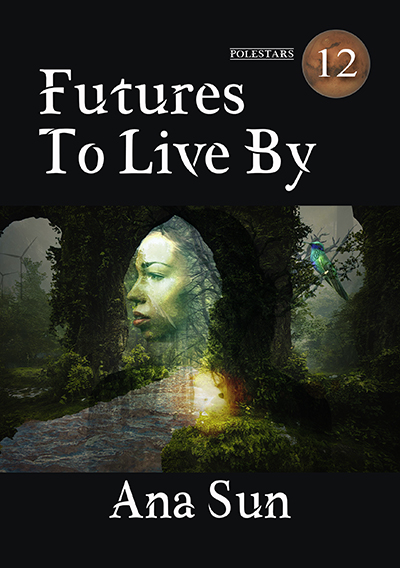
Ever wonder why we tend to refer to the future in its singular form in everyday speech? Why ‘the future’, and not simply ‘futures’? Considering that we can probably agree that a myriad of futures is possible before one of them falls into the present, this seems to be a mundane but overlooked mystery.
In Futurevision: scenarios for the world in 2040, Richard Watson and Oliver Freeman observed [1]:
There is a problem with most books about the future – and indeed, there is a fatal flaw with almost all of our thinking about what will happen next. This is because of a simple point. The fact is, there is no single future, regardless of our deepest desire that it be so, and there is no heavenly salvation in sight.
As someone who often explores progressive, positive futures within the context of climate change and social justice through science fiction, in particular Solarpunk [2], I’m intrigued: does the common view of a singular future mean we are more likely to believe that climate collapse is inevitable? Do we therefore find it difficult to imagine – and enact – alternatives? Have we inadvertently accepted a destiny described by cyberpunk, a future rocket-boosted by uncaring technology, systems of oppression and power concentrated in the hands of a few? In Zoefuturistic terms, have we simply accepted the ‘being’ and forfeited the ‘becoming’?
There’s some evidence that language can influence how we perceive time and our relationship with the future… or, rather, futures [3]. Our bodies are limited in conscious capacity, our brains constrained by how our memories are formed [4] [5] [6].
Unlike futurists and futurologists, thinking about the long-term future in its simultaneous multiplicities, especially when it comes to a complex issue such as climate change, is not something that most of us are able to conceptualise easily [7]. Sure, we may deal well enough with the immediate future, such as considering different possible routes we might take between two locations, or how we might fill the hours between morning and night on a given day. Beyond a certain timeframe, the future can resemble a different place; this afternoon, tonight, or tomorrow can easily seem like disembodied worlds beyond our reach [27]. And yet, the next second appears on the near horizon in the shadow of the following minute, then the hour thereafter – all rapidly pouring into the now, one liquid moment flowing into the next.
Perhaps there are deeper reasons for why we struggle with notions of futures in our everyday lives, and that’s worth examining.
Caught in destiny’s netSometime in the early summer of 2025, after an event on climate change resilience, a frustrated attendee next to me mumbled words to the effect, “So all of it is going to end, isn’t it?”
At the time, her blunt nihilism shocked me into silence, but that feeling of impotence is all too familiar: what’s the use of fighting if all will be destroyed in the end? If we were to believe that an impending climate collapse is destiny, we’d have already been defeated before we even began.
One winter morning, I asked a question to an audience of about two hundred people in the middle of a talk I was giving: how did they visualise critical environmental thresholds – what we commonly call ‘climate tipping points’? The majority believed these to be a cliff-edge for survival: once we topple over the side, it’s game over. No surprise; I certainly did too, once.
In August 2025, updated analysis showed an increased risk of the Atlantic meridional overturning circulation (AMOC) collapsing when researchers examined data modelling that ran for a longer timeframe until 2300 and 2500 [8]. Separately, a seventh planetary boundary – out of the nine environmental limits that demarcate the planet’s health – has been breached this year, according to the annual assessment by Potsdam Institute for Climate Impact Research, as ocean acidification transgresses the critical safe threshold for marine ecosystems [9].
All these are alarming signals designed to induce a sense of urgency and a drive to action, but taken alone without accompanying solutions, these types of headlines incite panic and breed disempowerment [10], rendering us helpless and stripped of agency while an inevitable future barrels down upon us.
The AMOC tipping point is particularly worrying because the change to humanity as we know it would be drastic. If we don’t succeed in lowering our CO2 emissions in line with the Paris Agreement, the current estimation is that we might pass this particular tipping point within a few decades.
There still remains deep uncertainty whether the AMOC may weaken partially or result in a full collapse, and over what timeframe. Likely, we have at least a few decades at hand to act to avert the worst outcomes. Johan Rockström, Director of Potsdam Institute for Climate Impact Research, said of the seventh planetary boundary breach [11]:
We’re not yet in the high-risk zone of irreversible, unmanageable change of the planet, which suggests that we can still turn this around. The window is still open even though it’s closing fast, and we have so much evidence of scalable solutions across all sectors from the food sector to the built environment to the energy transition that we can bend the curves and bring ourselves back within a safe operating space within the next decades.
Seaver Wang, the Director of Climate and Energy at The Breakthrough Institute wrote comprehensively about the misnomer of ‘tipping points’:
First, the word ‘tipping’ implies the rapidity of an unbalanced cart toppling over. […] Second, the word ‘point,’ too, is bound to confuse. It implies a single, precise, known critical threshold beyond which Earth system components tip. [12]
The reality is that environmental tipping points are far more complex [13]. The Global Tipping Points Report 2023 emphasises that their assessment ‘does not suggest that crossing major tipping points could lead to runaway warming, with mitigation to prevent further tipping points being worthwhile even if some tipping points are reached. [14]’.
We also spend so little time focusing on positive tipping points – such as those scalable solutions that Johan Rockström refers to [11] [15]. If my sample of two hundred or so attendees was anything to go by, solutions that have a positive impact aren’t something that typically crosses our minds. While our media coverage would have us imagine apocalyptic scenarios where the Earth drowns under several metres of seawater – a scenario that, in reality, is highly unlikely in the near future – the current estimates suggest that the Greenland and West Antarctic ice sheets would likely take hundreds to thousands of years to melt after their tipping points are breached [16]. The complexity in predicting circulation and heat transfers in the ocean means much is unknown; current projections, even in our worst case scenario, project sea level rise of up to 180mm by 2050 [17].
We shouldn’t be under the impression that all is well – but there’s time to act, to reverse the damage if we could collectively grasp our agency.
Unfortunately, few narrative tools exist to remind us we are not rolling downhill off the far side of Freytag’s Pyramid into fated tragedy. Just how well science fiction is placed to shift collective imagination is still a nascent experiment [18].
Science fiction: from imaginary prediction to unintended blueprintIt might sometimes look like cyberpunk has predicted our current trajectory: a world where AI is poised to displace us, where an elite, privileged few exploit political institutions to concentrate their power, preying on people and planet to enrich themselves.
Ursula K. Le Guin famously declared [19], ‘Science fiction is not predictive; it is descriptive.’ Istvan Csicsery-Ronay discusses this at length in The Seven Beauties of Science Fiction [20]: ‘SF is imaginary prediction, drawing on the same sort of historical-projective suspension of disbelief as the real thing, if only to explore, to problematize, and to play with it.’
In other words, science fiction originally took on the mantle of holding up a mirror to our present from a possible future. Until recently, SF has often been written in past tense, presenting narratives as if a particular future has already happened so we could project ourselves forward in time. But how did we get from those glorious imaginary predictions to what Simon McNeil recounts as the ‘future horrors Silicon Valley merchants of human misery are trying to produce’ [21]? How did we get from Star Trek to a world where technology is threatening humanity, at the very same time as our obsession with economic growth means the planet can no longer sustain all of us?
In his epic essay The Men Who Sold the Moon, Eden Kupernmintz explains how we our current situation might have transpired [22]:
[..] if you want to read about militarism in Heinlein’s work, you can find countless articles online on the topic, as well as on the fascism of Campbell and the many, many awful passages of Vance’s career. But consider the supposedly more progressive works of authors like Simak, Asimov, Pohl Anderson, Blish, or Roddenberry. Most, if not all, of their ideas and values are realized through individualist, liberal lenses. They are mostly concerned with heroes who uphold values such as compassion, honor, duty, and virtue. They very rarely, if ever, engage with meaningful, systematic criticisms of society. Indeed, they are perfect examples of “suburban science fiction”, importing much of the underlying, and thus powerful, presuppositions of our own society into the future. Their heroes are almost invariably male, white, abled, and dripping with machismo and “charisma”. Solutions to problems revolve around rationalism and scientism at best and downright calls for technocracy at worst. The idea of the supremacy of science, without engaging in its colonial roots, without engaging with ideas and problems like eugenics, without any meaningful critiques of its role in serving capitalism, is one of the main motivating powers of much of the careers cited above.
Kupernmintz goes on to suggest that the heroes portrayed in the Golden Age of science fiction created the archetypes upon which powerful people such as Elon Musk, Jeff Bezos or Peter Thiel could comfortably model themselves. A challenging stance, certainly, to flatten such rich visions of the future. However, even the post-scarcity utopia depicted in Star Trek would have assumed that we continue extractive practices on Earth’s finite resources – such as precious metals and fossil fuels – for us to get there [23].
Science fiction as a genre has never set out to predict any specific future and yet here we are, witnessing what should have been cautionary tales become ingrained blueprints for the potential destruction of humanity and our living planet – adding to already debilitating helplessness, tempting us to give in to seemingly inescapable destiny.
In recent years, we’ve seen a more significant shift of how we discuss science fiction as a mirror of our present to a vehicle for intentional imagination and activism. Roger Luckhurst in his review of Uneven Futures [24] calls it ‘a move from SF as noun to SF as verb, a set of actions, […] a move from static textual study to motivated activity that follows on from the reading of texts.’ Alongside genres such as Afrofuturism and Solarpunk, we can also observe increasing use of applied science fiction to anticipate policy risks and opportunities [25].
Even then, the question continues to plague me: might stories alone be enough? Would words on a page ultimately change how we behave, as individuals living within systems that are often out of our control? A question worth asking, considering our human physiology proves a disadvantage when it comes to thinking about the future – because of our struggle with the concept of time.
Wibbly wobbly, timey wimeyIn a book that’s equal parts science, philosophy and poetry, The Death of Forever, Darryl Reanney explains how time as we would commonly think of it – as a force external to us – is likely an illusion [6]:
Superficially, time is something we create when we measure it, dividing it into seconds, minutes, hours, days, etc. […] Our experience of time is of something that moves, that sweeps upon its breast like a river forever moving at a constant rate from past to future.
Our sense of how time passes directly correlates to the number of instances our brains encode as new experiences; these are also how memories are formed. This is why sometimes a month can speed by, but a minute can feel eternal [26].
My favourite understanding of what happens to our sense of time – from moments to memories – comes from Daniel Kahnemann, who describes the distinction between the ‘experiencing self’ and the ‘remembering self’ [5]. The experiencing self is the part of us that lives in the continuous present and knows only of the now. However, these actual moments get discarded, filtered through the ‘remembering self’, which leaves us with a cohesive picture of who we are. Kahnemann says:
Now, the remembering self is a storyteller. And that really starts with a basic response of our memories – it starts immediately. We don’t only tell stories when we set out to tell stories. Our memory tells us stories, that is, what we get to keep from our experiences is a story.”
Suppose a collection of these stories is how we make sense of our past, but scientists have discovered the neural pathways we use to remember the past are identical to ones we use for imagining the future.
Professors Martin A. Conway and Catherine Loveday articulated the remembering-imagining system as a window where we can access everyday memories of the recent past and the near future [27]. In their research, they found that events that lie further in the future are more abstract, just as memories in the remote past become more generic; they likened it to a ‘fish-eye lens’. Interesting challenges arise when we need to think beyond the visible future [28]:
Just as in certain areas of physics, for example, quantum mechanics, it is not possible to precisely predict a future state of a system, so with people the future is only probable. However, once a future state has come into being, it may be possible, to at least some extent, to work back to previous states. […]
Nevertheless, retrospectively reversible or not, given that there are an infinite number of indeterminate possible futures, this poses a major adaptive problem for goal-driven organisms. This is particularly so as the end point of all unrealized goals lies somewhere in the future. Indeed, in order to have a goal a future state has to be anticipated and often consciously imagined.”
While their research refers specifically to individual memory forming and goal creation, I can’t help wondering what this would mean on a collective level. More on that later.
Firstly, our actual experiences are fleeting. The moment passes and our brains form a narrative about what we thought happened – and no, it’s not necessarily reliable. Secondly, cognitive science suggests that we can only look as far into the future clearly as we are able to recall the past; beyond a certain point, the future becomes less certain and more conjecture, just as the past becomes fuzzier in our memory. If we want to determine a goal that’s beyond the boundary of the remembering-imagining system, we need to consciously imagine what we want our futures to be. But that assumes we have free will and therein lies another pitfall, a conundrum possibly best summarised by S. Pahl and colleagues [29]:
If evidence for climate change events is difficult to retrieve from memory, climate risks will be underestimated (or biased toward very salient information or images). Moreover, information about climate change faces stiff competition from the media barrage and other daily issues that are simply more salient, compelling and urgent in demanding our attention. […] In addition, research in cognitive psychology has indicated that individuals experience less emotive mental imagery with respect to generalized long-term goals (such as living more healthily or sustainably) compared to short-term goals (such as eating a doughnut or driving to the shop), because the former are less engaging and may lack specific cues in our daily environment that trigger appropriate action (whereas a doughnut might be displayed in a shop we walk past, with additional multi-sensory cues such as smell).
In her excellent book Consciousness: A Very Short Introduction, Susan Blackmore discusses the famous Libet experiments – which imply an intention to act exists before the brain is conscious of the action, therefore potentially suggesting that ‘free will’ is an illusion [4]. The idea that we don’t have free will is so antithetical to our experience that the debate surrounding interpretation of these experiments endures. However, Libet discovered that what we do have is an overriding mechanism. In Blackmore’s words, “although we do not have free will, we do have ‘free won’t’.”
On an individual level, this means we have a severe cognitive disadvantage in connecting a climate-crisis-free future to our immediate present in a way that drives positive action. The question then: how might we exercise our ‘free won’t?’
In her final chapter, Blackmore gives us a potential clue:
Some people argue that the addition of language completely transforms minds, bringing about the essentials of consciousness, including the sense of self, theory of mind and the ability to think about past and future.
The power of language, the power of becomingYou might well call to mind Ted Chiang’s Story of Your Life, or its film adaptation Arrival. I doubt we’d remember the future without some alien assistance in this world; however, evidence shows language can influence our perception of time, including how we might visualise time as directions. Some languages contain the sense of time in their grammar: past tense (“I went”), present tense (“I go”) and a future tense (“I will go”). English does not have conjugations, but Romance languages such as French, Italian, Spanish and Portuguese do. Other languages could be said to be ‘futureless’, where a qualifier (e.g. tomorrow, last night), when tagged onto a phrase, clarifies the sense of time; in languages such as Mandarin and German, we would say “I go tomorrow”, and it refers to a future time [3].
In a 2013 study, Keith Chen, a behavioural economist at UCLA, concludes that speakers of ‘futureless languages’ such as German, Chinese, Japanese, Dutch and the Scandinavian languages engaged more with the future in terms of financial savings and maintained better health, behaviours he attributes to how they don’t view the future as something separate from the present [30]. While we should be conscious that correlation never implies causation, the results are nonetheless fascinating.
We would have to make greater logical leaps to conclude if understanding our own linguistic biases would reframe our relationship to the perceived destiny of the climate crisis – and to conjure up viable alternatives. However, the field of futures anthropology might provide some useful vocabulary to unpack how we experience and envision the future, revealing how we might act in the present. Unlike Dr. Louise Banks, perhaps we don’t have to know the future to make our choices.
From the outset of this essay, I raised the question of whether we might be treating environmental collapse as destiny, a deliberate word choice. ‘Destiny’ is one of the six orientations that Rebecca Bryant and Daniel M. Knight proposed in The Anthropology of the Future, enabling us to examine our relationship with the future – or futures – with richer nuance [31]. Other orientations include anticipation, expectation, speculation, potentiality and hope.
I used the word destiny as we might do in common parlance, but also as an orientation: how a future would come to pass regardless of what happens in between, despite how we might get from here to there. The intention had been to provoke: have we simply accepted that an inequitable AI future coupled with the climate emergency would happen? Are we content to let it happen?
The nuances of these words warrant a closer look. Expectation has a close but different nuance to anticipation:
One may, for instance, expect rain and take an umbrella when going out ‘just in case.’ The expectation of rain, is, in this instance, still on the horizon and is tempered by, for example, weather reports that have failed in the past. […] Expectation may be viewed as a conservative teleology, one that gives thickness to the present through its reliance on the past. To anticipate rain, however, is to feel and smell it in the air, to close one’s windows and cover lawn furniture while imagining the future in the present. Anticipation slims the present, often breaking entirely with the past as it draws present and future into the same activity timespace [31].
Anticipation has a forward pull; expectation implies an action that often coincides with a notion of ‘ought’ or ‘should’. We expect that if we install solar panels, we should reduce our reliance on fossil fuels; we expect it because we’ve seen this happen before. To anticipate a world running on renewables has a forward-looking nuance, it may mean we focus on developing technologies across different types of energy generators to manage consistent power. Anticipating this kind of future gives me goosebumps.
Speculation happens in the gap between what we expect and what we anticipate – when the end point is not clear, and when the information is partial or unavailable. For example, if the rollout of solar farms did not necessarily reduce reliance on fossil fuels, we might speculate that something has gone quite wrong with our energy governance. Or we might speculate whether we would have better success had we decided to prioritise, say, bladeless turbines. At the time of writing, the UK government is building policies on speculation: to ensure long-term energy resilience, we would need a combination of sources, including nuclear, geothermal, solar and wind [33]. The power of speculation could be that first step that creates hypotheses and assumptions against which we can create models or gather existing evidence – enabling us to make solutions real.
Just the other day, while on a train to North Wales, I’d been struck by the number of solar farms en route; this is a new thing. Potentiality is rooted in the present, a sense that things have been set in motion, lending possibility to certain futures. Based on the view out my train window, and the offshore wind farms when I look out to the English Channel closer to home, a world running solely on a diverse range of renewables is a potentiality.
Finally, hope — a word used so often, we probably take its meaning for granted. Hope: a forward-driving force, fed by potentiality, resting on anticipation. Bryant and Knight describe hope as an orientation that ‘emerges in the gap between the potential and the actual, between matter and its not-yet form’. But my preferred definition comes the stirring words of Rebecca Solnit [34]:
Hope locates itself in the premises that we don’t know what will happen and in that spaciousness of uncertainty is room to act. […] Hope is not like a lottery ticket you can sit on the sofa and clutch, feeling lucky. I say it because hope is an ax you break down doors with in an emergency; because hope should shove you out the door, because it will take everything you have to steer the future away from endless war, from the annihilation of the earth’s treasures and the grinding down of the poor and marginal. Hope just means another world might be possible, not promised, not guaranteed. Hope calls for action; action is impossible without hope.
In order to evade undesirable destinies, of all the orientations available to us, I consider hope our primary vehicle. But individual hope is rarely enough – how might we bolster collective hope for collective action?
Making future memories to rememberSummer had come early that day in May, rendering the communal meeting space warmer inside than out. As part of the cultural work around the Rights of River Charter for the Ouse, about twenty of us gathered and explored how we might strengthen our relationship to the river and channel its voice through conversation and collaborative art. In the centre of the room, an old metal bucket had been filled with river water earlier that morning; throughout the entire day, a part of the Ouse remained with us.
The inspiration and exhilaration from that one day gave birth to collective and individual memories that have since continued. Ideas flowed, creativity flourished, connections between humans and human-to-water rejuvenated. For me, the workshop sowed seeds of imagination, evoking emotions that would later make it into my writing, into the edits for my short story collection [2] that I’d been working on at the time.
In this instance, collective memory has been instrumental in building a future-facing, positive relationship with a body of water that we have neglected for too long. Of course, collective memory could be traumatic too, as evidenced by the events around Covid-19 [35] – a global pandemic which had long been a potentiality most of us somehow ignored. To imagine desired futures, we would need to be intentional about creating collective memories so we can have rich pasts to carry forward into new futures.
Rob Hopkins, the founder of the Transition Movement, wrote in his recent book How to Fall in Love with the Future [36]:
Researchers use the term ‘mental time travel’ to describe our capacity to imagine the future – or the past – and how that capacity impacts our present-day experiences and decisions. While a lot of research has focused on individual future thought, more recently researchers have been expanding the focus of their attention to collective memory and collective future thought, or what they term ‘collective mental time travel’.
[…] When we ‘time travel’ to the future, we dip into the cupboards of our memory, rummage around for snippets that might be useful, and then combine these snippets to create novel and unique ideas about the future. In other words, we assemble visions of the future from the resources of our past.’
Researchers have also found that social interaction with knowledge can shape outcomes: it could induce forgetfulness but also reinforce insights [37]. At the end of his book, Hopkins generously shares his ‘Time Machine Blueprint’ – tools to help a collective group of people mentally travel into the future. Science-fiction writers would recognise the worldbuilding; improv theatre types would recognise the set ups.
We already have the skills and the tools to evade a destiny we don’t want. We already know how to form collective memories; we celebrate festivals, commune for conventions. As storytellers, we know what matters less is when the story is being told because our experiencing selves will forget it all. It’s about what happens after it ends – what our remembering selves will keep.
Participating in making collective memories – the conscious decision to take words off a page into our real world – charts a way forward to creating kindred futures: futures enabling us to reclaim our agency from the illusion of destiny, futures that care for people and planet.
References- R. Watson and O. Freeman, Futurevision: scenarios for the world in 2040. Scribe Publications, 2012.
- A. Sun, Futures to Live By. United Kingdom: Newcon Press, 2025.
- M. Frankel and M. Warren. “The weird way language affects our sense of time and space.” BBC Future, Nov. 2022, https://www.bbc.co.uk/future/article/20221103-how-language-warps-the-way-you-perceive-time-and-space (accessed Sep. 29, 2025).
- S. Blackmore. Consciousness: A very Short Introduction (2nd Ed.) United Kingdom: Oxford University Press, 2017.
- D. Kahnemann. “The Riddle of Experience vs. Memory.” TED 2010. https://www.ted.com/talks/daniel_kahneman_the_riddle_of_experience_vs_memory
- D. Reanney, The Death of Forever. Melbourne, Australia: Longman, 1991.
- M. Bertoli, M. De Cesaris, S. Bonventre, and M. Brunetti. “Cognition in Climate Change: Is It Just a Matter of Time?” WIREs Cognitive Science: Vol. 16, Issue 5, September/October 2025, Oct. 2025, (accessed May 11, 2026) https://pmc.ncbi.nlm.nih.gov/articles/PMC12489530/
- D. Carrington. “Collapse of critical Atlantic current is no longer low-likelihood, study finds.” The Guardian, Aug. 2025, https://www.theguardian.com/environment/2025/aug/28/collapse-critical-atlantic-current-amoc-no-longer-low-likelihood-study (accessed Sep. 29, 2025).
- Planetary Health Check. https://www.planetaryhealthcheck.org/ (accessed Sep. 29, 2025).
- W. Ejaz, M. Mukherjee, R. Fletcher and R. K. Nielsen. “Climate change and news audiences report 2022: Analysis of news use and attitudes in eight countries.” Reuters Institute for the Study of Journalism, Dec. 2022, https://reutersinstitute.politics.ox.ac.uk/climate-change-and-news-audiences-report-2022-analysis-news-use-and-attitudes-eight-countries (accessed Sep. 29, 2025).
- J. Rockström. “Official Planetary Health Check 2025 with Johan Rockström.” Planetary Boundaries Science. https://www.youtube.com/watch?v=ndPVcg6uSZc (accessed Sep. 29, 2025).
- S. Wang. “There Is No Climate Tipping Point.” The Breakthrough Institute Journal, Apr. 2023, https://thebreakthrough.org/journal/climate-change-banned-words/climate-tipping-point-real
- T. M. Lenton, et al. “Key Concepts.” Global Tipping Points Report 2023. https://report-2023.global-tipping-points.org/introduction/key-concepts/ (accessed Sep. 29, 2025).
- D. I. Armstrong McKay and S. Loriani. “Key Messages.” Global Tipping Points Report 2023. https://report-2023.global-tipping-points.org/section1/1-earth-system-tipping-points/1-7-earth-system-tipping-points-synthesis/1-7-1-key-messages/ (accessed Sep. 29, 2025).
- T. M. Lenton. “Why some tipping points may be positive for the planet.” Chatham House, Sep. 2025, https://www.chathamhouse.org/publications/the-world-today/2025-09/why-some-tipping-points-may-be-positive-planet (accessed Sep. 29, 2025).
- W. Zuckerman et al. “Have We Crossed the Climate Tipping Point?” Science Vs. (podcast), Sep. 2024, https://uk-podcasts.co.uk/podcast/science-vs/have-we-crossed-the-climate-tipping-point (accessed Sep. 29, 2025).
- S.A. Kulp, B.H. Strauss. “New elevation data triple estimates of global vulnerability to sea-level rise and coastal flooding.” Nature Communications 10, 4844 (2019). https://www.nature.com/articles/s41467-019-12808-z (accessed May 19, 2026)
- J. L. Walton and P. Levontin. “Vector editors at COP26”, Vector Magazine, Nov 2021, https://vector-bsfa.com/2021/11/02/vector-editors-at-cop26/ (accessed May 19, 2026)
- U. K. Le Guin, The Left Hand of Darkness. Great Britain: Gollanz, 2017. (UK SF Masterworks Edition.)
- I. Csicsery-Ronay, The Seven Beauties of Science Fiction. Middletown, U.S.A. Wesleyan University Press, 2008.
- S. McNeil. “Nobody Wants to Buy The Future: Why Science Fiction Literature is Vanishing.” Typebar Magazine, March 2024, http://typebarmagazine.com/2024/03/24/nobody-wants-to-buy-the-future-why-science-fiction-literature-is-vanishing/ (accessed Sep. 29, 2025).
- E. Kupernmintz. “The Men Who Sold The Moon.” https://www.notthesky.com/posts/essays/the-men-who-sold-the-moon/ (accessed Sep. 29, 2025).
- N. Hagens, T. Murphy and DJ White. “The Fantasy of Space Colonization: The Spaceship We’re Already On.” Feb 24, 2026, https://www.thegreatsimplification.com/episode/reality-roundtable-24 (accessed May 22, 2026).
- R. Luckhurst. “Science Fiction as Mode of Action: On MIT Press’s ‘Uneven Futures.’” Los Angeles Review of Books, April 2023. https://lareviewofbooks.org/article/article-science-fiction-as-mode-of-action-on-mit-presss-uneven-futures/ (accessed May 17, 2026).
- B. Quinn. “UK Ministry of Defence enlists sci-fi writers to prepare for dystopian futures.” The Guardian, January 2025. https://www.theguardian.com/uk-news/2025/jan/19/ministry-of-defence-enlists-sci-fi-writers-to-prepare-for-dystopian-futures (accessed May 17, 2026).
- J. M. Broadway and B. Sandoval. “Why Does Time Seem to Speed Up with Age?” Scientific American, July 2016. https://www.scientificamerican.com/article/why-does-time-seem-to-speed-up-with-age/ (accessed Sep. 29, 2025).
- M. A. Conway and C. Loveday. “Remembering, imagining, false memories & personal meanings,” Consciousness and Cognition, 2015, http://dx.doi.org/10.1016/j.concog.2014.12.002
- M. A. Conway, C. Loveday and S. N. Cole. “The Remembering–Imagining System,” Memory Studies Vol. 9 (3) 256 –265, 2016, https://doi.org/10.1177/1750698016645231
- S. Pahl, S. Sheppard, C. Boomsma, and C. Groves. “Perceptions of time in relation to climate change.” WIREs Clim Change, Vol. 5, Issue 3: 375-388, May/June 2014. https://wires.onlinelibrary.wiley.com/doi/full/10.1002/wcc.272
- M. K. Chen. “The Effect of Language on Economic Behavior: Evidence from Savings Rates, Health Behaviors, and Retirement Assets,” American Economic Review, vol. 103, no. 2, April 2013 (pp. 690–731), https://doi.org/10.1257/aer.103.2.690
- R. Bryant and D. M. Knight, Anthropology of the Future. United Kingdom: Cambridge University Press, 2019.
- UK Department for Energy Security & Net Zero. “Unlocking the benefits of the clean energy economy.” https://www.gov.uk/government/publications/carbon-budget-and-growth-delivery-plan/unlocking-the-benefits-of-the-clean-energy-economy-accessible-webpage (accessed May 13, 2026).
- G. Gharde, S. Mander, C. McLachlan, C. Jones and A. Larkin. “UK energy experts call for wider range of plausible futures for decarbonisation scenarios.” Tyndall Centre for Climate Change Research, March 2026. https://tyndall.ac.uk/news/uk-energy-experts-call-for-wider-range-of-plausible-futures-for-decarbonisation-scenarios/ (accessed May 19, 2026).
- R. Solnit,. Hope in the Dark. Great Britain: Canongate Books, 2016.
- N. Rouhania et al. “Collective events and individual affect shape autobiographical memory,” Proc. Natl. Acad. Sci. U.S.A. 120 (29) e2221919120, 2023, https://doi.org/10.1073/pnas.2221919120
- R. Hopkins, How to Fall in Love with the Future. White River Junction, VT, U.S.A. : Chelsea Green Publishing, 2025.
- C. Merck, M. N. Topcu and W. Hirst. “Collective mental time travel: Creating a shared future through our shared past,” Memory Studies, vol. 9(3) 284 –294, 2016, https://doi.org/10.1177/1750698016645236
Categories: Industry News
Towards Kindred Futures
By Ana Sun
Ever wonder why we tend to refer to the future in its singular form in everyday speech? Why ‘the future’, and not simply ‘futures’? Considering that we can probably agree that a myriad of futures is possible before one of them falls into the present, this seems to be a mundane but overlooked mystery.
In Futurevision: scenarios for the world in 2040, Richard Watson and Oliver Freeman observed [1]:
There is a problem with most books about the future – and indeed, there is a fatal flaw with almost all of our thinking about what will happen next. This is because of a simple point. The fact is, there is no single future, regardless of our deepest desire that it be so, and there is no heavenly salvation in sight.
As someone who often explores progressive, positive futures within the context of climate change and social justice through science fiction, in particular Solarpunk [2], I’m intrigued: does the common view of a singular future mean we are more likely to believe that climate collapse is inevitable? Do we therefore find it difficult to imagine – and enact – alternatives? Have we inadvertently accepted a destiny described by cyberpunk, a future rocket-boosted by uncaring technology, systems of oppression and power concentrated in the hands of a few? In Zoefuturistic terms, have we simply accepted the ‘being’ and forfeited the ‘becoming’?
There’s some evidence that language can influence how we perceive time and our relationship with the future… or, rather, futures [3]. Our bodies are limited in conscious capacity, our brains constrained by how our memories are formed [4] [5] [6].
Unlike futurists and futurologists, thinking about the long-term future in its simultaneous multiplicities, especially when it comes to a complex issue such as climate change, is not something that most of us are able to conceptualise easily [7]. Sure, we may deal well enough with the immediate future, such as considering different possible routes we might take between two locations, or how we might fill the hours between morning and night on a given day. Beyond a certain timeframe, the future can resemble a different place; this afternoon, tonight, or tomorrow can easily seem like disembodied worlds beyond our reach [27]. And yet, the next second appears on the near horizon in the shadow of the following minute, then the hour thereafter – all rapidly pouring into the now, one liquid moment flowing into the next.
Perhaps there are deeper reasons for why we struggle with notions of futures in our everyday lives, and that’s worth examining.
Caught in destiny’s netSometime in the early summer of 2025, after an event on climate change resilience, a frustrated attendee next to me mumbled words to the effect, “So all of it is going to end, isn’t it?”
At the time, her blunt nihilism shocked me into silence, but that feeling of impotence is all too familiar: what’s the use of fighting if all will be destroyed in the end? If we were to believe that an impending climate collapse is destiny, we’d have already been defeated before we even began.
One winter morning, I asked a question to an audience of about two hundred people in the middle of a talk I was giving: how did they visualise critical environmental thresholds – what we commonly call ‘climate tipping points’? The majority believed these to be a cliff-edge for survival: once we topple over the side, it’s game over. No surprise; I certainly did too, once.
In August 2025, updated analysis showed an increased risk of the Atlantic meridional overturning circulation (AMOC) collapsing when researchers examined data modelling that ran for a longer timeframe until 2300 and 2500 [8]. Separately, a seventh planetary boundary – out of the nine environmental limits that demarcate the planet’s health – has been breached this year, according to the annual assessment by Potsdam Institute for Climate Impact Research, as ocean acidification transgresses the critical safe threshold for marine ecosystems [9].
All these are alarming signals designed to induce a sense of urgency and a drive to action, but taken alone without accompanying solutions, these types of headlines incite panic and breed disempowerment [10], rendering us helpless and stripped of agency while an inevitable future barrels down upon us.
The AMOC tipping point is particularly worrying because the change to humanity as we know it would be drastic. If we don’t succeed in lowering our CO2 emissions in line with the Paris Agreement, the current estimation is that we might pass this particular tipping point within a few decades.
There still remains deep uncertainty whether the AMOC may weaken partially or result in a full collapse, and over what timeframe. Likely, we have at least a few decades at hand to act to avert the worst outcomes. Johan Rockström, Director of Potsdam Institute for Climate Impact Research, said of the seventh planetary boundary breach [11]:
We’re not yet in the high-risk zone of irreversible, unmanageable change of the planet, which suggests that we can still turn this around. The window is still open even though it’s closing fast, and we have so much evidence of scalable solutions across all sectors from the food sector to the built environment to the energy transition that we can bend the curves and bring ourselves back within a safe operating space within the next decades.
Seaver Wang, the Director of Climate and Energy at The Breakthrough Institute wrote comprehensively about the misnomer of ‘tipping points’:
First, the word ‘tipping’ implies the rapidity of an unbalanced cart toppling over. […] Second, the word ‘point,’ too, is bound to confuse. It implies a single, precise, known critical threshold beyond which Earth system components tip. [12]
The reality is that environmental tipping points are far more complex [13]. The Global Tipping Points Report 2023 emphasises that their assessment ‘does not suggest that crossing major tipping points could lead to runaway warming, with mitigation to prevent further tipping points being worthwhile even if some tipping points are reached. [14]’.
We also spend so little time focusing on positive tipping points – such as those scalable solutions that Johan Rockström refers to [11] [15]. If my sample of two hundred or so attendees was anything to go by, solutions that have a positive impact aren’t something that typically crosses our minds. While our media coverage would have us imagine apocalyptic scenarios where the Earth drowns under several metres of seawater – a scenario that, in reality, is highly unlikely in the near future – the current estimates suggest that the Greenland and West Antarctic ice sheets would likely take hundreds to thousands of years to melt after their tipping points are breached [16]. The complexity in predicting circulation and heat transfers in the ocean means much is unknown; current projections, even in our worst case scenario, project sea level rise of up to 180mm by 2050 [17].
We shouldn’t be under the impression that all is well – but there’s time to act, to reverse the damage if we could collectively grasp our agency.
Unfortunately, few narrative tools exist to remind us we are not rolling downhill off the far side of Freytag’s Pyramid into fated tragedy. Just how well science fiction is placed to shift collective imagination is still a nascent experiment [18].
Science fiction: from imaginary prediction to unintended blueprintIt might sometimes look like cyberpunk has predicted our current trajectory: a world where AI is poised to displace us, where an elite, privileged few exploit political institutions to concentrate their power, preying on people and planet to enrich themselves.
Ursula K. Le Guin famously declared [19], ‘Science fiction is not predictive; it is descriptive.’ Istvan Csicsery-Ronay discusses this at length in The Seven Beauties of Science Fiction [20]: ‘SF is imaginary prediction, drawing on the same sort of historical-projective suspension of disbelief as the real thing, if only to explore, to problematize, and to play with it.’
In other words, science fiction originally took on the mantle of holding up a mirror to our present from a possible future. Until recently, SF has often been written in past tense, presenting narratives as if a particular future has already happened so we could project ourselves forward in time. But how did we get from those glorious imaginary predictions to what Simon McNeil recounts as the ‘future horrors Silicon Valley merchants of human misery are trying to produce’ [21]? How did we get from Star Trek to a world where technology is threatening humanity, at the very same time as our obsession with economic growth means the planet can no longer sustain all of us?
In his epic essay The Men Who Sold the Moon, Eden Kupernmintz explains how we our current situation might have transpired [22]:
[..] if you want to read about militarism in Heinlein’s work, you can find countless articles online on the topic, as well as on the fascism of Campbell and the many, many awful passages of Vance’s career. But consider the supposedly more progressive works of authors like Simak, Asimov, Pohl Anderson, Blish, or Roddenberry. Most, if not all, of their ideas and values are realized through individualist, liberal lenses. They are mostly concerned with heroes who uphold values such as compassion, honor, duty, and virtue. They very rarely, if ever, engage with meaningful, systematic criticisms of society. Indeed, they are perfect examples of “suburban science fiction”, importing much of the underlying, and thus powerful, presuppositions of our own society into the future. Their heroes are almost invariably male, white, abled, and dripping with machismo and “charisma”. Solutions to problems revolve around rationalism and scientism at best and downright calls for technocracy at worst. The idea of the supremacy of science, without engaging in its colonial roots, without engaging with ideas and problems like eugenics, without any meaningful critiques of its role in serving capitalism, is one of the main motivating powers of much of the careers cited above.
Kupernmintz goes on to suggest that the heroes portrayed in the Golden Age of science fiction created the archetypes upon which powerful people such as Elon Musk, Jeff Bezos or Peter Thiel could comfortably model themselves. A challenging stance, certainly, to flatten such rich visions of the future. However, even the post-scarcity utopia depicted in Star Trek would have assumed that we continue extractive practices on Earth’s finite resources – such as precious metals and fossil fuels – for us to get there [23].
Science fiction as a genre has never set out to predict any specific future and yet here we are, witnessing what should have been cautionary tales become ingrained blueprints for the potential destruction of humanity and our living planet – adding to already debilitating helplessness, tempting us to give in to seemingly inescapable destiny.
In recent years, we’ve seen a more significant shift of how we discuss science fiction as a mirror of our present to a vehicle for intentional imagination and activism. Roger Luckhurst in his review of Uneven Futures [24] calls it ‘a move from SF as noun to SF as verb, a set of actions, […] a move from static textual study to motivated activity that follows on from the reading of texts.’ Alongside genres such as Afrofuturism and Solarpunk, we can also observe increasing use of applied science fiction to anticipate policy risks and opportunities [25].
Even then, the question continues to plague me: might stories alone be enough? Would words on a page ultimately change how we behave, as individuals living within systems that are often out of our control? A question worth asking, considering our human physiology proves a disadvantage when it comes to thinking about the future – because of our struggle with the concept of time.
Wibbly wobbly, timey wimeyIn a book that’s equal parts science, philosophy and poetry, The Death of Forever, Darryl Reanney explains how time as we would commonly think of it – as a force external to us – is likely an illusion [6]:
Superficially, time is something we create when we measure it, dividing it into seconds, minutes, hours, days, etc. […] Our experience of time is of something that moves, that sweeps upon its breast like a river forever moving at a constant rate from past to future.
Our sense of how time passes directly correlates to the number of instances our brains encode as new experiences; these are also how memories are formed. This is why sometimes a month can speed by, but a minute can feel eternal [26].
My favourite understanding of what happens to our sense of time – from moments to memories – comes from Daniel Kahnemann, who describes the distinction between the ‘experiencing self’ and the ‘remembering self’ [5]. The experiencing self is the part of us that lives in the continuous present and knows only of the now. However, these actual moments get discarded, filtered through the ‘remembering self’, which leaves us with a cohesive picture of who we are. Kahnemann says:
Now, the remembering self is a storyteller. And that really starts with a basic response of our memories – it starts immediately. We don’t only tell stories when we set out to tell stories. Our memory tells us stories, that is, what we get to keep from our experiences is a story.”
Suppose a collection of these stories is how we make sense of our past, but scientists have discovered the neural pathways we use to remember the past are identical to ones we use for imagining the future.
Professors Martin A. Conway and Catherine Loveday articulated the remembering-imagining system as a window where we can access everyday memories of the recent past and the near future [27]. In their research, they found that events that lie further in the future are more abstract, just as memories in the remote past become more generic; they likened it to a ‘fish-eye lens’. Interesting challenges arise when we need to think beyond the visible future [28]:
Just as in certain areas of physics, for example, quantum mechanics, it is not possible to precisely predict a future state of a system, so with people the future is only probable. However, once a future state has come into being, it may be possible, to at least some extent, to work back to previous states. […]
Nevertheless, retrospectively reversible or not, given that there are an infinite number of indeterminate possible futures, this poses a major adaptive problem for goal-driven organisms. This is particularly so as the end point of all unrealized goals lies somewhere in the future. Indeed, in order to have a goal a future state has to be anticipated and often consciously imagined.”
While their research refers specifically to individual memory forming and goal creation, I can’t help wondering what this would mean on a collective level. More on that later.
Firstly, our actual experiences are fleeting. The moment passes and our brains form a narrative about what we thought happened – and no, it’s not necessarily reliable. Secondly, cognitive science suggests that we can only look as far into the future clearly as we are able to recall the past; beyond a certain point, the future becomes less certain and more conjecture, just as the past becomes fuzzier in our memory. If we want to determine a goal that’s beyond the boundary of the remembering-imagining system, we need to consciously imagine what we want our futures to be. But that assumes we have free will and therein lies another pitfall, a conundrum possibly best summarised by S. Pahl and colleagues [29]:
If evidence for climate change events is difficult to retrieve from memory, climate risks will be underestimated (or biased toward very salient information or images). Moreover, information about climate change faces stiff competition from the media barrage and other daily issues that are simply more salient, compelling and urgent in demanding our attention. […] In addition, research in cognitive psychology has indicated that individuals experience less emotive mental imagery with respect to generalized long-term goals (such as living more healthily or sustainably) compared to short-term goals (such as eating a doughnut or driving to the shop), because the former are less engaging and may lack specific cues in our daily environment that trigger appropriate action (whereas a doughnut might be displayed in a shop we walk past, with additional multi-sensory cues such as smell).
In her excellent book Consciousness: A Very Short Introduction, Susan Blackmore discusses the famous Libet experiments – which imply an intention to act exists before the brain is conscious of the action, therefore potentially suggesting that ‘free will’ is an illusion [4]. The idea that we don’t have free will is so antithetical to our experience that the debate surrounding interpretation of these experiments endures. However, Libet discovered that what we do have is an overriding mechanism. In Blackmore’s words, “although we do not have free will, we do have ‘free won’t’.”
On an individual level, this means we have a severe cognitive disadvantage in connecting a climate-crisis-free future to our immediate present in a way that drives positive action. The question then: how might we exercise our ‘free won’t?’
In her final chapter, Blackmore gives us a potential clue:
Some people argue that the addition of language completely transforms minds, bringing about the essentials of consciousness, including the sense of self, theory of mind and the ability to think about past and future.
The power of language, the power of becomingYou might well call to mind Ted Chiang’s Story of Your Life, or its film adaptation Arrival. I doubt we’d remember the future without some alien assistance in this world; however, evidence shows language can influence our perception of time, including how we might visualise time as directions. Some languages contain the sense of time in their grammar: past tense (“I went”), present tense (“I go”) and a future tense (“I will go”). English does not have conjugations, but Romance languages such as French, Italian, Spanish and Portuguese do. Other languages could be said to be ‘futureless’, where a qualifier (e.g. tomorrow, last night), when tagged onto a phrase, clarifies the sense of time; in languages such as Mandarin and German, we would say “I go tomorrow”, and it refers to a future time [3].
In a 2013 study, Keith Chen, a behavioural economist at UCLA, concludes that speakers of ‘futureless languages’ such as German, Chinese, Japanese, Dutch and the Scandinavian languages engaged more with the future in terms of financial savings and maintained better health, behaviours he attributes to how they don’t view the future as something separate from the present [30]. While we should be conscious that correlation never implies causation, the results are nonetheless fascinating.
We would have to make greater logical leaps to conclude if understanding our own linguistic biases would reframe our relationship to the perceived destiny of the climate crisis – and to conjure up viable alternatives. However, the field of futures anthropology might provide some useful vocabulary to unpack how we experience and envision the future, revealing how we might act in the present. Unlike Dr. Louise Banks, perhaps we don’t have to know the future to make our choices.
From the outset of this essay, I raised the question of whether we might be treating environmental collapse as destiny, a deliberate word choice. ‘Destiny’ is one of the six orientations that Rebecca Bryant and Daniel M. Knight proposed in The Anthropology of the Future, enabling us to examine our relationship with the future – or futures – with richer nuance [31]. Other orientations include anticipation, expectation, speculation, potentiality and hope.
I used the word destiny as we might do in common parlance, but also as an orientation: how a future would come to pass regardless of what happens in between, despite how we might get from here to there. The intention had been to provoke: have we simply accepted that an inequitable AI future coupled with the climate emergency would happen? Are we content to let it happen?
The nuances of these words warrant a closer look. Expectation has a close but different nuance to anticipation:
One may, for instance, expect rain and take an umbrella when going out ‘just in case.’ The expectation of rain, is, in this instance, still on the horizon and is tempered by, for example, weather reports that have failed in the past. […] Expectation may be viewed as a conservative teleology, one that gives thickness to the present through its reliance on the past. To anticipate rain, however, is to feel and smell it in the air, to close one’s windows and cover lawn furniture while imagining the future in the present. Anticipation slims the present, often breaking entirely with the past as it draws present and future into the same activity timespace [31].
Anticipation has a forward pull; expectation implies an action that often coincides with a notion of ‘ought’ or ‘should’. We expect that if we install solar panels, we should reduce our reliance on fossil fuels; we expect it because we’ve seen this happen before. To anticipate a world running on renewables has a forward-looking nuance, it may mean we focus on developing technologies across different types of energy generators to manage consistent power. Anticipating this kind of future gives me goosebumps.
Speculation happens in the gap between what we expect and what we anticipate – when the end point is not clear, and when the information is partial or unavailable. For example, if the rollout of solar farms did not necessarily reduce reliance on fossil fuels, we might speculate that something has gone quite wrong with our energy governance. Or we might speculate whether we would have better success had we decided to prioritise, say, bladeless turbines. At the time of writing, the UK government is building policies on speculation: to ensure long-term energy resilience, we would need a combination of sources, including nuclear, geothermal, solar and wind [33]. The power of speculation could be that first step that creates hypotheses and assumptions against which we can create models or gather existing evidence – enabling us to make solutions real.
Just the other day, while on a train to North Wales, I’d been struck by the number of solar farms en route; this is a new thing. Potentiality is rooted in the present, a sense that things have been set in motion, lending possibility to certain futures. Based on the view out my train window, and the offshore wind farms when I look out to the English Channel closer to home, a world running solely on a diverse range of renewables is a potentiality.
Finally, hope — a word used so often, we probably take its meaning for granted. Hope: a forward-driving force, fed by potentiality, resting on anticipation. Bryant and Knight describe hope as an orientation that ‘emerges in the gap between the potential and the actual, between matter and its not-yet form’. But my preferred definition comes the stirring words of Rebecca Solnit [34]:
Hope locates itself in the premises that we don’t know what will happen and in that spaciousness of uncertainty is room to act. […] Hope is not like a lottery ticket you can sit on the sofa and clutch, feeling lucky. I say it because hope is an ax you break down doors with in an emergency; because hope should shove you out the door, because it will take everything you have to steer the future away from endless war, from the annihilation of the earth’s treasures and the grinding down of the poor and marginal. Hope just means another world might be possible, not promised, not guaranteed. Hope calls for action; action is impossible without hope.
In order to evade undesirable destinies, of all the orientations available to us, I consider hope our primary vehicle. But individual hope is rarely enough – how might we bolster collective hope for collective action?
Making future memories to rememberSummer had come early that day in May, rendering the communal meeting space warmer inside than out. As part of the cultural work around the Rights of River Charter for the Ouse, about twenty of us gathered and explored how we might strengthen our relationship to the river and channel its voice through conversation and collaborative art. In the centre of the room, an old metal bucket had been filled with river water earlier that morning; throughout the entire day, a part of the Ouse remained with us.
The inspiration and exhilaration from that one day gave birth to collective and individual memories that have since continued. Ideas flowed, creativity flourished, connections between humans and human-to-water rejuvenated. For me, the workshop sowed seeds of imagination, evoking emotions that would later make it into my writing, into the edits for my short story collection [2] that I’d been working on at the time.
In this instance, collective memory has been instrumental in building a future-facing, positive relationship with a body of water that we have neglected for too long. Of course, collective memory could be traumatic too, as evidenced by the events around Covid-19 [35] – a global pandemic which had long been a potentiality most of us somehow ignored. To imagine desired futures, we would need to be intentional about creating collective memories so we can have rich pasts to carry forward into new futures.
Rob Hopkins, the founder of the Transition Movement, wrote in his recent book How to Fall in Love with the Future [36]:
Researchers use the term ‘mental time travel’ to describe our capacity to imagine the future – or the past – and how that capacity impacts our present-day experiences and decisions. While a lot of research has focused on individual future thought, more recently researchers have been expanding the focus of their attention to collective memory and collective future thought, or what they term ‘collective mental time travel’.
[…] When we ‘time travel’ to the future, we dip into the cupboards of our memory, rummage around for snippets that might be useful, and then combine these snippets to create novel and unique ideas about the future. In other words, we assemble visions of the future from the resources of our past.’
Researchers have also found that social interaction with knowledge can shape outcomes: it could induce forgetfulness but also reinforce insights [37]. At the end of his book, Hopkins generously shares his ‘Time Machine Blueprint’ – tools to help a collective group of people mentally travel into the future. Science-fiction writers would recognise the worldbuilding; improv theatre types would recognise the set ups.
We already have the skills and the tools to evade a destiny we don’t want. We already know how to form collective memories; we celebrate festivals, commune for conventions. As storytellers, we know what matters less is when the story is being told because our experiencing selves will forget it all. It’s about what happens after it ends – what our remembering selves will keep.
Participating in making collective memories – the conscious decision to take words off a page into our real world – charts a way forward to creating kindred futures: futures enabling us to reclaim our agency from the illusion of destiny, futures that care for people and planet.
References- R. Watson and O. Freeman, Futurevision: scenarios for the world in 2040. Scribe Publications, 2012.
- A. Sun, Futures to Live By. United Kingdom: Newcon Press, 2025.
- M. Frankel and M. Warren. “The weird way language affects our sense of time and space.” BBC Future, Nov. 2022, https://www.bbc.co.uk/future/article/20221103-how-language-warps-the-way-you-perceive-time-and-space (accessed Sep. 29, 2025).
- S. Blackmore. Consciousness: A very Short Introduction (2nd Ed.) United Kingdom: Oxford University Press, 2017.
- D. Kahnemann. “The Riddle of Experience vs. Memory.” TED 2010. https://www.ted.com/talks/daniel_kahneman_the_riddle_of_experience_vs_memory
- D. Reanney, The Death of Forever. Melbourne, Australia: Longman, 1991.
- M. Bertoli, M. De Cesaris, S. Bonventre, and M. Brunetti. “Cognition in Climate Change: Is It Just a Matter of Time?” WIREs Cognitive Science: Vol. 16, Issue 5, September/October 2025, Oct. 2025, (accessed May 11, 2026) https://pmc.ncbi.nlm.nih.gov/articles/PMC12489530/
- D. Carrington. “Collapse of critical Atlantic current is no longer low-likelihood, study finds.” The Guardian, Aug. 2025, https://www.theguardian.com/environment/2025/aug/28/collapse-critical-atlantic-current-amoc-no-longer-low-likelihood-study (accessed Sep. 29, 2025).
- Planetary Health Check. https://www.planetaryhealthcheck.org/ (accessed Sep. 29, 2025).
- W. Ejaz, M. Mukherjee, R. Fletcher and R. K. Nielsen. “Climate change and news audiences report 2022: Analysis of news use and attitudes in eight countries.” Reuters Institute for the Study of Journalism, Dec. 2022, https://reutersinstitute.politics.ox.ac.uk/climate-change-and-news-audiences-report-2022-analysis-news-use-and-attitudes-eight-countries (accessed Sep. 29, 2025).
- J. Rockström. “Official Planetary Health Check 2025 with Johan Rockström.” Planetary Boundaries Science. https://www.youtube.com/watch?v=ndPVcg6uSZc (accessed Sep. 29, 2025).
- S. Wang. “There Is No Climate Tipping Point.” The Breakthrough Institute Journal, Apr. 2023, https://thebreakthrough.org/journal/climate-change-banned-words/climate-tipping-point-real
- T. M. Lenton, et al. “Key Concepts.” Global Tipping Points Report 2023. https://report-2023.global-tipping-points.org/introduction/key-concepts/ (accessed Sep. 29, 2025).
- D. I. Armstrong McKay and S. Loriani. “Key Messages.” Global Tipping Points Report 2023. https://report-2023.global-tipping-points.org/section1/1-earth-system-tipping-points/1-7-earth-system-tipping-points-synthesis/1-7-1-key-messages/ (accessed Sep. 29, 2025).
- T. M. Lenton. “Why some tipping points may be positive for the planet.” Chatham House, Sep. 2025, https://www.chathamhouse.org/publications/the-world-today/2025-09/why-some-tipping-points-may-be-positive-planet (accessed Sep. 29, 2025).
- W. Zuckerman et al. “Have We Crossed the Climate Tipping Point?” Science Vs. (podcast), Sep. 2024, https://uk-podcasts.co.uk/podcast/science-vs/have-we-crossed-the-climate-tipping-point (accessed Sep. 29, 2025).
- S.A. Kulp, B.H. Strauss. “New elevation data triple estimates of global vulnerability to sea-level rise and coastal flooding.” Nature Communications 10, 4844 (2019). https://www.nature.com/articles/s41467-019-12808-z (accessed May 19, 2026)
- J. L. Walton and P. Levontin. “Vector editors at COP26”, Vector Magazine, Nov 2021, https://vector-bsfa.com/2021/11/02/vector-editors-at-cop26/ (accessed May 19, 2026)
- U. K. Le Guin, The Left Hand of Darkness. Great Britain: Gollanz, 2017. (UK SF Masterworks Edition.)
- I. Csicsery-Ronay, The Seven Beauties of Science Fiction. Middletown, U.S.A. Wesleyan University Press, 2008.
- S. McNeil. “Nobody Wants to Buy The Future: Why Science Fiction Literature is Vanishing.” Typebar Magazine, March 2024, http://typebarmagazine.com/2024/03/24/nobody-wants-to-buy-the-future-why-science-fiction-literature-is-vanishing/ (accessed Sep. 29, 2025).
- E. Kupernmintz. “The Men Who Sold The Moon.” https://www.notthesky.com/posts/essays/the-men-who-sold-the-moon/ (accessed Sep. 29, 2025).
- N. Hagens, T. Murphy and DJ White. “The Fantasy of Space Colonization: The Spaceship We’re Already On.” Feb 24, 2026, https://www.thegreatsimplification.com/episode/reality-roundtable-24 (accessed May 22, 2026).
- R. Luckhurst. “Science Fiction as Mode of Action: On MIT Press’s ‘Uneven Futures.’” Los Angeles Review of Books, April 2023. https://lareviewofbooks.org/article/article-science-fiction-as-mode-of-action-on-mit-presss-uneven-futures/ (accessed May 17, 2026).
- B. Quinn. “UK Ministry of Defence enlists sci-fi writers to prepare for dystopian futures.” The Guardian, January 2025. https://www.theguardian.com/uk-news/2025/jan/19/ministry-of-defence-enlists-sci-fi-writers-to-prepare-for-dystopian-futures (accessed May 17, 2026).
- J. M. Broadway and B. Sandoval. “Why Does Time Seem to Speed Up with Age?” Scientific American, July 2016. https://www.scientificamerican.com/article/why-does-time-seem-to-speed-up-with-age/ (accessed Sep. 29, 2025).
- M. A. Conway and C. Loveday. “Remembering, imagining, false memories & personal meanings,” Consciousness and Cognition, 2015, http://dx.doi.org/10.1016/j.concog.2014.12.002
- M. A. Conway, C. Loveday and S. N. Cole. “The Remembering–Imagining System,” Memory Studies Vol. 9 (3) 256 –265, 2016, https://doi.org/10.1177/1750698016645231
- S. Pahl, S. Sheppard, C. Boomsma, and C. Groves. “Perceptions of time in relation to climate change.” WIREs Clim Change, Vol. 5, Issue 3: 375-388, May/June 2014. https://wires.onlinelibrary.wiley.com/doi/full/10.1002/wcc.272
- M. K. Chen. “The Effect of Language on Economic Behavior: Evidence from Savings Rates, Health Behaviors, and Retirement Assets,” American Economic Review, vol. 103, no. 2, April 2013 (pp. 690–731), https://doi.org/10.1257/aer.103.2.690
- R. Bryant and D. M. Knight, Anthropology of the Future. United Kingdom: Cambridge University Press, 2019.
- UK Department for Energy Security & Net Zero. “Unlocking the benefits of the clean energy economy.” https://www.gov.uk/government/publications/carbon-budget-and-growth-delivery-plan/unlocking-the-benefits-of-the-clean-energy-economy-accessible-webpage (accessed May 13, 2026).
- G. Gharde, S. Mander, C. McLachlan, C. Jones and A. Larkin. “UK energy experts call for wider range of plausible futures for decarbonisation scenarios.” Tyndall Centre for Climate Change Research, March 2026. https://tyndall.ac.uk/news/uk-energy-experts-call-for-wider-range-of-plausible-futures-for-decarbonisation-scenarios/ (accessed May 19, 2026).
- R. Solnit,. Hope in the Dark. Great Britain: Canongate Books, 2016.
- N. Rouhania et al. “Collective events and individual affect shape autobiographical memory,” Proc. Natl. Acad. Sci. U.S.A. 120 (29) e2221919120, 2023, https://doi.org/10.1073/pnas.2221919120
- R. Hopkins, How to Fall in Love with the Future. White River Junction, VT, U.S.A. : Chelsea Green Publishing, 2025.
- C. Merck, M. N. Topcu and W. Hirst. “Collective mental time travel: Creating a shared future through our shared past,” Memory Studies, vol. 9(3) 284 –294, 2016, https://doi.org/10.1177/1750698016645236
Categories: Industry News