Industry News
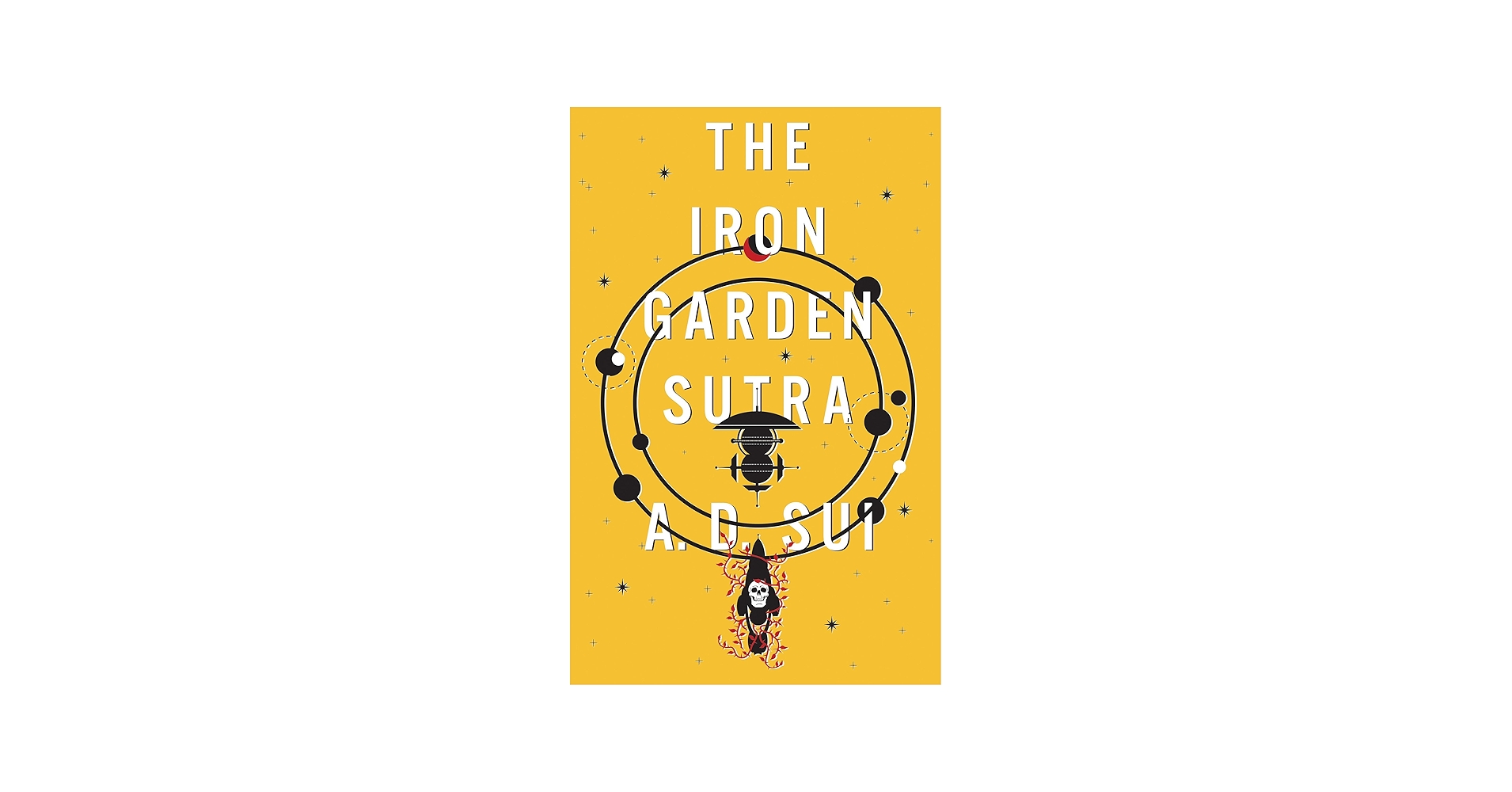
Jean-Paul L. Garnier interviews A.D. Sui
Jean-Paul L. Garnier: One theme of The Iron Garden Sutra concerns failed generation ships and the existential troubles they face during their journeys. I have read several books recently with similar takes on generation ships. Do you feel that this kind of story reflects a growing tension between generations in the real world and youth feeling that they have been dealt a bad hand by previous generations?
A.D. Sui: Generation ships are a long-standing tradition in sci-fi. What’s not alluring about packing up ourselves into a tin can and running off into the universe in search of greener pastures? But in my opinion, it’s also a very naïve take. Space is hostile. Space is hard. But there is a romanticism in cutting and running. Staying is, arguably, far more difficult.
I think every generation feels that pull of running away from their reality. Every generation can say that they have been dealt a bad hand. Millennials are economically disadvantaged because of policies enacted by Gen X and Boomers (and yes, have lived through three recessions now, but who’s counting?). Gen Xers felt they’ve been invisible all their lives. Boomers, I’m sure, felt disadvantaged in some way as well. Hard to imagine now, but one might. The generation before probably felt that they were unfairly thrust into a war that was only possible because of what the previous generation had done. And this is just the North American perspective. There are many more global conflicts, recessions, and other strains on each generation. We all want to run away, thinking that it will be better. To where? No one knows for sure, but somewhere that isn’t here.
Part of The Iron Garden Sutra’s theme is deciding when to stand your ground and fight for the things we believe in. Even if we are one person. Even if the outcome doesn’t look hopeful. Millennials are of the age when our financial decisions and our voting have the most impact. Some of us are even in positions of influence. Some are making decisions on scales that will impact the next generation (hi, Gen Z, and sorry). We can continue to bemoan the hand we’ve been dealt, or we can also work towards leaving things better for those who are coming after us. I, personally, am a huge fan of complaining while doing the thing.
It’s going to suck and it’s going to be a lot of work, sure, but we can leave a better world for those after us.
You’ve also created a religion in this novel, The Starlit. What did the process of creating a theology look like for you, and please tell us about the introduction of cosmology into the religion of peoples who have colonized the stars?
The Starlit is loosely based on Zen Buddhism. I have a very strong preference for non-monotheistic religions and like pondering where they can end up in thousands of years. What is the natural progression of something like Zen if it was supported into the future? What would its practitioners decide to keep and what would they discard? Because religion does change! Doctrine does change! It changes very slowly since religious institutions are massive and can’t afford to throw their entire weight around every other week, but it does change.
I think the introduction of cosmology is the natural transition, given how we commonly incorporate elements from our immediate environments into religious texts. Parting the Red Sea, trudging through deserts, and all that. If people are traversing between stars frequently, then star-like language would begin bleeding into texts.
The Iron Garden Sutra has multiple AI characters. Would you have written these characters differently had you written this book today?
I’ve been doing a lot of laughing/crying since the book has come out. You can guess why.
A very niche fury that I’m experiencing about GenAI is that it has taken a very well-established trope in sci-fi and made it into a real-life abomination. I’ve been hearing some discussions in the genre that we need a new name for this concept now because any time we even drop the term “AI,” readers begin to think that we support the existence of Grok.
In The Iron Garden Sutra, I have tried to move from the term “AI” and sometimes use “synthetic consciousness” because that’s really what I’m describing here. This is a fully-fledged individual that can act (mostly) autonomously, who has agency and drive, but isn’t born from organics. This isn’t Claude writing an email. This is something that is as much of a person as other characters in the novel.
If I were to write this book again, I’d change nothing. I think I would lean into the AI ethics component of the book even harder to hammer the point home that these characters are sentient and deserving of individual rights. The caveat is that if I were to rewrite it, it would take several years for the book to get published and by that point we’d all be fighting Boston Robotics dogs for access to fresh water, and no one would be reading anymore.
Two of the characters in this book share a body. What complications arose during writing characters that do not have complete bodily autonomy and must occupy the same internal space?
Two characters/one body is becoming a very popular trope in spec fiction!
This was, arguably, my favorite dynamic to write and explore. What kind of relationship can you have when one of you cannot act on the physical world without the other’s permission? How does a relationship develop when you have complete access to someone’s deepest, darkest thoughts?
There’s a balance of power between Iris and VIFAI (Iris’s AI companion/helper) and I think this allows them to have a true relationship and friendship, even if Iris doesn’t believe it at first. It’s the closest and most meaningful relationship Iris has had in his entire life, but it cannot stay pure from the fact that he *is* the container for VIFAI and the one supposedly “in charge”. Without spoiling anything, this does budge a bit throughout the book and Iris does come to a deeper understanding that VIFAI is not as helpless as Iris had believed it to be.
The name of the main spaceship in the story is the Counsel of Nicaea, which suggests a Christian theological bent, and is a great contrast to the Starlit and their worldview reminiscent of Buddhism and Hinduism. What were your aims in creating such a stark, yet subtle, contrast?
The contrast does exist, but it was not intentional!
The Buddhist worldview is the one I am most familiar with and preferred writing from that vantage point, and I must admit that the Christian theological bent was inspired by the generation ship in the ‘Expanse’ series, and the Nauvoo, which was commissioned by a group of Mormons who wanted to travel far past the Solar System. It made sense to me that a group of people united by intense faith would do well in long-term space travel. Although, as we see with the Nicaea, that might not always be the case.
Without spoilers, the main character has revelatory experiences leading him to contemplate the meaning of the void and the space between the stars. Can you elaborate on how you used spiritual growth and crisis of faith in your character arcs?
Oh, poor Iris.
I wanted him to be a reluctant monk. I wanted him to look right, wear the right clothing, say the right things, but I wanted him to think all the wrong ones. Well, what he believes to be wrong. I think there is a stereotype of monks being happy and peaceful at all times, but in reality, they are just people, experiencing the same existence we are, who also hold a specific job. Being a monk is a job, above all else, and people come to it for very different and personal reasons.
And I wanted Iris to grapple with how he related to the doctrine and his role as a monk. I wanted to push him towards an understanding of what holding the role of a Vessel meant to him. There is a term in Buddhism called a koan. It’s kind of like a riddle used to impart a teaching of some sort and it’s often posed by a teacher to their pupil. The goal is for the pupil to have a revelation, to “get” the koan. There is no single answer to a koan, but rather a feeling that comes when one understands it. It’s like that feeling you get when you’re learning to ride a bike and after stumbling and falling, and trying over and over again, suddenly, you catch your balance. Hard to describe, but once you have it, you have it.
The entire experience aboard the Nicaea is a koan for Iris, a question of his relationship with faith that only he can answer, and only towards the end.
There’s a sequel coming, The Starlight Samsara.. Can you tell us about when and what we can expect from the continued adventure?
The sequel should be coming sometime near the summer of 2027! You can expect some new faces in the cast, but also some favorites returning. While The Iron Garden Sutra touched on the notion of AI ethics, The Starlight Samsara takes a deeper dive into the topic. And finally, things do get better for Iris, but not before they get significantly worse.
A.D. SUI is a Ukrainian-born, internationally raised speculative writer, Nebula winner, and Aurora, and Theodore Sturgeon Memorial Award finalist. They are the author of The Dragonfly Gambit (2024), The Iron Garden Sutra (2026), and more than two dozen short stories. A failed academic and retired fencer, they spend most days wrangling their two dogs and tending to their myriads of tropical plants.
You can find them on most social media platforms as @thesuiway and https://thesuiway.ca/
Jean-Paul L. Garnier is the owner of Space Cowboy Books bookstore and publishing house, producer of Simultaneous Times Podcast (2023/25 Laureate Award Winner, 2024 BSFA, Ignyte, and British Fantasy Award Finalist), and was the editor of the SFPA’s Star*Line magazine from 2021-2025. He is also Editor-in-Chief of Electronic Brain magazine. In 2024 he won the Laureate Award for Best Editor. He has written many books of poetry and science fiction. https://spacecowboybooks.com/
Categories: Industry News
2026 Wellman Award Finalists
The North Carolina Speculative Fiction Foundation (NCSFF) has announced the finalists for the 2026 Manly Wade Wellman Award. The award recognizes outstanding achievement in science fiction and fantasy novels written by North Carolina authors.
- The Unseen, Ania Ahlborn (Gallery)
- Last Chance Live!, Helena Haywoode Henry (Nancy Paulsen)
- Infinite Archive, Mur Lafferty (Ace)
- Transmentation: Transience, Darkly Lem (Blackstone)
- The Coming Dark, D.J. Molles (published by the author)
- Labyrinth, A.G. …Read More
The post 2026 Wellman Award Finalists appeared first on Locus.
Categories: Industry News, Industry News Home
S&S Relaunches Pocket Books
Simon & Schuster has announced that Atria Gallery Group will relaunch the Pocket Books imprint as a core romance imprint that will also publish additional genres including romantic thrillers, dark romance, and horror. Anh Schluep, who is joining Atria Gallery, will be vice president, editorial director, and deputy publisher of Pocket Books. Schluep said,
I'm excited to be bringing back Pocket Books. The imprint, which published its first list in …Read More
The post S&S Relaunches Pocket Books appeared first on Locus.
Categories: Industry News, Industry News Home
2026 CSFFA Hall of Fame Inductees
The Canadian Science Fiction & Fantasy Association (CSFFA) announced three inductees to the Canadian Science Fiction and Fantasy Hall of Fame for 2026: author Kelley Armstrong, author James Alan Gardner, and past president of Fanzine Writers of America Mike Glicksohn.
This year's jury included David Clink (chair), JM Landels, Y.M. Pang, Clifford Samuels, and Edo van Belkom.
For more information, see the CSFFA website. …Read More
The post 2026 CSFFA Hall of Fame Inductees appeared first on Locus.
Categories: Industry News, Industry News Home
Press Release – June 30, 2026
Looking Back and Moving Forward
Dear writer,
We’ve had an incredible year at SFWA. We charted new Constellations and visited a Quasar on our professional journey to the latest Nebulas. Together, we expanded our orbit, welcomed new travelers, and built momentum that will carry us toward our next horizon.
Yet, we can’t move forward without looking back. This year, we lost Past President Jane Yolen. A Grand Master, storyteller, and tireless advocate for writers, she inspired a generation of writers (like me!) to keep writing, creating, and, most importantly, imagining. Her legacy lives on, not just in the stories and poems she wrote, but in the community she helped shape. In the months and years ahead, we will continue to honor Jane by celebrating her work and carrying forward the spirit of generosity that defines her legacy. (or defined her life?)
Our community was joined this year by Executive Director Isis Asare. During her tenure, SFWA reached new audiences, launched ambitious initiatives, strengthened current programming, and became decidedly and emphatically more human. As Isis concludes her time at SFWA, we are deeply grateful for her collaborative leadership and supportive vision of what our community can and should be. We will miss her steady hand, but we also know that her next chapter will continue to shape the future of our genre. We will be cheering her on for years to come. You can follow along with Isis’ journey here.
As one chapter closes, another begins. At this year’s Nebulas, we welcomed N. K. Jemisin as SFWA’s newest Grand Master, celebrating her groundbreaking and world-shaking contributions to speculative fiction. In her acceptance speech (which literally lit the room on fire), she reminded us of the collective power and possibility of our community: “We should revel in our growth, fellow writers. And as we grow, we can make the world better, too.” That spirit has always been the gravity that holds SFWA’s constellation together. We are a community of creators who challenge the boundaries of what is possible, and build, build, build the future we want to see (revising all along the way).
This August, at Worldcon, we’ll continue that tradition by honoring our next Grand Master, another writer whose work has expanded our universe and strengthened our community. I can’t wait to introduce you to the next star in our bright sky.
The future of our genre has never been built by one writer, one organizer, or one creator. It is shaped by the networks, community, uplift, and care that help us keep creating. After all, a constellation is only as bright as all of the stars reflecting light within it. With that in mind, this summer, SFWA is opening new opportunities and strengthening pathways for care and connection with the launch of our Writers in Crisis Grant on August 1 and the opening of our Givers Fund Grant on September 15.
These programs are a promise to our community in a time of change: when you are struggling or facing moments of uncertainty, and when you are ready to build something bigger and better than what was there before, SFWA will be there for you with practical support, a helping hand, and a big reminder that none of us has to go it alone. As Jemisin reminded us, we can combine our powers, and as Grand Master Nicola Griffith told us in her 2025 speech, “No one does this alone.” Together, we can care for one another as we reach for the stars and build the future we want to see (with magic, science, sorcery, monsters and miracles). There is always more on the next horizon.
Speaking of which, Singularity returns next Tuesday, with new Recommended Reading List features and new pro-human guidance from our Emerging Tech committee, along with updates from other great teams, SFWA members, and industry peers. If you are an active SFWA member, you can also join Emerging Tech for an introductory session this July 5 at 8 a.m. PDT (or review the panel on our new SFWA Events Theater at your leisure later).
The universe of SFWA is still expanding. As we continue this journey together (always), we want you to know this: wherever you are at in your writing, in the world, or with whatever challenges you are facing, SFWA is here for you because of you.
So, keep creating,
Kate Ristau
SFWA Board President
The post Press Release – June 30, 2026 appeared first on SFWA - The Science Fiction & Fantasy Writers Association.
Categories: Industry News, Industry News Home
Rewriting the Empire: Lessons from South Asian Speculative Fiction
by Aashima Rawal
Read by Liz J. BradleyA child stands before a Bright Door carved into the cracked walls of a city that always braces for impact. Police lines shimmer like heat across streets split by old debts. On one side, jinn watch with quiet, tired defiance. On the other, a clerk posts notices about vanished neighborhoods. Beyond the threshold, the architecture folds in on itself and reforms, as if memory is the only true map. In Vajra Chandrasekera’s The Saint of Bright Doors, borders are drawn not with ink but with ghosts. The empire collapses again, but this time in the imagination of someone who refuses to accept the old version of the story.
Bright Door. Photo by Tekeshwar Singh on Unsplash.Speculative fiction from former colonies often doesn’t prioritize spectacle. Its urgency lies elsewhere. These stories rebuild what history tried to erase. They confront the past without allowing it to dictate the ending. In the hands of a growing group of South Asian writers, the project becomes something quieter and far more ambitious: a way of restoring dignity to the record.
Decolonial speculative fiction has gained traction over the years, but it has recently become hard to ignore. Chandrasekera’s Rakesfall won the 2025 Ursula K. Le Guin Prize for Fiction for its ability to connect hope to the aftershocks of colonial violence. Writers like Premee Mohamed and Sami Shah consistently appear on the Nebula, Locus, and Le Guin Prize lists. Their work is recognized not for niche appeal but for expanding the emotional reach of the field. Many describe their stories as a form of repair—a conversation with parts of history that were rushed or redacted. Their rise also reveals familiar tensions like the so-called Tiffany Problem, where historically accurate names or customs in non-Western settings are deemed “incorrect” simply because they fall outside Eurocentric expectations. This serves as a reminder that imagination also has borders, and someone has to redraw them.
Rewriting the empire on the page isn’t just a matter of rearranging events. It involves method. How do you acknowledge wounds without reopening them? How do you write about power clearly instead of imitating it? The stories in the anthology The Djinn Falls in Love and Other Stories offer one approach. Jinn are not depicted as curiosities or exotic ornaments. They are figures carrying memory, burden, and rebellion. In Kamila Shamsie’s contribution, jinn move through domestic and communal spaces rather than distant myth, grounding the supernatural in the everyday aftermath of loss. Amal el-Mohtar’s story similarly resists spectacle, using lyric restraint and intimate perspective to explore longing and fracture instead of grand conflict. In both cases, folklore becomes a vehicle for emotional complexity rather than a simplified symbol.
Premee Mohamed has discussed drawing on scientific research, including climate science, in her speculative fiction, while still foregrounding community, character, and emotional stakes. Tasha Suri has said that the world of Empire of Sand was heavily inspired by the Mughal Empire and that she drew on the culture and politics of Mughal India before deliberately diverging from historical context to meet the needs of the plot. Critics describe the future Tel Aviv and Jaffa setting of Central Station as a liminal, layered border city and hub of cultural exchange, where multiple histories, faiths, and communities intersect in everyday life rather than through explicit political exposition. Taken together, these examples suggest a model of ethical alt-history rooted in attention and care rather than entitlement to historical material.
To rewrite an empire is to ask what might have happened if the world had been kinder, and then to sit with the knowledge that it wasn’t. It is both an act of mourning and imagination. Sami Shah’s “Reap” takes this to its limits. Partition, the 1947 division of British India into India and Pakistan, triggered mass displacement and violence that still shapes family memory across the region. In Shah’s story, the jinn bear witness to what people cannot bear to name, moving through the aftermath with a steadiness that feels like endurance. The story unsettles because it will not allow easy distance. Mohamed explores this same instinct in her essays: the inheritance of grief and the responsibility to transform it into something usable. This image recalls textile traditions like khadi and kantha, the way one carries the mark of the hand, while the other layers scraps of past lives into a single surface. Memory, in both cloth and story, rarely follows a straight line. It accumulates.
Kantha embroidery. Image by Nancy Kassim Farran from Pixabay.For writers, this shift in speculative fiction is not a trend but a change in approach. It calls for slower reflection. It calls for empathy instead of spectacle. Recent Planetside craft columns state it clearly: use archives, not assumptions; write with history, not over it; let care shape the revision. The goal is not to tidy up the past but to listen to it. This might involve returning to primary documents, noting who is missing from official maps, or paying attention to rituals that continue to hold stories long after the paperwork has disappeared.
Each time a writer reimagines the empire, the world gains another map—one that accepts complexity, sorrow, and resilience. In Chandrasekera’s city of Bright Doors, no border is permanent. Streets erased by policy can be brought back into existence by memory alone. South Asian speculative fiction takes this possibility seriously. It offers a way to write with both accuracy and humanity, treating history not as a fixed monument but as something still capable of change.
Explore more articles from Writing from History
Aashima Rawal is a freelance writer with bylines in Art UK, Monograph, Hearth Magazine, Modest, and Business Insider. She writes about the intersections of storytelling, history, and culture, blending research with an accessible, reflective style. Her work often explores how memory, craft, and imagination shape the worlds we inherit and the ones we build.
The post Rewriting the Empire: Lessons from South Asian Speculative Fiction appeared first on SFWA - The Science Fiction & Fantasy Writers Association.
Categories: Industry News, Industry News Home
Starlog Magazine to Relaunch with Podcast
Starlog, the magazine devoted to visionary sci-fi and cutting-edge science, has announced its return to print for November 13, 2026. The magazine will be published annually; there will also be a weekly email newsletter, Lodestar.
Annalee Newitz will serve as editor-in-chief, with Meredith Borders as senior editor and Jason Kauzlarich as senior art director. In a podcast episode announcing the relaunch, Newitz described the goals of the print issue:
The post Starlog Magazine to Relaunch with Podcast appeared first on Locus.
Categories: Industry News, Industry News Home
2026 Le Guin Prize for Fiction Shortlist
The Ursula K. Le Guin Literary Trust has announced the shortlist for the Ursula K. Le Guin Prize for Fiction, awarding a $25,000 cash prize to the author of a book that reflects the concepts and ideas that were central to Ursula's own work.
The nine shortlisted titles are:
- Audition, Pip Adam (Coffee House)
- Sunward, William Alexander (Saga)
- Call and Response,Christopher Caldwell (Neon Hemlock)
- Midnight Timetable, Bora Chung, …Read More
The post 2026 Le Guin Prize for Fiction Shortlist appeared first on Locus.
Categories: Industry News, Industry News Home
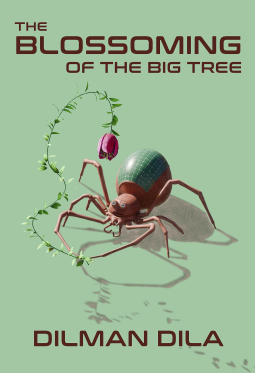
No One at the Centre: Reading Dilman Dila’s The Blossoming of the Big Tree
By Kemi Cole
Adita does not want to lead anything. She is seventy years old, she would rather pedal a solar tractor across an acre than borrow a battery from a neighbour, and she has spent her life arranging her existence so that other people leave her alone. However, the system she lives under has other ideas.
Yat Madit, the political system Dilman Dila imagines in his novella The Blossoming of the Big Tree, distributes power so thoroughly that there is nowhere to hide from it. Dila has also written an essay tracing the precolonial Acholi governance structures that inspired this world, grounding the fiction in historical and political argument. This is the beating heart of the book, and also its best joke. Adita becomes the central figure of a narrative about a system explicitly built to have no central figures. The irony is precise and it does not soften.
What makes Adita remarkable is not that she changes. She does not. She remains uncomfortable in her own skin, hostile to touch, resistant to the idea that her interiority should be understood by anyone else. Dila never asks her to overcome this. The narrative does not cure her through the pressure of events or through a relationship. Instead, her introversion becomes the actual mechanism by which Yat Madit functions at scale. A leader who wants nothing consolidates nothing. A leader who retreats cannot become a tyrant. The political argument and the character are the same thing. That is what makes her work.
The world Dila builds around her is grounded and specific. Kampala is Kampala. Villages have names. Solar panels are made from a paste of leaves and algae. Governance runs on consensus down to the smallest communal decision. Dila embeds Acholi concepts into the narrative without translation. He is writing as if Uganda is the centre of the world, not a location that requires outsider comprehension. That act of centering is political. What is unusual is not the centering itself, which is a defining feature of Africanfuturism, but the depth and specificity of the political system he builds from precolonial Acholi structures, and his refusal to simplify it.
When war arrives, Adita must navigate the central paradox of Yat Madit: how do you mount a defence in a system explicitly built to reject centralised command? A federation of hundreds of villages cannot coordinate quickly enough through pure consensus. The problem emerges early. As someone says in frustration: “Really? An idea to defeat the mighty army of USA? You?” The question is not cruel. It is structural. Dila is naming what his system cannot do. In response, they create a War Council of twelve people to speed up decision-making, but that very act risks betraying the founding principle that power should not concentrate. The danger, as Dila makes clear, is that such small numbers could lead to centralism, to a few people making decisions that affect everyone. They have created the thing they feared most in order to survive.
In face of this massive threat of war, solutions seem to arrive faster than the reader can absorb them. A spaceship appears. Technology embedded with living jok code, a form of sentient programming rooted in Acholi spiritual tradition rather than Western computing logic, is deployed. A satellite is accessed. Because so much depends on mechanisms the narrative never fully clarifies, the resolution feels contingent in ways that might be intentional but are also difficult to settle into.
Lokang, who should be the most complex figure in the novella, sits at the centre of this problem. En, the pronoun used for Lokang, is not a god. En is not quite human. En designed much of Yat Madit and then withdrew from public life, quietly innovating for decades. The novella never gives the reader enough to know what en actually is beyond those outlines. This means Lokang cannot quite carry the weight the final movement of the story needs from en. Dila seems aware of this and does not try to solve it by making Lokang less opaque. It is a choice, but it costs something in the narrative and might leave a reader wanting more.
What is not in question is the seriousness of what Dila is attempting. He is not interested in the aesthetics of Africanfuturism. He is interested in whether a society built on consensus can survive the demand for speed that crisis requires, whether precolonial political structures powered by contemporary technology could actually function, whether you can write about power without making power the story. These are genuine questions and the kind that speculative fiction is uniquely positioned to ask, using narrative to stress-test political ideas that policy cannot yet imagine.
In the aftermath, the federation does not solidify into a new order. Power begins to reconcentrate around those who used it well during the crisis. The system’s founding commitments are already being tested. Adita is alone. The tree, in Acholi tradition the meeting place where the village gathers, remains. The conversation never ends. That is not a triumphant ending. It is an honest one. It is the kind of ending that makes you want to argue with the book, which is exactly what Dila has built it to do.
The Blossoming of the Big Tree is a genuinely absorbing read, funny and serious in equal measure, and Adita is one of the most quietly original protagonists I have encountered in the genre in some time.
Categories: Industry News
No One at the Centre: Reading Dilman Dila’s The Blossoming of the Big Tree
By Kemi Cole
Adita does not want to lead anything. She is seventy years old, she would rather pedal a solar tractor across an acre than borrow a battery from a neighbour, and she has spent her life arranging her existence so that other people leave her alone. However, the system she lives under has other ideas.
Yat Madit, the political system Dilman Dila imagines in his novella The Blossoming of the Big Tree, distributes power so thoroughly that there is nowhere to hide from it. Dila has also written an essay tracing the precolonial Acholi governance structures that inspired this world, grounding the fiction in historical and political argument. This is the beating heart of the book, and also its best joke. Adita becomes the central figure of a narrative about a system explicitly built to have no central figures. The irony is precise and it does not soften.
What makes Adita remarkable is not that she changes. She does not. She remains uncomfortable in her own skin, hostile to touch, resistant to the idea that her interiority should be understood by anyone else. Dila never asks her to overcome this. The narrative does not cure her through the pressure of events or through a relationship. Instead, her introversion becomes the actual mechanism by which Yat Madit functions at scale. A leader who wants nothing consolidates nothing. A leader who retreats cannot become a tyrant. The political argument and the character are the same thing. That is what makes her work.
The world Dila builds around her is grounded and specific. Kampala is Kampala. Villages have names. Solar panels are made from a paste of leaves and algae. Governance runs on consensus down to the smallest communal decision. Dila embeds Acholi concepts into the narrative without translation. He is writing as if Uganda is the centre of the world, not a location that requires outsider comprehension. That act of centering is political. What is unusual is not the centering itself, which is a defining feature of Africanfuturism, but the depth and specificity of the political system he builds from precolonial Acholi structures, and his refusal to simplify it.
When war arrives, Adita must navigate the central paradox of Yat Madit: how do you mount a defence in a system explicitly built to reject centralised command? A federation of hundreds of villages cannot coordinate quickly enough through pure consensus. The problem emerges early. As someone says in frustration: “Really? An idea to defeat the mighty army of USA? You?” The question is not cruel. It is structural. Dila is naming what his system cannot do. In response, they create a War Council of twelve people to speed up decision-making, but that very act risks betraying the founding principle that power should not concentrate. The danger, as Dila makes clear, is that such small numbers could lead to centralism, to a few people making decisions that affect everyone. They have created the thing they feared most in order to survive.
In face of this massive threat of war, solutions seem to arrive faster than the reader can absorb them. A spaceship appears. Technology embedded with living jok code, a form of sentient programming rooted in Acholi spiritual tradition rather than Western computing logic, is deployed. A satellite is accessed. Because so much depends on mechanisms the narrative never fully clarifies, the resolution feels contingent in ways that might be intentional but are also difficult to settle into.
Lokang, who should be the most complex figure in the novella, sits at the centre of this problem. En, the pronoun used for Lokang, is not a god. En is not quite human. En designed much of Yat Madit and then withdrew from public life, quietly innovating for decades. The novella never gives the reader enough to know what en actually is beyond those outlines. This means Lokang cannot quite carry the weight the final movement of the story needs from en. Dila seems aware of this and does not try to solve it by making Lokang less opaque. It is a choice, but it costs something in the narrative and might leave a reader wanting more.
What is not in question is the seriousness of what Dila is attempting. He is not interested in the aesthetics of Africanfuturism. He is interested in whether a society built on consensus can survive the demand for speed that crisis requires, whether precolonial political structures powered by contemporary technology could actually function, whether you can write about power without making power the story. These are genuine questions and the kind that speculative fiction is uniquely positioned to ask, using narrative to stress-test political ideas that policy cannot yet imagine.
In the aftermath, the federation does not solidify into a new order. Power begins to reconcentrate around those who used it well during the crisis. The system’s founding commitments are already being tested. Adita is alone. The tree, in Acholi tradition the meeting place where the village gathers, remains. The conversation never ends. That is not a triumphant ending. It is an honest one. It is the kind of ending that makes you want to argue with the book, which is exactly what Dila has built it to do.
The Blossoming of the Big Tree is a genuinely absorbing read, funny and serious in equal measure, and Adita is one of the most quietly original protagonists I have encountered in the genre in some time.
Categories: Industry News
How Neuroscience Reveals the Alien Mind
by C. L. Kagmi
Read by Tobias LokassonThe goal of science fiction is to expand our horizons. The genre asks not only what is, but what might be. What might life be like in a time or place we haven’t seen yet? How might alien minds be different from our own?
These investigations start, like all literature, with studying our own experiences. Then, some of us ask: What if our senses, our social structures, our emotions were different?
Neuroscience can help answer that question. By revealing the building blocks of our own perception in the concrete forms of genes, proteins, and neurons, it gives us authors new toys to play with.
Sensory PerceptionDid your aliens grow up in a place with a different spectrum of light? Is their sun a different type of star, or did they evolve in the black depths of an alien sea? Maybe their eyes need different photoreceptors from our own. They’ll see different colors or perhaps substitute vision with some completely different sense.
Which sensory perceptions mean home, safety, and love to them? Which mean danger, fear, and rejection? Are they warm-blooded social creatures for whom warmth, softness, and touch are the language of intimacy? Or does their biology fear heat and embrace solitude as the surest form of safety? Do they read some form of long-distance communication as the language of love and solidarity instead?
Many of us learned in school that we have five senses: sight, smell, hearing, touch, and taste. Science has revealed that we actually perceive much more than that: temperature, balance, pain, chemical communication, proprioception, magnetoreception, and intuitions from a whole-body neural network that processes information outside of the brain. We now know that chemical communication and magnetoreception are major parts of the sensory world of some species on Earth, and that “gut feelings” in humans are not just a figure of speech. How many frontiers does that open?
Worldbuilding QuestionsWhen crafting an alien viewpoint character, there are two major questions to ask:
- How might their physical sense organs be different from ours? If their sun is of a different star type, does it make sense for them to have evolved different photoreceptors? Will there be colors, types of electromagnetic radiation, they can see that we can’t? How might temperatures, energies, and pigments that are invisible to one species but not another become a plot point? How might it affect their daily relationships to know they literally do not see the world in the same way?
- How do they feel about these sensations? Our emotional and sensory associations with colors are shaped by Earth. The calming blues of clear skies and still water, the soothing greens of plant life in daylight, the warm yellow of the sun, the excitement and danger of red blood. How might another species whose sun, sky, blood, or plant life are different colors feel about our world? On the other hand, how might we feel about theirs?
Consider life around a Class K star. These are more common than our own sun’s type, and scientists believe they may host life. This means many aliens may grow up around them. These stars are cooler, producing more light we would think of as red and less of the light we would perceive as blue or green.
Would it make sense for their children to see into the infrared range or to lack receptors for the color blue? Would they have finer distinction in the red part of the spectrum, perceiving multiple primary colors in shades that look nearly identical to us? Would they pity us for our inability to appreciate the finer points of their art, while a Monet canvas might appear black and white to them?
How would such a species feel about the colors they do see? Do they have red iron blood, like most Earth animals, or blue copper or green blood like a few? Would they associate the color of their hemoglobin with excitement and danger, or would it be the absence of red light found in hemocyanin or biliverdin that speaks of spilled blood?
An ExampleLet’s try something a little more alien. What if a sense that is minor in our experience is conscious and major for our aliens? What would a technological species that relies on chemical communication look like? This species could communicate in ways others can’t, using messages carried in air or water currents. But how do they feel about telecommunications that can’t transmit pheromones?
I play with this question in the design of my own aquatic species, discussed in my short story “Hostess.”
“The taste of Draco cannot be described,” she says, suddenly. Her eyes finally leave my face and stray to the sea. “It is—was—like any underwater ecosystem, swimming with pheromones and gametes and waste products, but much more intense. Much more varied—the flavors of a given reef much more subtle.
“Our people coded messages in carbon chains, memories and mating calls, interesting observations, art pieces designed to elicit emotion, requests for and offers of help. I’m sure you’ve read about it, how our entire ocean, our entire world, was effectively a massive brain. Our ocean thought, knew, experienced, expected. Our World-Minds speculated about life around other stars before you came, you know.”
Learn to Stretch Your HorizonsAt first glance, breaking experience down into its mechanical parts, its genes and proteins and neurons, might sound clinical. But human experience arises from our proteins. When seeking to stretch our horizons beyond what we know, looking at what we do know and then breaking it can be very instructive.
We often forget how much we share with all life on Earth: common ancestors, a common genetic code, a shared environment for billions of years. We can’t be sure what alien life is like with a sample size of one world. But we can study the hardware that creates our own experiences and ask, “Would this be the same if it evolved somewhere else?”
The experiences, emotions, meanings, and relationships these mechanisms create, that is the domain of science fiction.
Explore more articles from Writing from Science
C. L. Kagmi earned her B.S. in neuroscience from the University of Michigan in 2011. She worked in clinical research at Mott Children’s Hospital for five years before leaving to start her writing business. Her writings have appeared in Analog Science Fiction & Fact, Writers of the Future Vol. 33, and Compelling Science Fiction: The First Collection.
The post How Neuroscience Reveals the Alien Mind appeared first on SFWA - The Science Fiction & Fantasy Writers Association.
Categories: Industry News, Industry News Home
Jean-Paul L. Garnier interviews James Machell
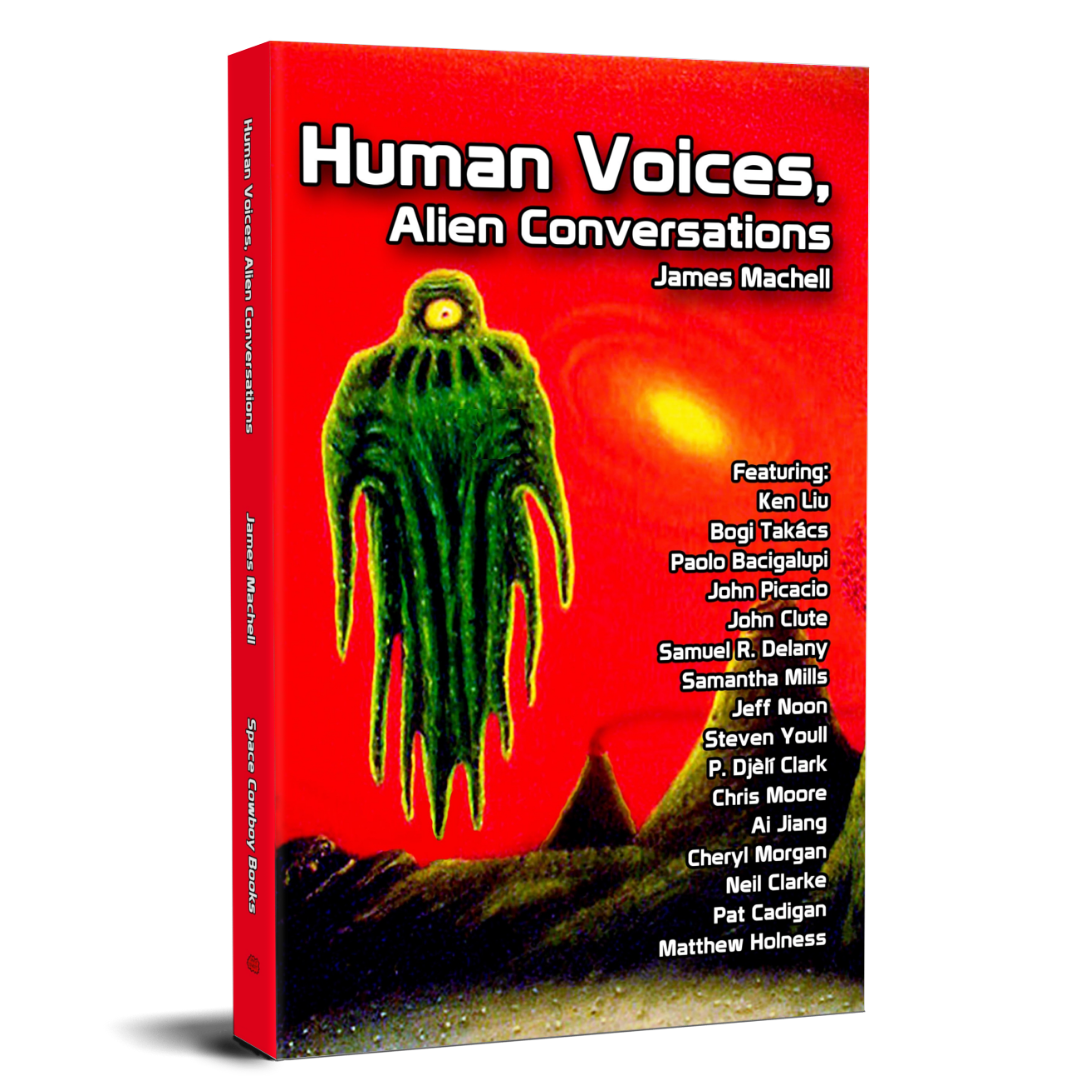
Jean-Paul L. Garnier: What inspired you to conduct the series of interviews in Human Voices, Alien Conversations, and how do you go about selecting interviewees?
James Machell: Several of the interviews had appeared in Utopia Science Fiction Magazine and Electronic Brain. What I wanted to do with Human Voices, Alien Conversations was pull them together into one narrative, and additional interviews were conducted to fill what I perceived to be the gaps in the collection as an overview of SF in the 21st Century. In order to show this with a bird’s eye, I couldn’t just focus on writing when there’s art, editing, performance, and adaptation. I also wanted to explore understated significance. Samuel R. Delany, for example, is nowhere near as well known as Andy Weir, but his influence, even at the time of composing his major works, has been much more profound. Similarly, Chris Moore, with his prog-rock styled art for the SF Masterworks Series, created some of the most recognisable images in the history of SF but did so quietly, never chasing awards or drawing attention to himself: he let his art speak. Cyberpunk, almost exclusively associated with William Gibson, was developed by a “team” of writers in the ‘80s: I thought it would be much more interesting to speak with Pat Cadigan, who is frequently dubbed the “queen” of the subgenre. But I couldn’t just focus on the legends when their contributions to SF are constantly evolving through their influence on younger writers. Interviewees, therefore, vary greatly in age, juxtaposing the perspectives of those blossoming into the SF landscape with those who loosened the soil. Bogi Takács, Samantha Mills, and Ai Jiang, also included in Human Voices, Alien Conversations, are writers we should be looking out for. The final interview is with Matthew Holness, co-writer, co-director, and star of Garth Marenghi’s Darkplace, which gets my vote as the most underappreciated use of SF in visual media. As Holness is now working on the third in a series of spin-off novels, he was ideal to pull everything together.
JPG: How do you go about researching your subjects in preparation for interviews?
JM: Most of the interviewees were selected because I’d been enjoying their work for years. The questions came easily. The Internet Speculative Fiction Database and The Encyclopedia of Science Fiction, however, were excellent resources for pinning down dates and discovering aspects of their careers which may have eluded even the most die-hard fan.
JPG: What do you see as some of the main concerns and themes in early 21st Century science fiction?
JM: I might cheat here and offer two answers because I think the answer differs based on whether we’re talking about long or short form SF. With novels, the main concerns are harder to pinpoint, in major Western ones of this century, including M. John Harrison’s Light, China Mieville’s Perdido Street Station, Paolo Bacigalupi’s The Windup Girl, Ann Leckie’s Ancillary Justice, N. K. Jemisin’s The Fifth Season, Arkady Martine’s A Memory Called Empire, and Jeff VanderMeer’s Annihilation. These books deal with the climate, colonisation, technology (developing with unprecedented strangeness), and the uncanny, but none of this is new. I think concerns may have shifted but the passions of the writer and tastes of the reader have roughly been continuous since the ‘60s. There’s a reason the Modernist period lasted all of forty years and the postmodern sees no sign of ending. Naturally, we live on a different planet now, but I don’t believe the cognitive shift from Donald Trump’s presidency or the rise of AI has been as profound as the First World War or Civil Rights Movement, at least among readers. Characters were having conversations with their automatic computers in the ‘50s and we can go all the way back to Sinclair Lewis’s 1935 dystopia, It Can’t Happen Here, for premonitions of Trumpism.
The underlying revolution in 21st century SF is the shift in emphasis from sexuality to gender. Ellen Datlow waved goodbye to the 20th with her anthologies, Alien Sex and Off Limits: Tales of Alien Sex, perhaps the last time to shock an audience who would become mentally hardened by the internet. Some of the most striking stories to emerge during the last five years include Blue Neustifter’s “Unknown Number” which is told through a series of texts between a transgender woman and an alternate universe version of herself in which she didn’t physically transition, and Samantha Mills’ “Rabbit Test,” which contrasts the future of invasive procedures on women’s bodies with the history of abortion and pregnancy tests. In both cases, the author is examining the self of their protagonists in correlation to the world around them. This is a far cry from H. P. Lovecraft, Harlan Ellison, or Clive Barker menacing their readers with abominations. The notion of the self is evolving and magazines, with a small but dedicated audience, provide a space for writers to explore this in different settings. Enormous strides have been made in the last 26 years regarding the understanding of gender fluidity and trans* identity. “What does it mean to be a woman?” is a question posed and answered since at least Simone de Beauvoir. My prediction for the next quarter of this century is that we’ll see further examinations of masculinity. Louis Theroux’s recent documentary on the “manosphere” has highlighted the prevalence of toxic manhood being marketed to young people. SF writers from the targeted age group will no doubt reflect on the so-called “red pill” philosophy and what it means to be a man in the mid-21st century.
JPG: In your introductions and interviews, authors such as J. G. Ballard and Thomas Pynchon are regularly referenced. What is your attraction to these difficult, genre-defying works?
JM: My attraction stems largely from seeing myself in their work. As much as I enjoy Leo Tolstoy’s Anna Karenina, I am less passionate about aristocrats discovering the joy of “simple living” as characters feeling anxious and being right to do so. J. G. Ballard’s Crash is a photorealistic portrait of evil. Here, he examines a dystopian gang of car crash fetishists. Now, I’ve never been turned on by a car (I can’t even drive) but this aligns with my experience of real-world villains. They are weird, which is also to say, unpredictable. (One of the themes I’d like to explore more in my own writing is the exhaustion of constantly having to figure out the thought process and motivations of those who’d cut off their own finger to rob a stranger of their hand.) With Pynchon, this applies as well, but he delves deeper (partly because his works tend to be much longer) into the propulsion that stems from threat. His characters are rarely still; they search for peace, but their loud worlds have been shaken. At the risk of sounding gloomy here, I’ll add that I also find myself in Charles Dickens and D. H. Lawrence, but there’s even less to be said about these authors in 2026.
Part of the reason for Ballard and Pynchon coming up in Human Voices, Alien Conversations is that the interviewees tend to share a passion for them. Several list a Ballard novel among their favourite works of SF. This isn’t a coincidence. The likes of Jeff Noon will have found the same things to enjoy in Ballard as I have in his Vurt Series. The other writers that come up most frequently in my writing include Alfred Bester, Theodore Sturgeon, and Samuel R. Delany. In Human Voices, Alien Conversations, Delany lists Bester and Sturgeon as the writers of his favourite SF novels. You can find his key mainstream influences in there as well.
JPG: What do you think are some of today’s biggest differences in science fiction coming from the UK and US?
JM: The central difference, to my mind, between British and American writers, is their self-consciousness as writers of genre fiction. This, in the UK, goes back to Olaf Stapledon, David Lindsay, C. S. Lewis, and G. K. Chesterton, who were writing novels about other planets and the future, but I doubt “science fiction” was a term often used. They were writing allegories and warnings. Edgar Rice Burroughs and E. E. “Doc” Smith, however, were firmly aware of their roots in pulp, brazenly (and gloriously) escapist. This trend extends beyond the Golden Age. Compare J. G. Ballard’s grey dystopias with Philip K. Dick’s plastic realities. One seems to follow Kafka’s route into the speculative, while the other invigorates SF canon tropes. Kazuo Ishiguro’s Never Let Me Go, China Mieville’s The City & The City, and David Mitchell’s Cloud Atlas are among the most loved contemporary works of British SF, but none of these revel in their speculative setting. John Scalzi’s Old Man’s War, however, is a novel that could only be written by an American. (There are, of course, exceptions to this rule, Michael Moorcock being a prime example of a writer who managed to fuse a British and American way of thinking.)
JPG: You are also a writer for The Encyclopedia of Science Fiction. How did that come about, and how has writing for the encyclopedia affected your approach to interviewing SF writers, editors, and artists?
JM: This actually came about after an interview.
I had been reading The Encyclopedia of Science Fiction since I was a student and as someone who now writes about SF, the SFE is an inescapable reference work. It’s not just useful as a source of information, but opinion. You’ll see in Pat Cadigan’s Human Voices, Alien Conversations interview that she has a very interesting response to the SFE’s take on her career. As John Clute (its co-editor with David Langford) has supplied a Brobdingnagian number of entries, I thought he would be an interesting person to interview for Utopia Science Fiction Magazine. We carried on talking and following some of my own entries, we met in person. The one featured in Human Voices, Alien Conversations was our second, and was conducted at his dining table while I anxiously ensured that my phone was still recording. I’m still impressed by the speed with which he was able to formulate opinions, and it explains how he came to publish more words than perhaps any other critic. We’ve since started an SFE Substack, which currently features essays by John, me, and Gary Westfahl, but we’re open to new contributors. Topics thus far have included Brexit, The Wind and the Willows, Gormenghast, and autism as a product of human evolution.
In terms of influencing my interviewing technique, it’s shown me that non-fiction can be both informative and challenging. Dr. Simon Malpas, who is a senior lecturer at The University of Edinburgh, said quite a few nice things about Human Voices, Alien Conversations, but the one I most appreciated was that it is “occasionally provocative.” I think the same could be said of the SFE in that it gives a balanced view of quality and in contrast to Wikipedia, isn’t afraid to make debatable assertions about SF history. It does, however, get some disgruntled emails, predominantly from insecure authors, which I see as a sign of doing something right.
JPG: Can you share your thoughts on the interview as an artform and its role in genre fiction?
JM: Alfred Bester (better known for The Demolished Man and The Stars My Destination) is a great example of an interviewer who turned conversations into art. “Woody [Allen] isn’t a funny man in real life,” he writes in an introduction. He makes his own presence felt so that the reader doesn’t perceive questions as appearing from dark corners, nor is the interviewee professing their responses like an influencer with a smartphone. I particularly enjoyed his exchange with Isaac Asimov because, although the focus was on the Foundation author, there was a real sense of being in a room with two characters. The best interviews tell a story. Of course, they’re opportunities for interviewees to promote their work, but they’re also vehicles of discovery as to how they got there. And you make that discovery through the lens of the interviewer. This is why Human Voices, Alien Conversations opens autobiographically, giving the reader a sense of who I am and how I came to be posing questions. In terms of the role it plays in genre fiction, I think it serves the same role as it does in the literary sphere: consumers of art want to feel a connection with the artist. I wonder if The Beatles would have achieved half their success if they recorded anonymously, never appeared on an album cover, and never advertised the personality in their music.
JPG: Do you have any advice for interviewers and non-fiction genre adjacent writers?
JM: The big thing I learned from Human Voices, Alien Conversations is to think of SF as something that’s happening now rather than the current period as a link in a chain that goes back to Mary Shelley. When thinking of SF editors, the first ones that come to mind are Hugo Gernsback, August Derleth, John W. Campbell, Isaac Asimov, Robert Silverberg, and Michael Moorcock, all prolific authors themselves. When I asked Neil Clarke about why his focus was on editing rather than writing, his response was that it wasn’t unusual, giving Ellen Datlow and Jonathan Strahan as examples. Had I been thinking more in 21st Century terms, Clarke would not have struck me as unique, as while there are many contemporary editors who write their own fiction, I can think of about as many who don’t. It is a question, however, that I chose to keep in, anticipating that many readers of the collection may also approach SF with a similar mindset.
Secondly, I’d advise newer non-fiction writers to diversify. I began interviewing for Utopia Science Fiction Magazine because I’d previously published prose, poetry, and an article there (I was at the time and may still be the first to do all three). There are lots of people who want people to read what they write, but there are many gaps in the fence.
Keep trying to squeeze through the same one: you may get through, or you may get stuck.
###
Bios:James Machell is a British writer. He contributes to The Encyclopedia of Science Fiction and curates its Substack. He also serves as Outreach Manager for Utopia Science Fiction Magazine and was the 2025 Contest Chair for the Science Fiction and Fantasy Poetry Association. Find him on Bluesky @jamesmachell.bsky.social or YouTube @Fell-Purpose. https://jamesmachell.com/
#
Jean-Paul L. Garnier is the owner of Space Cowboy Books bookstore and publishing house, producer of Simultaneous Times Podcast (2023/25 Laureate Award Winner, 2024 BSFA, Ignyte, and British Fantasy Award Finalist), and was the editor of the SFPA’s Star*Line magazine from 2021-2025. He is also Editor-in-Chief of Electronic Brain magazine. In 2024 he won the Laureate Award for Best Editor. He has written many books of poetry and science fiction. https://spacecowboybooks.com/
Categories: Industry News
Jean-Paul L. Garnier interviews James Machell
Jean-Paul L. Garnier: What inspired you to conduct the series of interviews in Human Voices, Alien Conversations, and how do you go about selecting interviewees?
James Machell: Several of the interviews had appeared in Utopia Science Fiction Magazine and Electronic Brain. What I wanted to do with Human Voices, Alien Conversations was pull them together into one narrative, and additional interviews were conducted to fill what I perceived to be the gaps in the collection as an overview of SF in the 21st Century. In order to show this with a bird’s eye, I couldn’t just focus on writing when there’s art, editing, performance, and adaptation. I also wanted to explore understated significance. Samuel R. Delany, for example, is nowhere near as well known as Andy Weir, but his influence, even at the time of composing his major works, has been much more profound. Similarly, Chris Moore, with his prog-rock styled art for the SF Masterworks Series, created some of the most recognisable images in the history of SF but did so quietly, never chasing awards or drawing attention to himself: he let his art speak. Cyberpunk, almost exclusively associated with William Gibson, was developed by a “team” of writers in the ‘80s: I thought it would be much more interesting to speak with Pat Cadigan, who is frequently dubbed the “queen” of the subgenre. But I couldn’t just focus on the legends when their contributions to SF are constantly evolving through their influence on younger writers. Interviewees, therefore, vary greatly in age, juxtaposing the perspectives of those blossoming into the SF landscape with those who loosened the soil. Bogi Takács, Samantha Mills, and Ai Jiang, also included in Human Voices, Alien Conversations, are writers we should be looking out for. The final interview is with Matthew Holness, co-writer, co-director, and star of Garth Marenghi’s Darkplace, which gets my vote as the most underappreciated use of SF in visual media. As Holness is now working on the third in a series of spin-off novels, he was ideal to pull everything together.
JPG: How do you go about researching your subjects in preparation for interviews?
JM: Most of the interviewees were selected because I’d been enjoying their work for years. The questions came easily. The Internet Speculative Fiction Database and The Encyclopedia of Science Fiction, however, were excellent resources for pinning down dates and discovering aspects of their careers which may have eluded even the most die-hard fan.
JPG: What do you see as some of the main concerns and themes in early 21st Century science fiction?
JM: I might cheat here and offer two answers because I think the answer differs based on whether we’re talking about long or short form SF. With novels, the main concerns are harder to pinpoint, in major Western ones of this century, including M. John Harrison’s Light, China Mieville’s Perdido Street Station, Paolo Bacigalupi’s The Windup Girl, Ann Leckie’s Ancillary Justice, N. K. Jemisin’s The Fifth Season, Arkady Martine’s A Memory Called Empire, and Jeff VanderMeer’s Annihilation. These books deal with the climate, colonisation, technology (developing with unprecedented strangeness), and the uncanny, but none of this is new. I think concerns may have shifted but the passions of the writer and tastes of the reader have roughly been continuous since the ‘60s. There’s a reason the Modernist period lasted all of forty years and the postmodern sees no sign of ending. Naturally, we live on a different planet now, but I don’t believe the cognitive shift from Donald Trump’s presidency or the rise of AI has been as profound as the First World War or Civil Rights Movement, at least among readers. Characters were having conversations with their automatic computers in the ‘50s and we can go all the way back to Sinclair Lewis’s 1935 dystopia, It Can’t Happen Here, for premonitions of Trumpism.
The underlying revolution in 21st century SF is the shift in emphasis from sexuality to gender. Ellen Datlow waved goodbye to the 20th with her anthologies, Alien Sex and Off Limits: Tales of Alien Sex, perhaps the last time to shock an audience who would become mentally hardened by the internet. Some of the most striking stories to emerge during the last five years include Blue Neustifter’s “Unknown Number” which is told through a series of texts between a transgender woman and an alternate universe version of herself in which she didn’t physically transition, and Samantha Mills’ “Rabbit Test,” which contrasts the future of invasive procedures on women’s bodies with the history of abortion and pregnancy tests. In both cases, the author is examining the self of their protagonists in correlation to the world around them. This is a far cry from H. P. Lovecraft, Harlan Ellison, or Clive Barker menacing their readers with abominations. The notion of the self is evolving and magazines, with a small but dedicated audience, provide a space for writers to explore this in different settings. Enormous strides have been made in the last 26 years regarding the understanding of gender fluidity and trans* identity. “What does it mean to be a woman?” is a question posed and answered since at least Simone de Beauvoir. My prediction for the next quarter of this century is that we’ll see further examinations of masculinity. Louis Theroux’s recent documentary on the “manosphere” has highlighted the prevalence of toxic manhood being marketed to young people. SF writers from the targeted age group will no doubt reflect on the so-called “red pill” philosophy and what it means to be a man in the mid-21st century.
JPG: In your introductions and interviews, authors such as J. G. Ballard and Thomas Pynchon are regularly referenced. What is your attraction to these difficult, genre-defying works?
JM: My attraction stems largely from seeing myself in their work. As much as I enjoy Leo Tolstoy’s Anna Karenina, I am less passionate about aristocrats discovering the joy of “simple living” as characters feeling anxious and being right to do so. J. G. Ballard’s Crash is a photorealistic portrait of evil. Here, he examines a dystopian gang of car crash fetishists. Now, I’ve never been turned on by a car (I can’t even drive) but this aligns with my experience of real-world villains. They are weird, which is also to say, unpredictable. (One of the themes I’d like to explore more in my own writing is the exhaustion of constantly having to figure out the thought process and motivations of those who’d cut off their own finger to rob a stranger of their hand.) With Pynchon, this applies as well, but he delves deeper (partly because his works tend to be much longer) into the propulsion that stems from threat. His characters are rarely still; they search for peace, but their loud worlds have been shaken. At the risk of sounding gloomy here, I’ll add that I also find myself in Charles Dickens and D. H. Lawrence, but there’s even less to be said about these authors in 2026.
Part of the reason for Ballard and Pynchon coming up in Human Voices, Alien Conversations is that the interviewees tend to share a passion for them. Several list a Ballard novel among their favourite works of SF. This isn’t a coincidence. The likes of Jeff Noon will have found the same things to enjoy in Ballard as I have in his Vurt Series. The other writers that come up most frequently in my writing include Alfred Bester, Theodore Sturgeon, and Samuel R. Delany. In Human Voices, Alien Conversations, Delany lists Bester and Sturgeon as the writers of his favourite SF novels. You can find his key mainstream influences in there as well.
JPG: What do you think are some of today’s biggest differences in science fiction coming from the UK and US?
JM: The central difference, to my mind, between British and American writers, is their self-consciousness as writers of genre fiction. This, in the UK, goes back to Olaf Stapledon, David Lindsay, C. S. Lewis, and G. K. Chesterton, who were writing novels about other planets and the future, but I doubt “science fiction” was a term often used. They were writing allegories and warnings. Edgar Rice Burroughs and E. E. “Doc” Smith, however, were firmly aware of their roots in pulp, brazenly (and gloriously) escapist. This trend extends beyond the Golden Age. Compare J. G. Ballard’s grey dystopias with Philip K. Dick’s plastic realities. One seems to follow Kafka’s route into the speculative, while the other invigorates SF canon tropes. Kazuo Ishiguro’s Never Let Me Go, China Mieville’s The City & The City, and David Mitchell’s Cloud Atlas are among the most loved contemporary works of British SF, but none of these revel in their speculative setting. John Scalzi’s Old Man’s War, however, is a novel that could only be written by an American. (There are, of course, exceptions to this rule, Michael Moorcock being a prime example of a writer who managed to fuse a British and American way of thinking.)
JPG: You are also a writer for The Encyclopedia of Science Fiction. How did that come about, and how has writing for the encyclopedia affected your approach to interviewing SF writers, editors, and artists?
JM: This actually came about after an interview.
I had been reading The Encyclopedia of Science Fiction since I was a student and as someone who now writes about SF, the SFE is an inescapable reference work. It’s not just useful as a source of information, but opinion. You’ll see in Pat Cadigan’s Human Voices, Alien Conversations interview that she has a very interesting response to the SFE’s take on her career. As John Clute (its co-editor with David Langford) has supplied a Brobdingnagian number of entries, I thought he would be an interesting person to interview for Utopia Science Fiction Magazine. We carried on talking and following some of my own entries, we met in person. The one featured in Human Voices, Alien Conversations was our second, and was conducted at his dining table while I anxiously ensured that my phone was still recording. I’m still impressed by the speed with which he was able to formulate opinions, and it explains how he came to publish more words than perhaps any other critic. We’ve since started an SFE Substack, which currently features essays by John, me, and Gary Westfahl, but we’re open to new contributors. Topics thus far have included Brexit, The Wind and the Willows, Gormenghast, and autism as a product of human evolution.
In terms of influencing my interviewing technique, it’s shown me that non-fiction can be both informative and challenging. Dr. Simon Malpas, who is a senior lecturer at The University of Edinburgh, said quite a few nice things about Human Voices, Alien Conversations, but the one I most appreciated was that it is “occasionally provocative.” I think the same could be said of the SFE in that it gives a balanced view of quality and in contrast to Wikipedia, isn’t afraid to make debatable assertions about SF history. It does, however, get some disgruntled emails, predominantly from insecure authors, which I see as a sign of doing something right.
JPG: Can you share your thoughts on the interview as an artform and its role in genre fiction?
JM: Alfred Bester (better known for The Demolished Man and The Stars My Destination) is a great example of an interviewer who turned conversations into art. “Woody [Allen] isn’t a funny man in real life,” he writes in an introduction. He makes his own presence felt so that the reader doesn’t perceive questions as appearing from dark corners, nor is the interviewee professing their responses like an influencer with a smartphone. I particularly enjoyed his exchange with Isaac Asimov because, although the focus was on the Foundation author, there was a real sense of being in a room with two characters. The best interviews tell a story. Of course, they’re opportunities for interviewees to promote their work, but they’re also vehicles of discovery as to how they got there. And you make that discovery through the lens of the interviewer. This is why Human Voices, Alien Conversations opens autobiographically, giving the reader a sense of who I am and how I came to be posing questions. In terms of the role it plays in genre fiction, I think it serves the same role as it does in the literary sphere: consumers of art want to feel a connection with the artist. I wonder if The Beatles would have achieved half their success if they recorded anonymously, never appeared on an album cover, and never advertised the personality in their music.
JPG: Do you have any advice for interviewers and non-fiction genre adjacent writers?
JM: The big thing I learned from Human Voices, Alien Conversations is to think of SF as something that’s happening now rather than the current period as a link in a chain that goes back to Mary Shelley. When thinking of SF editors, the first ones that come to mind are Hugo Gernsback, August Derleth, John W. Campbell, Isaac Asimov, Robert Silverberg, and Michael Moorcock, all prolific authors themselves. When I asked Neil Clarke about why his focus was on editing rather than writing, his response was that it wasn’t unusual, giving Ellen Datlow and Jonathan Strahan as examples. Had I been thinking more in 21st Century terms, Clarke would not have struck me as unique, as while there are many contemporary editors who write their own fiction, I can think of about as many who don’t. It is a question, however, that I chose to keep in, anticipating that many readers of the collection may also approach SF with a similar mindset.
Secondly, I’d advise newer non-fiction writers to diversify. I began interviewing for Utopia Science Fiction Magazine because I’d previously published prose, poetry, and an article there (I was at the time and may still be the first to do all three). There are lots of people who want people to read what they write, but there are many gaps in the fence.
Keep trying to squeeze through the same one: you may get through, or you may get stuck.
###
Bios:James Machell is a British writer. He contributes to The Encyclopedia of Science Fiction and curates its Substack. He also serves as Outreach Manager for Utopia Science Fiction Magazine and was the 2025 Contest Chair for the Science Fiction and Fantasy Poetry Association. Find him on Bluesky @jamesmachell.bsky.social or YouTube @Fell-Purpose. https://jamesmachell.com/
#
Jean-Paul L. Garnier is the owner of Space Cowboy Books bookstore and publishing house, producer of Simultaneous Times Podcast (2023/25 Laureate Award Winner, 2024 BSFA, Ignyte, and British Fantasy Award Finalist), and was the editor of the SFPA’s Star*Line magazine from 2021-2025. He is also Editor-in-Chief of Electronic Brain magazine. In 2024 he won the Laureate Award for Best Editor. He has written many books of poetry and science fiction. https://spacecowboybooks.com/
Categories: Industry News
SFWA Presents: Get to Know Our Industry Peer – National Association of Science Writers
by Janet Stilson and Sandeep Ravindran
Editor’s Note: This piece is part of a series celebrating fellow literary nonprofits. We are honored at SFWA to be working alongside so many organizations serving writers and other creators, both within our target genres and in service to improved literary outcomes in general.
Journalists and authors who specialize in real-world science confront any number of issues. Press freedom? Check. Layoffs? You betcha. Generative AI? Absolutely. And that’s just for starters. At the center of that swirl is the National Association of Science Writers, whose many members lend each other support in an impressive variety of ways.
Leading the charge is NASW President Sandeep Ravindran, who engaged in the following Q&A interview with SFWA member Janet Stilson. In addition to discussing the organization’s full scope, Ravindran gives guidance on the ways fiction writers can tap into the deep resources that NASW provides—and the best ways to approach its members. He also explains why he became such a dedicated member of the organization and how he eventually rose to lead it.
How big is NASW’s team, and how big a community does it serve?
While we serve more than 2,000 members in the US and abroad, NASW is primarily a volunteer-run professional association. Many, many volunteers support the myriad projects, programs, and awards that NASW is known for, including the 15-person NASW Board and more than 100 committee members. NASW has one full-time staff member, our amazing Executive Director Tinsley Davis, as well as several excellent contractors and vendors.
Our community includes journalists, authors, editors, producers, institutional communicators, students, and people who write and produce material intended to inform the public about science, health, engineering, and technology. The organization serves 1,719 professional members, 108 affiliate members, and 172 student members.
How did you get involved in NASW, and what got you excited, or interested, in joining the fold?
I’ve always been interested in both science and writing. I grew up reading a lot of science fiction and science nonfiction books and was an avid reader of the weekly science column in our local newspaper. But it was only towards the end of my PhD that I realized I could pursue science writing as a career. I went on to earn a graduate degree in science communication, and that was when I first came across NASW, including its book intended to introduce people to the field: A Field Guide for Science Writers. I remember attending my first Science Writers meeting and realizing I’d found my people.
NASW played a huge role in launching my science writing career, from finding out about jobs and freelance work to meeting editors at pitch slams. Most of all, it provided a community, which was particularly helpful once I started freelancing. I soon joined NASW’s freelance committee and started organizing pitch slams at the annual meeting and finding other ways to help the science writing community.
A few years later, I was elected to the NASW Board, and after stints as Secretary, Treasurer, and Vice President, I’ve been the President for the past year and a half. These leadership roles have been extremely fulfilling and have provided me with the opportunity to give back to this community that has meant so much to me, while also allowing me to exercise other skillsets besides just writing and reporting—from organizing events to managing people.
Our community tends to be enthusiastic about collaborations and love to offer their expertise.
Does the organization work more with individual authors or trade organizations that cater to the needs of authors?
NASW primarily serves individual authors. We have multiple resources for individual authors, from our “Advance Copy” column, which highlights NASW authors, to book and publishing-related events at our in-person and virtual conferences. In addition, we are grateful for our partnerships with other Authors Coalition of America members and have found it very rewarding to work with and co-organize events and webinars with our colleagues, including the Association of Health Care Journalists and SFWA.
Is there a stronger focus on science journalism, academic publishing, or popular science publishing? And are there differences in how you support writers in different spaces?
NASW is really a big-tent organization. We try to offer something for all those who produce material intended to inform the public about science, health, engineering, and technology—no matter what stage of their career they are in or what subjects they cover or whether they freelance or are staff or what medium they work in.
Our membership is varied enough that no matter what you’re focused on or want to learn, there’s someone out there with the same interest who can provide information and support. Organizationally, that support and programming often comes from various committees, including the freelance committee, institutional communicators committee, and journalism committee.
What NASW events, publications, and resources would you recommend to authors in the broader community, to learn more about your work and impact?
Our annual conference is our flagship event and is an excellent way to get a sense of our work and community. The in-person component of the conference moves from region to region every year, all across the country and in both big cities and smaller towns. No matter where it’s held, about 30% of our attendees are first-timers, and we do our best to make sure any interested people can walk in and feel welcome.
This year’s in-person conference will be held in Corvallis, Oregon, from September 25-28, and the virtual-only component will be held on October 14-16. In addition to the Field Guide I mentioned earlier, NASW publishes a monthly email newsletter that highlights our latest news and events. Until 2023, we published a print magazine called ScienceWriters. We also work with a lot of local science writers’ groups, and that’s another way to learn more about our community.
If a writer researching a fictional story thinks they could benefit from conversation with NASW’s members or its staff, what are the best ways to approach the organization (or specific people within it)?
An interested writer is welcome to check out our Find a Writer resource to look for members with specific expertise. They can also follow NASW on Bluesky and LinkedIn and engage in conversations with our organization and community there. The NASW annual meeting and virtual events are other good places to meet our members.
If fiction writers do reach out, what can they do to improve the experience? What are some healthy expectations that should be set in advance by anyone asking a science writer for help with their project?
In general, our community tends to be enthusiastic about collaborations and love to offer their expertise. Of course, like any freelance work, it’s important for people to be paid for their creative efforts and expertise and for activities such as editing or proofreading, so it’s best to be upfront about rates and expectations to avoid later misunderstandings. A great way to reach our members for any type of freelance gig is to post a job ad in the NASW newsletter/mailing list. Ads for single, one-time assignments are free.
Our mission feels more critical now than ever as we see increasing challenges to the First Amendment and freedom of information.
Has the nature of NASW’s work changed over the years? If so, in what ways and why? And if not, has the challenge of fulfilling the organization’s mission changed instead?
NASW has been around since 1934, and as you can imagine the science writing environment has changed considerably during that time, although it feels like the field has been changing particularly rapidly over the last two decades. Among other things, we’ve seen a decline in staff science writing jobs and an increasing number of freelance members. In response, our organization has adjusted to better serve and represent freelancers.
The internet also brought with it many opportunities beyond print, including podcasts, newsletters, and videos. And we have been doing our best to incorporate these different media, including having a series of workshops this summer to provide people with the tools and support to help incorporate multimedia in their work.
The past few years have also raised a lot of concerns in our field and among members of the Authors Coalition about AI, particularly the use of copyrighted material to train generative AI models. We released a statement about our use of generative AI and have organized webinars to help our members learn more about AI tools and issues.
Science writing has also seen a lot of recent layoffs, with journalism publications closing and many university and federal science communication jobs affected by recent cuts in federal funding. We have tried to provide resources and support to help people affected by such layoffs, including sessions on career and mental health support.
What hasn’t changed throughout the years is NASW’s mission to fight for the free flow of science news, including promoting press freedom and improving access to information related to science and scientific research. Our mission feels more critical now than ever as we see increasing challenges to the First Amendment and freedom of information. Among other things, we have organized webinars, including a 2025 SciWriRoundtable, “Reporting in Challenging Free Speech Environments.” We’ve published many statements both by ourselves and in partnership with other organizations on these issues, and it’s something that we will continue to track.
What does a typical year of NASW events look like, and what initiatives and opportunities should writers look for in the coming months?
NASW has activities throughout the year, including regular webinars and virtual networking socials organized by our committees or co-organized with partner organizations. The NASW Board also organizes virtual SciWriRoundtables each summer; this year’s offerings will be announced soon.
Also this year, several of our Board members are organizing a series of workshops on multimedia, including vertical and explainer videos, podcasts, and newsletters, and these will be announced soon. We offer a mentoring program for students over the summer, as well as various awards, grants, and fellowship opportunities throughout the year. As I mentioned, our annual conference is always in the fall, with both an in-person and virtual component. We hope to see some of you there or online!
Explore more articles from SFWA Presents: Get to Know…
For over 90 years, the National Association of Science Writers has built upon the aspirations of science writers and educators, in large part with the help of fellow dreamers working toward a more scientifically curious and literate world. Does their work align with any of your projects? You can learn more about their Awards & Grants opportunities at nasw.org/awards.
Sandeep Ravindran is President of NASW and a freelance science journalist whose byline has appeared in The New York Times, TIME, Smithsonian, National Geographic, Science, Nature, WIRED, and other outlets. He is now serving his fourth term on the NASW Board, and previously served as vice president, treasurer and secretary during preceding terms. Additionally, in 2023 and 2024 Sandeep chaired the NASW Programs Committee, which curates the NASW professional development sessions and plenaries for the annual ScienceWriters national conference.
Interviewer Janet Stilson’s work as a sci-fi novelist has garnered IPPY and NYC Big Book awards. As a film writer, she was selected to be part of the Writers Lab for Women, sponsored by Meryl Streep. Her sci-fi novels, The Juice and Universe of Lost Messages, were inspired by her work as a journalist reporting on the crazy media industry. Janet’s short fiction has appeared in Asimov’s, Metastellar, and Pink Hydra.
The post SFWA Presents: Get to Know Our Industry Peer – National Association of Science Writers appeared first on SFWA - The Science Fiction & Fantasy Writers Association.
Categories: Industry News, Industry News Home
Photostories Past and Present
by Emmalia Harrington
Read by Robert GreenbergerPhotostories are a form of graphic storytelling using one or more photographs. The images may come with captions, comic-book-style word balloons, or forgo text altogether. The medium originated in early 20th-century American newspapers and 1960s Italian fumetti comics. Photostories, marketed as “fotonovels,” have also appeared in many beloved science fiction and fantasy franchises, such as Alien and Star Trek. For today’s SFF authors, photostories can serve as a form of marketing, combining prose with striking imagery. For authors with dysgraphia, making storytelling easier can be achieved by reducing the amount of text required to convey their ideas.
How the Format Evolved The cover of Novellino (1907), illustrated by Yambo, via Wikimedia Commons.Some of the first known photostories were published in the New York Evening Graphic, a tabloid newspaper that ran from 1924 to 1932. During its brief run, it gained a reputation for recreating current events using composite photos with captions and pieces of dialogue beneath the images. From the 1940s onward, the medium gained popularity in Italy, producing stories from a diverse range of genres, including melodramas, romances, crime stories, and more. They became so popular that the Italian word for comics, “fumetti,” became an English term for photostories.
In the late 1970s, there was a boom of photostories in the SFF world. Franchises such as Doctor Who, Alien, Battlestar Galactica, and Star Trek found new lives for their movies and television episodes. Screen captures became comic book panels, and the panels combined to retell the films and shows in print format. These books had many names, including “photostory,” “photonovel,” “fotonovel,” and “movie novel.” The publications varied in size and scale, from a modest 300 screencaps for smaller books to over 1,000 for oversized deluxe editions.
A page from a photocomic made with Comic Life. Photo by Nelson Pavlosky, CC BY-SA 2.0, via Wikimedia Commons.This boom faded with the advent and growing popularity of the VCR and home video. SFF photostories still live on today, though they’re more likely to be independent work than part of a greater franchise. Alien Loves Predator, an independent parody, uses action figures to portray the characters living among humans. The Last Gay Man on Earth uses the medium to blend memoir with science fiction, magical realism, and meta-narrative.
Photostories as Creative ToolsIn our age of social media, authors are expected to do a lot of our own self-promotion. Photostories are a useful tool for drawing attention to ourselves and our work. Using pictures with evocative imagery catches attention. They also quickly establish setting and character, allowing for condensed storytelling useful for social media. In this way, they serve as an elevator pitch, but with visual details.
Panel from Visiting Escapism. Photo and story by Emmalia Harrington. Published on Emmalia Writes.One instance where photostories can help with promotions is by drawing attention to a new publication. I have done this, as has fellow author Beth Alvarez. A side story related to the new work can be a literal and metaphorical snapshot into your characters’ world, or of the themes you’re conveying. Photostories can be used on their own or incorporated into a greater campaign, along with blog tours, reviews, and the like. Pieces related to your older works can help draw attention to your back catalogue.
Panel from Hyperfocus Playtime: The Crisis. Photo and story by Emmalia Harrington. Published on Den of Angels.On a personal note, photostories can also be useful for authors with dysgraphia. Dysgraphia is an umbrella term for various forms of neurodiversity that make writing challenging. Sometimes, the act of handwriting can be physically painful, resulting in illegible writing. Others may struggle with translating raw thoughts into understandable text. When they do write, they may end up with confusing grammar, omitted words, or inconsistent spelling. Or they may be like me, with all of the above.
Photostories are a compromise between the passion for storytelling and dysgraphic challenges. Images convey setting and reduce the need for descriptions. They also help with characterization as the model’s looks or poses showcase age, mannerisms, and other elements of character. As pictures say so much, dysgraphic authors can focus on writing about the heart of the story through dialogue or narration.
How to Get StartedTo make your own photostory, first decide on the story you want to tell and how you want to express it. For example, if you want a minimalist look with a character-based focus, then you don’t need many backgrounds and props. If you want to use preexisting photos, then you don’t need to worry about creating a set.
Photo by Emmalia Harrington. Published on TCO_Anthology’s Instagram page.Once you’ve finished planning, gather what you need. Some people, like the creator of Alien Loves Predator, tell their story through action figures or other objects. If you want to use models, scheduling is a must. Depending on the story, you may also want or need costumes, makeup, or other items to get the look you wish. Still more creators may want to take advantage of public domain photographs, like Victorian ghost photos or screencaps from films such as A Trip to the Moon. Another option is stock photography.
Panel from Spring Vacation: The Chess Battle. Photo and story by Emmalia Harrington. Published on Den of Angels.Since photographs are not always perfect, you may want to edit your chosen pictures to your desired lighting, filters, and other effects. If you prefer text or word balloons on your pictures rather than separate captions, edit them in. If you’d like to add captions, do so below the corresponding image.
Congratulations! Your photostory is now complete.
Panel from The Power of Immersion. Photo and story by Emmalia Harrington. Published in Emmalia Writes #6.Photostories are a fun way to stretch your creativity and explore alternative ways of telling stories. They have a long history in SFF, including retelling large studio productions such as films and TV shows. Today’s author doesn’t need the elaborate sets and equipment of film and TV to tell their own photostories, nor do they require printing. With a camera, a few models or props, and simple photo editing software, you can make your own photostories to promote your writing, work around dysgraphia, or whatever else you desire.
Explore more articles from Writing by Other Means
Emmalia Harrington is a disabled QBIPOC with a deep love of speculative fiction. This passion has led them to Codex and SFWA memberships, as well as the inaugural Voodoonauts program. Their short stories can be found at FIYAH, Abyss and Apex, Flame Tree Press, and other venues. Their first novel, Walk on Grey Ruins, is available at most bookstores. When they aren’t reading or writing, they are usually crafting or busy in the kitchen. Learn more at Emmalia Writes.
The post Photostories Past and Present appeared first on SFWA - The Science Fiction & Fantasy Writers Association.
Categories: Industry News, Industry News Home
2026 Lambda Literary Awards Winners
The Lambda Literary Foundation has announced the winners of the 38th Annual Lambda Literary Awards (the Lammys ), celebrating the best lesbian, gay, bisexual, and transgender books. Winning titles and authors of genre interest, and their competing finalists of genre interest, include the following:
LGBTQ+ Speculative Fiction
- WINNER: Beings, Ilana Masad (Bloomsbury)
- Volatile Memory, Seth Haddon (Tordotcom)
- Cry, Voidbringer, Elaine Ho (Bindery)
- Two Truths and …Read More
Categories: Industry News, Industry News Home
Hugo Awards and Lodestar Award Base Designers Announced
LAcon V has announced the Hugo Awards Base will be designed by Scott Lefton, and the Lodestar Award Base will be designed by H. Emiko Ogasawara.
Lefton specializes in multiple artistic forms, including metal, glass, wood, electronics, and digital design. He designed the 2004 Hugo Award base and the Hugo rocket displayed on the International Space Station. He is also an engineer. He says, I'm honored to have been …Read More
Categories: Industry News, Industry News Home
People & Publishing Roundup, June 2026
MILESTONES
CJ CHERRYH announced her retirement from writing on Facebook. She thanks her publisher Betsy Wollheim and wife Jane, who is all things.
KELLY MURASHIGE is now represented by Ashley Reisinger of Triada US. Murashige sold Milkiverse, in which a neurodiverse woman discovers that drinking her customers' leftover milk allows her to enter alternate worlds in which she is finally happy, to Alexa Wejko at Soho Press via Savannah …Read More
Categories: Industry News, Industry News Home
Vector interviews Rachel Feder
Vector (ed. Polina Levontin): As a literary scholar, you have written both about motherhood in Frankenstein and theorised the gothic genre in Dracula, a book you edited. How does writing and ‘research as practice’ intersect in The Turn?
Rachel Feder: One of my mentors in graduate school, Yopie Prins, once described herself as “promiscuous” in her scholarly interests. This stuck with me, and I like to say that I’m a slut for genre. I’m interested in genre as a form of experiment, one that calls a certain imagined readership into being. I’m interested in how genre hopping might allow me to imagine and, hopefully, connect with different communities of readers.
The Gothic is a really interesting test case, here. A text I think about a lot is Mary Wollstonecraft’s unfinished Gothic novel, The Wrongs of Woman, or Maria, which is, in my opinion, her most radically proto-feminist work. When Wollstonecraft enters political-theoretical discussions—which it’s actually incredible that she was able to do so effectively, given both her gender and her class and family background—she writes to the readership that was already established for that discourse field. She offers almost chiropractic adjustments to patriarchy. But then we get this raw, unfinished Gothic novel (edited and mediated by Godwin, who burned her drafts, sure), and suddenly we’re talking directly about abuse, assault, abortion, and suicide, in highly political ways. The femme-coded nature of the Gothic—which has always been a trade, or even pulp, genre—lets Wollstonecraft imagine talking directly to the victims of patriarchy. One of the most invested readers of that text was Mary Shelley—it really haunts her work—so Wollstonecraft’s feminist intervention in the Gothic informs the history of science fiction, too.
Personally, I’m interested in how the Gothic reveals totalities. When I want to understand forces that feel invisible, totally oppressive, or inevitable in our world, playing with fiction lets me take a hard look at my subject. When someone runs out of a haunted house, you get to see the house, if only for a moment.
And the follow-up question is the converse: writing from experience rather than theory, about motherhood, academic life, academic life as a mother… To me, who is also both, The Turn spoke directly. Genre fiction is precisely the mode to talk about the politics of care, both childcare and care as a creator more generally. Was reaching for the Gothic motivated by the desire to convey the real problems in the most visceral way?RF: Across genres, I would say that my writing mind and my parental mind are inseparable. I like to joke that I made my kids strange baby books—I began working in earnest on my monograph, Harvester of Hearts: Motherhood Under the Sign of Frankenstein, almost immediately postpartum with my older child, and started writing The Turn while home with a new baby during the pandemic. One argument I make in Harvester is that there is no such thing as writing from theory rather than experience. Our experiences—including our familial and embodied experiences, and our experiences of giving and receiving care—are always going to inform how we understand theory.
And then of course, there are external events. The pandemic. Did it really happen? Apparently, forgetting – a global amnesia – seems to be one of our responses. The memory gaps, of course, play a key part in the plot. Is this a random connection? When, in relation to the pandemic, did you begin writing this novella? Did you have to overcome forgetting?RF: In the summer of 2020, my husband and kids and I were staying at my childhood home in Boulder. (The house in The Turn is not based on my childhood home, but rather on the home of my friend, the writer, scholar, and lawyer Natalie Brown.) I awoke one morning to a strange dream, the dream Baxter has at the beginning of the novella. In the dream, I walked out into my childhood living room and looked out the window to find the house was a ship floating on the sea.
My first attempt at this project was a story serialized in the online literary journal Luna Luna Magazine. The editors there were so generously willing to take a chance on something I had yet to write, and very kind to me when, for various reasons, I was unable to keep going. But Baxter stayed with me, and, with some distance, I was finally able to come back to her story, and bring her home.
It’s interesting to me that you bring up forgetting. I’m a very inductive writer, so I didn’t imagine the memory gaps in the story as such when I was first drafting—I was just learning things at the same time Baxter did. But forgetting is such a crucial component of the way, for example, Mary Shelley imagines motherhood in relation to the Gothic. In terms of The Turn, I think the question for me has more to do with the fraught connection between cognitive and embodied knowledge.
One of the horror/realism aspects in The Turn is how gendered parental roles are. Fathers seem superfluous, while the biological bond between a mother and a child is rendered fantastical and supernatural. Is the gender of the child significant? In this way, we find a protagonist torn between two male figures with unnatural power over her body.RF: It’s really important to me, as a cis hetero person who often writes about parenthood—and who writes, inherently, from my own experience of the world, my own identity—not to ever imply that I think about biological motherhood as somehow better or “more than” any other type of parenthood. I feel the need to tread lightly to avoid spoilers here, so I will just mention that the monstrous forces at the margins of Baxter’s world are both paternal and maternal in nature—a hallmark of the Gothic.
Regardless of whether this pertains to gender, the fantastical, supernatural bonds in the book have to do with loving a child unconditionally and caring for that child no matter what. That’s the real magic, I think, that makes a parent.
In terms of the kids, Thebes and Quinn just kind of came to me whole cloth. You’d need to ask them any questions you have about their genders.
Power is often narrativised as magic. The imagery of vampirism has been used in critiques of capitalism and deployed to represent sexual power. Situating consent within the ambivalent framing of the gothic genre seemed especially difficult. What were the parts that gave you the most trouble?RF: When I teach the history of vampire literature, I invite students to consider how stories can be subversive, but not necessarily progressive. Monster stories often open up pockets of possibility—for queerness and polyamory in Dracula, for example—but then punish these desires and reassert the status quo.
One of the Gothic novellas that inspired this project is Henry James’s The Turn of the Screw. I’ll never forget reading that text in class for the first time. The professor, the great James scholar William Veeder, paid particular attention to the end of the book. I remember him saying something along the lines of, sometimes the Gothic opens Pandora’s box, and what comes out is too powerful. You can’t close the box. You can’t reassert the frame. You can’t put things back in their “proper” place. I’m committed to this Gothic potential. The greatest challenge of this project—and the most rewarding—was letting Baxter fully embrace her own power, even as the world around her continued to spin into disorder.
Will there be a sequence? What are you working on now?RF: The form of the Gothic governess novella is an integral part of The Turn’s deep engagement with literary history. Someday I’d love to try my hand at some kind of serialized adaptation of the story to a different medium, extending past the current ending, maybe even in collaboration with other writers.
I’m working on a few projects now, in different genres: a literary horroromance novel; a libretto for a musical; a collaborative scholarly project. Like all my creative endeavors, these examine how literary history informs our shared cultural mythologies, and our sense of what we owe ourselves and each other.
Categories: Industry News
Vector interviews Rachel Feder
Vector (ed. Polina Levontin): As a literary scholar, you have written both about motherhood in Frankenstein and theorised the gothic genre in Dracula, a book you edited. How does writing and ‘research as practice’ intersect in The Turn?
Rachel Feder: One of my mentors in graduate school, Yopie Prins, once described herself as “promiscuous” in her scholarly interests. This stuck with me, and I like to say that I’m a slut for genre. I’m interested in genre as a form of experiment, one that calls a certain imagined readership into being. I’m interested in how genre hopping might allow me to imagine and, hopefully, connect with different communities of readers.
The Gothic is a really interesting test case, here. A text I think about a lot is Mary Wollstonecraft’s unfinished Gothic novel, The Wrongs of Woman, or Maria, which is, in my opinion, her most radically proto-feminist work. When Wollstonecraft enters political-theoretical discussions—which it’s actually incredible that she was able to do so effectively, given both her gender and her class and family background—she writes to the readership that was already established for that discourse field. She offers almost chiropractic adjustments to patriarchy. But then we get this raw, unfinished Gothic novel (edited and mediated by Godwin, who burned her drafts, sure), and suddenly we’re talking directly about abuse, assault, abortion, and suicide, in highly political ways. The femme-coded nature of the Gothic—which has always been a trade, or even pulp, genre—lets Wollstonecraft imagine talking directly to the victims of patriarchy. One of the most invested readers of that text was Mary Shelley—it really haunts her work—so Wollstonecraft’s feminist intervention in the Gothic informs the history of science fiction, too.
Personally, I’m interested in how the Gothic reveals totalities. When I want to understand forces that feel invisible, totally oppressive, or inevitable in our world, playing with fiction lets me take a hard look at my subject. When someone runs out of a haunted house, you get to see the house, if only for a moment.
And the follow-up question is the converse: writing from experience rather than theory, about motherhood, academic life, academic life as a mother… To me, who is also both, The Turn spoke directly. Genre fiction is precisely the mode to talk about the politics of care, both childcare and care as a creator more generally. Was reaching for the Gothic motivated by the desire to convey the real problems in the most visceral way?RF: Across genres, I would say that my writing mind and my parental mind are inseparable. I like to joke that I made my kids strange baby books—I began working in earnest on my monograph, Harvester of Hearts: Motherhood Under the Sign of Frankenstein, almost immediately postpartum with my older child, and started writing The Turn while home with a new baby during the pandemic. One argument I make in Harvester is that there is no such thing as writing from theory rather than experience. Our experiences—including our familial and embodied experiences, and our experiences of giving and receiving care—are always going to inform how we understand theory.
And then of course, there are external events. The pandemic. Did it really happen? Apparently, forgetting – a global amnesia – seems to be one of our responses. The memory gaps, of course, play a key part in the plot. Is this a random connection? When, in relation to the pandemic, did you begin writing this novella? Did you have to overcome forgetting?RF: In the summer of 2020, my husband and kids and I were staying at my childhood home in Boulder. (The house in The Turn is not based on my childhood home, but rather on the home of my friend, the writer, scholar, and lawyer Natalie Brown.) I awoke one morning to a strange dream, the dream Baxter has at the beginning of the novella. In the dream, I walked out into my childhood living room and looked out the window to find the house was a ship floating on the sea.
My first attempt at this project was a story serialized in the online literary journal Luna Luna Magazine. The editors there were so generously willing to take a chance on something I had yet to write, and very kind to me when, for various reasons, I was unable to keep going. But Baxter stayed with me, and, with some distance, I was finally able to come back to her story, and bring her home.
It’s interesting to me that you bring up forgetting. I’m a very inductive writer, so I didn’t imagine the memory gaps in the story as such when I was first drafting—I was just learning things at the same time Baxter did. But forgetting is such a crucial component of the way, for example, Mary Shelley imagines motherhood in relation to the Gothic. In terms of The Turn, I think the question for me has more to do with the fraught connection between cognitive and embodied knowledge.
One of the horror/realism aspects in The Turn is how gendered parental roles are. Fathers seem superfluous, while the biological bond between a mother and a child is rendered fantastical and supernatural. Is the gender of the child significant? In this way, we find a protagonist torn between two male figures with unnatural power over her body.RF: It’s really important to me, as a cis hetero person who often writes about parenthood—and who writes, inherently, from my own experience of the world, my own identity—not to ever imply that I think about biological motherhood as somehow better or “more than” any other type of parenthood. I feel the need to tread lightly to avoid spoilers here, so I will just mention that the monstrous forces at the margins of Baxter’s world are both paternal and maternal in nature—a hallmark of the Gothic.
Regardless of whether this pertains to gender, the fantastical, supernatural bonds in the book have to do with loving a child unconditionally and caring for that child no matter what. That’s the real magic, I think, that makes a parent.
In terms of the kids, Thebes and Quinn just kind of came to me whole cloth. You’d need to ask them any questions you have about their genders.
Power is often narrativised as magic. The imagery of vampirism has been used in critiques of capitalism and deployed to represent sexual power. Situating consent within the ambivalent framing of the gothic genre seemed especially difficult. What were the parts that gave you the most trouble?RF: When I teach the history of vampire literature, I invite students to consider how stories can be subversive, but not necessarily progressive. Monster stories often open up pockets of possibility—for queerness and polyamory in Dracula, for example—but then punish these desires and reassert the status quo.
One of the Gothic novellas that inspired this project is Henry James’s The Turn of the Screw. I’ll never forget reading that text in class for the first time. The professor, the great James scholar William Veeder, paid particular attention to the end of the book. I remember him saying something along the lines of, sometimes the Gothic opens Pandora’s box, and what comes out is too powerful. You can’t close the box. You can’t reassert the frame. You can’t put things back in their “proper” place. I’m committed to this Gothic potential. The greatest challenge of this project—and the most rewarding—was letting Baxter fully embrace her own power, even as the world around her continued to spin into disorder.
Will there be a sequence? What are you working on now?RF: The form of the Gothic governess novella is an integral part of The Turn’s deep engagement with literary history. Someday I’d love to try my hand at some kind of serialized adaptation of the story to a different medium, extending past the current ending, maybe even in collaboration with other writers.
I’m working on a few projects now, in different genres: a literary horroromance novel; a libretto for a musical; a collaborative scholarly project. Like all my creative endeavors, these examine how literary history informs our shared cultural mythologies, and our sense of what we owe ourselves and each other.
Categories: Industry News