Industry News
New Call for Proposals: Play
CfP Vector 304 – Play
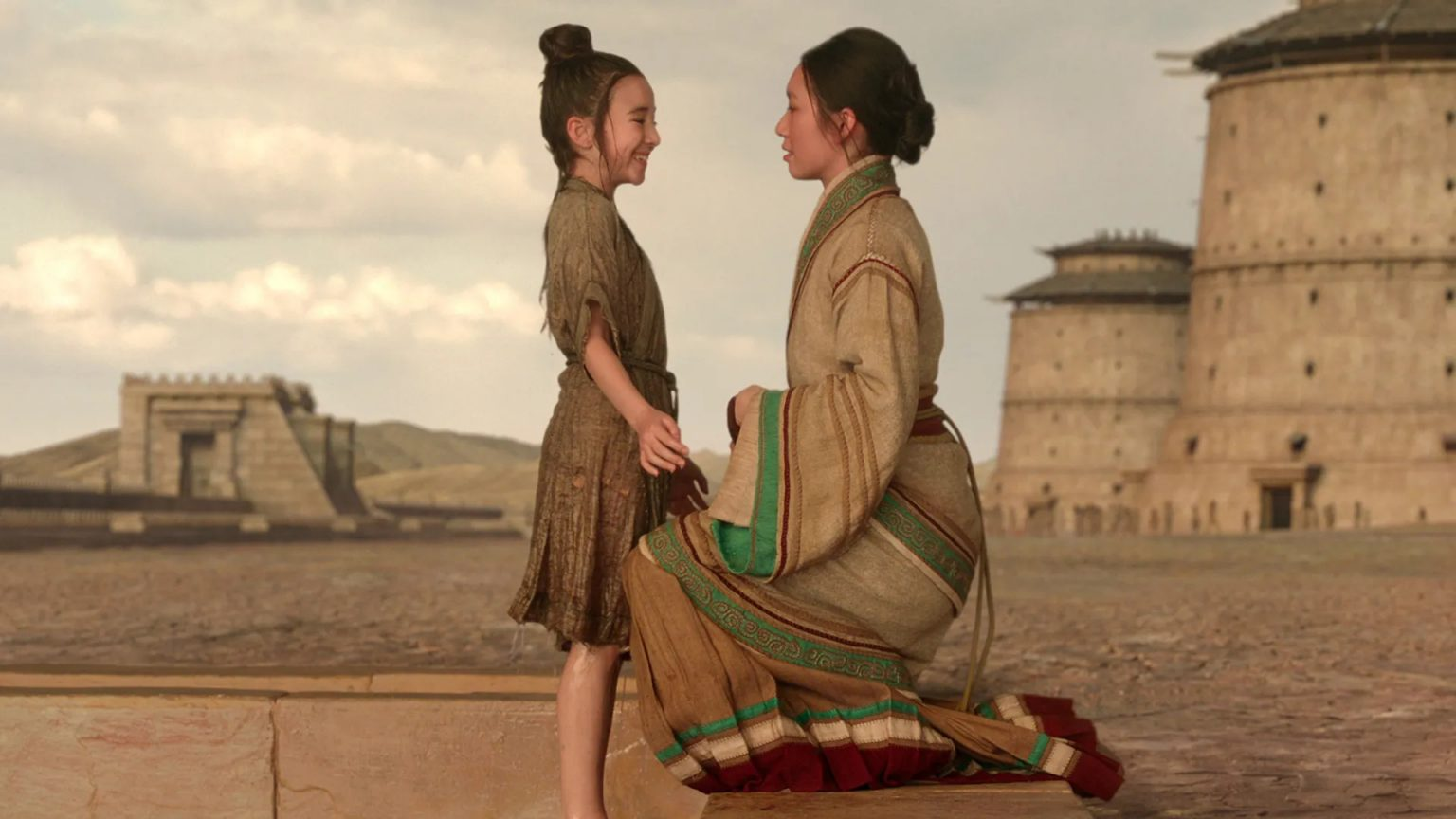
The Three-Body Problem (Netflix, 2024)
Enfolding world-building, community-making, and problem solving, the act of play is itself a powerful act of speculation. It can offer entertainment or education. It encourages, or sometimes sidesteps, empathy. It draws attention to the ways that stories are constructed and how we experience them.
In the context of video games, the recent announcement by Sony that it will halt production of physical game discs by 2028—and the attendant backlash from the gaming community—encourages us to think about physical vs. digital media and legacy access, and how economics factors into how we play, and for how long. Some games, like That Dragon, Cancer and The Final Exam, may barely be said to be ‘played’ at all: more experienced, and learned from. Play can inspire joy, flow states, immersion—or desolation.
This special issue of Vector invites contributors to engage with the act of ‘play’ in its most expansive definition, including but not limited to:
- Tabletop RPGs
- Collectibles
- Video games
- VR/AR
- Physical media
- AI and game creation (backlash, adopters)
- Educational games
- Citizen science games
- Gamification of labour
- Games in speculative fiction
- Games as forms of art or activism
- Affect
- Materialist/new historicist readings
Please submit your proposal by September 30th to vector.submissions@gmail.com, including:
- a 150-500 word proposal, including estimated length;
- something about yourself, either a 50-100 word bio or a CV.
Articles should be between 1,000 and 8,000 words. Please let us know your estimated word count. We seek articles that are carefully grounded in scholarly research, while also being clear, engaging, and suitable for a broad audience (including non-academics). Articles will be due by November 30th
Please also feel free to make queries about other formats, e.g. reviews, interviews, curated reading lists, roundtable discussions, unusual / innovative formats.
Categories: Industry News
New Call for Proposals: Play
CfP Vector 304 – Play
The Three-Body Problem (Netflix, 2024)
Enfolding world-building, community-making, and problem solving, the act of play is itself a powerful act of speculation. It can offer entertainment or education. It encourages, or sometimes sidesteps, empathy. It draws attention to the ways that stories are constructed and how we experience them.
In the context of video games, the recent announcement by Sony that it will halt production of physical game discs by 2028—and the attendant backlash from the gaming community—encourages us to think about physical vs. digital media and legacy access, and how economics factors into how we play, and for how long. Some games, like That Dragon, Cancer and The Final Exam, may barely be said to be ‘played’ at all: more experienced, and learned from. Play can inspire joy, flow states, immersion—or desolation.
This special issue of Vector invites contributors to engage with the act of ‘play’ in its most expansive definition, including but not limited to:
- Tabletop RPGs
- Collectibles
- Video games
- VR/AR
- Physical media
- AI and game creation (backlash, adopters)
- Educational games
- Citizen science games
- Gamification of labour
- Games in speculative fiction
- Games as forms of art or activism
- Affect
- Materialist/new historicist readings
Please submit your proposal by September 30th to vector.submissions@gmail.com, including:
- a 150-500 word proposal, including estimated length;
- something about yourself, either a 50-100 word bio or a CV.
Articles should be between 1,000 and 8,000 words. Please let us know your estimated word count. We seek articles that are carefully grounded in scholarly research, while also being clear, engaging, and suitable for a broad audience (including non-academics). Articles will be due by November 30th
Please also feel free to make queries about other formats, e.g. reviews, interviews, curated reading lists, roundtable discussions, unusual / innovative formats.
Categories: Industry News
Dark Carnival “Bookstore of the Imagination” to Celebrate 50 Years in the Bay Area
Dark Carnival, the second oldest science fiction bookstore in the US, will be celebrating its 50th anniversary on Saturday, August 1, 2026 from 5:00 p.m. to 7:00 p.m. at its longtime location on Claremont Avenue in Berkeley, CA.
The sprawling establishment, which specializes in science fiction, fantasy, horror, and mystery books-as well as comics through its next-door sister store, Escapist Comics-first opened its doors in 1976, resiliently weathering challenges including …Read More
Categories: Industry News, Industry News Home
Zoefuturism as CoFuturism: Revisiting the genre argument
Dr. Patrick Anthony Barbosa Brock
CoFutures
CoFutures
What do we do when we talk about Zoefuturism? This essay argues that Zoefuturism and CoFuturisms are not merely aesthetic or speculative categories, but infrastructural practices of collective world-making. I propose a framework for understanding how these movements intervene in social imaginaries through genre formation, manifestos, and boundary-making practices, while also examining their material implications for the communities and infrastructures from which they emerge. To that end, I draw on my previous theorization of the role genre mechanics play in the formation of collectivities.
Although they are envisioned here as operationally connected, speculative fiction, CoFuturisms, and Zoefuturism should not be treated as interchangeable categories. Speculative fiction is a broad narrative mode oriented toward hypothetical worlds, alternative temporalities, and estrangement from consensus reality. CoFuturisms, by contrast, designate culturally situated interventions that mobilize speculative methods to contest dominant imaginaries and produce alternative social horizons. Zoefuturism differs from both in that its central organizing principle is relationality itself: an ontological emphasis on “interconnected becoming” across human, nonhuman, ecological, and material forms of life. Where speculative fiction often asks what futures might exist, and CoFuturisms ask who gets to imagine and inhabit those futures, Zoefuturism asks how forms of life become entangled in the production of futurity.
CoFuturisms as a conceptual umbrella emerged with the publication of the Routledge Handbook of CoFuturisms and its survey of speculative works from the world’s periphery, many of which blur the boundaries between art and activism. Like the imaginaries from which they emerge, CoFuturisms are collective constructions shaped by forces operating at both macro and micro levels. As digital media theorist, poet, and software designer Jason Edward Lewis writes, they “create a field of ‘future facts,’ a fully realized reality that exists somewhere down the timeline, waiting for us to catch up to it” (11). More broadly, CoFuturisms often emerge through science fiction (SF) and speculative practices, commonly appropriating their methods, to critique dominant imaginaries and intervene micropolitically in the present. As science fiction scholar Taryne Jade Taylor observes, “CoFuturisms is a movement that is found both within science fiction and fantasy and also reaches past the boundaries of speculative fiction” (2023).
In conversation with the editors of this special issue, I was provided with the following conceptualization of Zoefuturism: “Zoefuturism as a genre is founded upon the understanding that all things are relational—where descriptors, characteristics, or even a sense of ‘being’ depend upon everything around them—and that everything is constantly becoming, much like our DNA. As such, Zoefuturism is not political.”
I interpret Zoefuturism as an attempt to articulate a relational understanding of the world that moves beyond binary frameworks by foregrounding becoming, interdependence, and ecological entanglement. Unlike many futurisms organized around identity, technological acceleration, or emancipatory struggle, Zoefuturism situates relationality itself as the condition of futurity. Its emphasis falls less on representing marginalized futures than on rethinking the ontological assumptions through which futures are imagined in the first place. Yet Zoefuturism cannot escape political implications simply by rejecting explicit political identification. Like CoFuturisms, it shapes how reality is narratively and institutionally organized through language, cultural production, archives, and the social imaginaries that orient collective life. Its politics emerge less through ideological declaration than through interventions into the conceptual and affective infrastructures governing how relations between life forms are understood.
These interventions occur through genre itself. Genres are not merely aesthetic containers but social formations circulating among texts, communities, markets, and institutions. Because genres organize recognition, expectation, and participation, they function as technologies of collective becoming. Speculative fiction provides many of the formal tools that make such interventions narratively intelligible, while CoFuturisms mobilize those tools toward situated cultural and political projects. Zoefuturism, in turn, redirects speculative practice toward relational ontologies that destabilize distinctions between nature and culture, subject and environment, and human and nonhuman life.
Manifesting Worlds
CoFuturisms are intersectional movements that combine narrative, ethical reflection, and speculative world-building across diverse epistemological traditions. If SF is commonly described as a genre that imagines the future, CoFuturisms seek instead to reshape the present. They assemble heterogeneous archives, practices, and modes of creation into new frameworks for collective life. Unlike speculative fiction broadly conceived, CoFuturisms are defined less by narrative conventions than by situated interventions into historical asymmetries of power, visibility, and futurity.
Observing how SF practitioners in Northeast Brazil sought to intervene in the genre as an emancipatory act, and how similar processes appeared elsewhere, I termed this phenomenon genre genesis (Brock 2022). Genre genesis describes how creators reshape the symbolic foundations of a genre to construct new collectivities and modes of belonging. Writers from Brazil’s Northeast, for instance, responded to their inferiorized position within the national imagination by coining sertãopunk, a form of science fiction rooted in the region’s ecological and political realities.
Comparable acts of conceptual creation appear across multiple CoFuturist contexts. Examples include Nnedi Okorafor’s Africanfuturism, the Afropantheology developed by Oghenechovwe Donald Ekpeki and Joshua Uchenna Omenga, Scott Russel Duncan’s Xicanxfuturism, and forms of Andean Futurism developed by Peruvian SF writers. These practices do more than produce new literary categories; they reshape the infrastructures through which speculative thinking circulates and acquires legitimacy. Zoefuturism operates through similar mechanisms, though with a distinctive emphasis on relationality as both method and ontology rather than primarily identity, territory, or historical exclusion. Fundamentally, they are creations that beget further creations, becoming self-replicating or generative through the interplay of individual agency and collective effort.
Furthermore, I believe that three interconnected processes help explain how these movements function: the pedagogical qualities of SF and speculative thinking; the interventionist tradition of manifestos; the mobilizing role of genres as boundary objects.
a) The pedagogical qualities of SF and speculative thinking
Speculative thinking includes counterfactual reasoning, prefactual thinking, the processing of spatial and temporal asymmetries, and the ability to distinguish between perceived reality and hypothetical scenarios (Lun et al. 2021). These capacities help individuals and communities to imagine alternative pasts and futures, and innovative solutions to problems. Emerging research suggests that speculative behaviors may also appear in nonhuman animals, including forms of play and curiosity observed among bees and zebrafish (Galpayage Dona et al. 2022; Franks et al. 2023).
SF amplifies speculative thinking by distributing it socially through narrative and mass culture. The genre combines recognizable conventions with remarkable flexibility, enabling continual reinvention (Wolfe 2011). Darko Suvin’s concept of the novum, for instance, describes the transformative innovation that estranges readers from familiar reality while opening new perspectives on it. SF thus enables writers to explore time, history, science, and social organization through speculative scenarios that cultivate both wonder and critical reflection.
As Seo-Young Chu argues, SF does not abandon realism but intensifies it through heightened complexity (2010). Because it is highly imaginative, SF often constructs worlds capable of revealing otherwise invisible structures of reality. Increasingly, SF also shapes political discourse rather than remaining confined to escapist entertainment (Taskale 2026). This helps explain why SF aligns so naturally with CoFuturisms and Zoefuturism alike. Speculative fiction supplies the formal and cognitive conditions through which alternative worlds become imaginable. CoFuturisms appropriate those capacities to intervene in disputes over culture, identity, historical memory, and futurity. Zoefuturism mobilizes them differently: not primarily to recover excluded identities or produce counter-histories, but to foreground relational interdependence as the basis for imagining collective existence across ecological and ontological scales.
b) Manifestos
If speculative fiction provides the imaginative conditions for collective world-building, manifestos provide its declarative form. Reading the call for papers for this special issue, I was struck by how closely it resembled a manifesto: “Zoefuturism takes its name from the Greek word for life, zoe (ζωή, zoí). It is a futurism of connectedness, engagement, and relationality, a futurism of ‘life-becomings.’” This statement situates Zoefuturism philosophically, identifies representative works, and proposes a framework through which they should be interpreted. It also intervenes by reorganizing a field of meaning around a new conceptual category.
Manifestos have historically functioned as instruments of political and cultural intervention. Originally associated with declarations of sovereign authority in the fifteenth century, they gradually evolved into vehicles for public participation. Earlier examples include the manifestos of the Levellers and Diggers in seventeenth-century England, which sought to establish new forms of public speech and political participation (Lamb 2022).
The manifesto form became especially influential within twentieth-century artistic movements. Although Filippo Tommaso Marinetti’s Futurist Manifesto carried deeply reactionary politics, its methodological influence in Latin America proved substantial (Schnapp and Rocha 1996; Sartor 2012; Aguirre et al. 2017). Writers and intellectuals appropriated the form to redefine national cultures and articulate alternative aesthetic programs. Brazilian and Peruvian modernists, for example, used manifestos to intervene directly in debates over cultural modernity (Montenegro 2017).
Manifestos therefore operate not simply as declarations but as interventions into public discourse. Entire literary works may function manifesto-like by reorganizing perception and political imagination. In the case of Zoefuturism, the intervention emerges through editorial framing itself: the decision to foreground Zoefuturism as a category for organizing a constellation of related works and ideas. Unlike many earlier futurist manifestos centered on rupture, acceleration, or technological conquest, Zoefuturism emphasizes interdependence, permeability, and becoming.
c) Boundary Objects and Genre Infrastructure
If manifestos provide interventionist declarations, genres provide the infrastructures through which those interventions circulate and become socially durable. Humans are deeply oriented toward cooperation and cumulative cultural learning. Through language, ritual, performance, and material artifacts, societies transmit vast bodies of non-genetic information across generations (Henrich and Muthukrishna 2018).
Drawing on science and technology studies, John Rieder adopts the concept of boundary objects to explain the cultural power of SF (2017). In this framework, SF encompasses not only literary texts but also the broader network of social, commercial, and institutional relations through which meanings circulate. Genres function as boundary objects because they remain flexible enough to accommodate multiple interpretations while stable enough to sustain collective participation.
My concepts of genre genesis and genre infrastructure extend this framework (Brock 2022; 2024). Genre genesis refers to the reshaping of symbolic foundations through collective cultural intervention. Genre infrastructure describes the institutional systems through which these interventions are sustained: publishing networks, reading communities, archives, digital platforms, markets, and criticism.
Creators engaged in these processes demonstrate a sophisticated awareness of what Frelik calls “boundary discourse” (2011): the socially negotiated construction of meaning through genre conventions. Genres are therefore not merely aesthetic categories but cultural and economic systems. By proposing new genre labels or redefining existing ones, creators intervene directly in the symbolic economy of literature and cultural production.
This is why CoFuturisms and Zoefuturism possess unavoidable political dimensions. Yet they do so differently. CoFuturisms tend to organize around highly situated struggles over representation, historical memory, and cultural agency. Zoefuturism instead foregrounds the relational conditions through which forms of life become mutually constituted. If CoFuturisms frequently ask who is excluded from dominant futures, Zoefuturism asks how futurity itself might be reorganized through interdependence rather than separation. Genres thus function not only as aesthetic categories but as infrastructures for negotiating different ontologies of collective existence.
Another Future, If You Can Keep It
The political significance of Zoefuturism and other CoFuturisms emerges not only from their explicit themes but from the infrastructures they construct and transform. By intervening in genres, archives, and systems of cultural circulation, these movements reshape the conditions under which futures become imaginable. Their micropolitics operate through negotiation, coalition-building, and symbolic intervention rather than singular revolutionary rupture.
Critics have argued that CoFuturisms risk absorption into the same capitalist systems they seek to challenge (Boyden 2024). Yet this tension does not invalidate their political significance. On the contrary, it reveals how struggles over futurity increasingly unfold through culture, narrative, and infrastructure. Across the political spectrum, movements are turning toward myth-making and storytelling as mechanisms for shaping public consciousness and social possibility.
CoFuturisms therefore should not be understood simply as expressions of modernity’s obsession with the future. Rather, they attempt to reconfigure that obsession by constructing alternative boundary objects through which communities negotiate meaning differently. Zoefuturism participates in this broader movement, but does so by emphasizing relational ontologies rather than primarily identity-based or civilizational alternatives. Its intervention lies in reframing futurity itself as an emergent property of entangled forms of life.
To recognize that CoFuturisms are constructing new archives is also to recognize that they intervene in the infrastructures through which ideas become realities. The movement from imagination to institutionalization unfolds unevenly across law, politics, economics, and culture. Some ideas remain marginal for decades; others become rapidly assimilated into dominant systems. Yet communities continue to act within this uncertain terrain, contesting the forces that seek to define the future on their behalf.
As anthropologist, anarchist, and social and political activist David Graeber observed, “the ultimate hidden truth of the world is that it is something that we make, and could just as easily make differently” (2024). While the process is rarely easy, CoFuturisms and Zoefuturism emerge from this recognition that we can start changing the present through the exquisite pathways described here, starting by just talking about them.
Works cited
Abrahamsen, Rita, Jean-François Drolet, Michael C. Williams, Srdjan Vucetic, Karin Narita, and Alexandra Gheciu. 2024. “The Gramscian Right, or Turning Gramsci on His Head.” In World of the Right: Radical Conservatism and Global Order. Cambridge: Cambridge University Press: pp. 34–66.
Aguirre, Mariana, Rosa Sarabia, Renée M. Silverman, and Ricardo Vasconcelos, ed. 2017. “Futurism in Latin America.” Special Issue, International Yearbook of Futurism Studies, Volume 7, De Gruyter.
Boyden, Michael. 2025. “Heterotemporality and Posthumanism in Alternative Futurisms.” Concentric: Literary and Cultural Studies 50.1 (2024): 69-87. Airiti Library. Web. 1 Aug.
Brock, Patrick A. B. 2022. “Futurism and genre genesis in Brazilian science fiction.” Zanzalá-Revista Brasileira de Estudos sobre Gêneros Cinematográficos e Audiovisuais, número 8.1: 8-18.
Brock, Patrick A. B. 2023. “Brazilian Afrofuturism, Heuristic Function, and the Mass Cultural Genre System.” SFRA Review 53.3, Summer, pp. 18-27.
Brock, Patrick A. B. 2024. “Genre Infrastructure as Speculative Method in Latin America.” Journal of the Fantastic in the Arts 34.3: pp. 277-303.
Chu, Seo-Young. 2010. Do Metaphors Dream of Literal Sleep? A Science-Fictional Theory of Representation. Harvard University Press.
Finchelstein, Federico. 2022. Fascist Mythologies: The History and Politics of Unreason in Borges, Freud, and Schmitt. Columbia University Press, 2022. https://doi.org/10.7312/finc18320
Franks, Becca, Leigh P. Gaffney, Courtney Graham and Daniel M. Weary. 2023. Curiosity in zebrafish (Danio rerio)? Behavioral responses to 30 novel objects. Front. Vet. Sci. 9:1062420. doi: 10.3389/fvets.2022.1062420
Frelik, Paweł. 2011. “Of Slipstream and Others: SF and Genre Boundary Discourses.” Science Fiction Studies, vol. 38, no. 1: pp. 20–45.
Galpayage Dona, Hiruni Samadi, Cwyn Solvi, Amelia Kowalewska, Kaarle Mäkelä, HaDi MaBouDi and Lars Chittka. 2022. “Do bumble bees play?” Animal Behaviour, Volume 194, Pages 239-251. https://doi.org/10.1016/j.anbehav.2022.08.013.
Ginway, M. Elizabeth, and J. Andrew Brown, editors. 2012. Latin American Science Fiction. Palgrave Macmillan US.
Graeber, David. 2024. The Ultimate Hidden Truth of the World. Penguin Books, 2024.
Henrich, Joseph and Michael Muthukrishna. 2021. “The Origins and Psychology of Human Cooperation.” Annual Review of Psychology 72:1: 207–240.
Jade Taylor, Taryne. 2023. “Introduction to CoFuturisms.” The Routledge Handbook of Cofuturisms. Taylor, T.J., Lavender III, I., Dillon, G.L., & Chattopadhyay, B. (Eds.) Routledge.
Komporozos-Athanasiou, Aris. 2023. Speculative Communities: Living with Uncertainty in a Financialized World. University of Chicago Press, 2023.
Lamb, Matthew. 2022. “So You Want to Write a Manifesto? (Part 1 of 2).” Public Things Newsletter, Substack, 3 April. publicthings.substack.com/p/so-you-want-to-write-a-manifesto.
Lewis, Jason Edward. 2023. “The Future Imaginary.” The Routledge Handbook of CoFuturisms. Edited By Taryne Jade Taylor, Isiah Lavender III, Grace L. Dillon, Bodhisattva Chattopadhyay. Routledge: pp. 11-22.
Lun, Huang, Xie Yibo and Chen Xiaolin. 2021. “A Review of Functions of Speculative Thinking.” Frontiers in Psychology, vol. 12: pp. 728946.
Montenegro, Giovanna. 2017. “Indigenismo and Futurism in Latin America: José Carlos Mariátegui and the Peruvian Avant-Garde.” International Yearbook of Futurism Studies. Special Issue: Futurism in Latin America. Volume 7, De Gruyter: pp. 29-59.
Rieder, John. 2017. Science Fiction and the Mass Cultural Genre System. Wesleyan University Press.
Sartor, Mario. 2012. “Italian Futurism and Its Latin American Echoes.” Seminário Internacional de Conservação de Escultura Moderna. MAC USP, 2012. Available in: http://www.mac.usp.br/mac/conteudo/academico/publicacoes/anais/modernidade/pdfs/MARIO_ESP.pdf.
Schnapp, J. T. and João Cezar de Castro Rocha. 1996. “Brazilian Velocities: On Marinetti’s 1926 Trip to South America.” South Central Review, 13(2/3): pp. 105–156.
Suvin, Darko. 2010. “Chapter 3: Science Fiction and the Novum (1977).” Defined by a Hollow: Essays on Utopia, Science Fiction and Political Epistemology. Ralahine Utopian Studies, v. 6: pp. 67-92.
Taskale, Ali Riza. 2026. “Materialized Science Fiction: The Tech Oligarchy’s Blueprint for a New Global Order.” Global Studies Quarterly, Volume 6, Issue 1, January 2026.
Wolfe, Gary K. 2011. Evaporating Genres: Essays on Fantastic Literature. Wesleyan University Press.
Categories: Industry News
Zoefuturism as CoFuturism: Revisiting the genre argument
Dr. Patrick Anthony Barbosa Brock
CoFutures
CoFutures
What do we do when we talk about Zoefuturism? This essay argues that Zoefuturism and CoFuturisms are not merely aesthetic or speculative categories, but infrastructural practices of collective world-making. I propose a framework for understanding how these movements intervene in social imaginaries through genre formation, manifestos, and boundary-making practices, while also examining their material implications for the communities and infrastructures from which they emerge. To that end, I draw on my previous theorization of the role genre mechanics play in the formation of collectivities.
Although they are envisioned here as operationally connected, speculative fiction, CoFuturisms, and Zoefuturism should not be treated as interchangeable categories. Speculative fiction is a broad narrative mode oriented toward hypothetical worlds, alternative temporalities, and estrangement from consensus reality. CoFuturisms, by contrast, designate culturally situated interventions that mobilize speculative methods to contest dominant imaginaries and produce alternative social horizons. Zoefuturism differs from both in that its central organizing principle is relationality itself: an ontological emphasis on “interconnected becoming” across human, nonhuman, ecological, and material forms of life. Where speculative fiction often asks what futures might exist, and CoFuturisms ask who gets to imagine and inhabit those futures, Zoefuturism asks how forms of life become entangled in the production of futurity.
CoFuturisms as a conceptual umbrella emerged with the publication of the Routledge Handbook of CoFuturisms and its survey of speculative works from the world’s periphery, many of which blur the boundaries between art and activism. Like the imaginaries from which they emerge, CoFuturisms are collective constructions shaped by forces operating at both macro and micro levels. As digital media theorist, poet, and software designer Jason Edward Lewis writes, they “create a field of ‘future facts,’ a fully realized reality that exists somewhere down the timeline, waiting for us to catch up to it” (11). More broadly, CoFuturisms often emerge through science fiction (SF) and speculative practices, commonly appropriating their methods, to critique dominant imaginaries and intervene micropolitically in the present. As science fiction scholar Taryne Jade Taylor observes, “CoFuturisms is a movement that is found both within science fiction and fantasy and also reaches past the boundaries of speculative fiction” (2023).
In conversation with the editors of this special issue, I was provided with the following conceptualization of Zoefuturism: “Zoefuturism as a genre is founded upon the understanding that all things are relational—where descriptors, characteristics, or even a sense of ‘being’ depend upon everything around them—and that everything is constantly becoming, much like our DNA. As such, Zoefuturism is not political.”
I interpret Zoefuturism as an attempt to articulate a relational understanding of the world that moves beyond binary frameworks by foregrounding becoming, interdependence, and ecological entanglement. Unlike many futurisms organized around identity, technological acceleration, or emancipatory struggle, Zoefuturism situates relationality itself as the condition of futurity. Its emphasis falls less on representing marginalized futures than on rethinking the ontological assumptions through which futures are imagined in the first place. Yet Zoefuturism cannot escape political implications simply by rejecting explicit political identification. Like CoFuturisms, it shapes how reality is narratively and institutionally organized through language, cultural production, archives, and the social imaginaries that orient collective life. Its politics emerge less through ideological declaration than through interventions into the conceptual and affective infrastructures governing how relations between life forms are understood.
These interventions occur through genre itself. Genres are not merely aesthetic containers but social formations circulating among texts, communities, markets, and institutions. Because genres organize recognition, expectation, and participation, they function as technologies of collective becoming. Speculative fiction provides many of the formal tools that make such interventions narratively intelligible, while CoFuturisms mobilize those tools toward situated cultural and political projects. Zoefuturism, in turn, redirects speculative practice toward relational ontologies that destabilize distinctions between nature and culture, subject and environment, and human and nonhuman life.
Manifesting Worlds
CoFuturisms are intersectional movements that combine narrative, ethical reflection, and speculative world-building across diverse epistemological traditions. If SF is commonly described as a genre that imagines the future, CoFuturisms seek instead to reshape the present. They assemble heterogeneous archives, practices, and modes of creation into new frameworks for collective life. Unlike speculative fiction broadly conceived, CoFuturisms are defined less by narrative conventions than by situated interventions into historical asymmetries of power, visibility, and futurity.
Observing how SF practitioners in Northeast Brazil sought to intervene in the genre as an emancipatory act, and how similar processes appeared elsewhere, I termed this phenomenon genre genesis (Brock 2022). Genre genesis describes how creators reshape the symbolic foundations of a genre to construct new collectivities and modes of belonging. Writers from Brazil’s Northeast, for instance, responded to their inferiorized position within the national imagination by coining sertãopunk, a form of science fiction rooted in the region’s ecological and political realities.
Comparable acts of conceptual creation appear across multiple CoFuturist contexts. Examples include Nnedi Okorafor’s Africanfuturism, the Afropantheology developed by Oghenechovwe Donald Ekpeki and Joshua Uchenna Omenga, Scott Russel Duncan’s Xicanxfuturism, and forms of Andean Futurism developed by Peruvian SF writers. These practices do more than produce new literary categories; they reshape the infrastructures through which speculative thinking circulates and acquires legitimacy. Zoefuturism operates through similar mechanisms, though with a distinctive emphasis on relationality as both method and ontology rather than primarily identity, territory, or historical exclusion. Fundamentally, they are creations that beget further creations, becoming self-replicating or generative through the interplay of individual agency and collective effort.
Furthermore, I believe that three interconnected processes help explain how these movements function: the pedagogical qualities of SF and speculative thinking; the interventionist tradition of manifestos; the mobilizing role of genres as boundary objects.
a) The pedagogical qualities of SF and speculative thinking
Speculative thinking includes counterfactual reasoning, prefactual thinking, the processing of spatial and temporal asymmetries, and the ability to distinguish between perceived reality and hypothetical scenarios (Lun et al. 2021). These capacities help individuals and communities to imagine alternative pasts and futures, and innovative solutions to problems. Emerging research suggests that speculative behaviors may also appear in nonhuman animals, including forms of play and curiosity observed among bees and zebrafish (Galpayage Dona et al. 2022; Franks et al. 2023).
SF amplifies speculative thinking by distributing it socially through narrative and mass culture. The genre combines recognizable conventions with remarkable flexibility, enabling continual reinvention (Wolfe 2011). Darko Suvin’s concept of the novum, for instance, describes the transformative innovation that estranges readers from familiar reality while opening new perspectives on it. SF thus enables writers to explore time, history, science, and social organization through speculative scenarios that cultivate both wonder and critical reflection.
As Seo-Young Chu argues, SF does not abandon realism but intensifies it through heightened complexity (2010). Because it is highly imaginative, SF often constructs worlds capable of revealing otherwise invisible structures of reality. Increasingly, SF also shapes political discourse rather than remaining confined to escapist entertainment (Taskale 2026). This helps explain why SF aligns so naturally with CoFuturisms and Zoefuturism alike. Speculative fiction supplies the formal and cognitive conditions through which alternative worlds become imaginable. CoFuturisms appropriate those capacities to intervene in disputes over culture, identity, historical memory, and futurity. Zoefuturism mobilizes them differently: not primarily to recover excluded identities or produce counter-histories, but to foreground relational interdependence as the basis for imagining collective existence across ecological and ontological scales.
b) Manifestos
If speculative fiction provides the imaginative conditions for collective world-building, manifestos provide its declarative form. Reading the call for papers for this special issue, I was struck by how closely it resembled a manifesto: “Zoefuturism takes its name from the Greek word for life, zoe (ζωή, zoí). It is a futurism of connectedness, engagement, and relationality, a futurism of ‘life-becomings.’” This statement situates Zoefuturism philosophically, identifies representative works, and proposes a framework through which they should be interpreted. It also intervenes by reorganizing a field of meaning around a new conceptual category.
Manifestos have historically functioned as instruments of political and cultural intervention. Originally associated with declarations of sovereign authority in the fifteenth century, they gradually evolved into vehicles for public participation. Earlier examples include the manifestos of the Levellers and Diggers in seventeenth-century England, which sought to establish new forms of public speech and political participation (Lamb 2022).
The manifesto form became especially influential within twentieth-century artistic movements. Although Filippo Tommaso Marinetti’s Futurist Manifesto carried deeply reactionary politics, its methodological influence in Latin America proved substantial (Schnapp and Rocha 1996; Sartor 2012; Aguirre et al. 2017). Writers and intellectuals appropriated the form to redefine national cultures and articulate alternative aesthetic programs. Brazilian and Peruvian modernists, for example, used manifestos to intervene directly in debates over cultural modernity (Montenegro 2017).
Manifestos therefore operate not simply as declarations but as interventions into public discourse. Entire literary works may function manifesto-like by reorganizing perception and political imagination. In the case of Zoefuturism, the intervention emerges through editorial framing itself: the decision to foreground Zoefuturism as a category for organizing a constellation of related works and ideas. Unlike many earlier futurist manifestos centered on rupture, acceleration, or technological conquest, Zoefuturism emphasizes interdependence, permeability, and becoming.
c) Boundary Objects and Genre Infrastructure
If manifestos provide interventionist declarations, genres provide the infrastructures through which those interventions circulate and become socially durable. Humans are deeply oriented toward cooperation and cumulative cultural learning. Through language, ritual, performance, and material artifacts, societies transmit vast bodies of non-genetic information across generations (Henrich and Muthukrishna 2018).
Drawing on science and technology studies, John Rieder adopts the concept of boundary objects to explain the cultural power of SF (2017). In this framework, SF encompasses not only literary texts but also the broader network of social, commercial, and institutional relations through which meanings circulate. Genres function as boundary objects because they remain flexible enough to accommodate multiple interpretations while stable enough to sustain collective participation.
My concepts of genre genesis and genre infrastructure extend this framework (Brock 2022; 2024). Genre genesis refers to the reshaping of symbolic foundations through collective cultural intervention. Genre infrastructure describes the institutional systems through which these interventions are sustained: publishing networks, reading communities, archives, digital platforms, markets, and criticism.
Creators engaged in these processes demonstrate a sophisticated awareness of what Frelik calls “boundary discourse” (2011): the socially negotiated construction of meaning through genre conventions. Genres are therefore not merely aesthetic categories but cultural and economic systems. By proposing new genre labels or redefining existing ones, creators intervene directly in the symbolic economy of literature and cultural production.
This is why CoFuturisms and Zoefuturism possess unavoidable political dimensions. Yet they do so differently. CoFuturisms tend to organize around highly situated struggles over representation, historical memory, and cultural agency. Zoefuturism instead foregrounds the relational conditions through which forms of life become mutually constituted. If CoFuturisms frequently ask who is excluded from dominant futures, Zoefuturism asks how futurity itself might be reorganized through interdependence rather than separation. Genres thus function not only as aesthetic categories but as infrastructures for negotiating different ontologies of collective existence.
Another Future, If You Can Keep It
The political significance of Zoefuturism and other CoFuturisms emerges not only from their explicit themes but from the infrastructures they construct and transform. By intervening in genres, archives, and systems of cultural circulation, these movements reshape the conditions under which futures become imaginable. Their micropolitics operate through negotiation, coalition-building, and symbolic intervention rather than singular revolutionary rupture.
Critics have argued that CoFuturisms risk absorption into the same capitalist systems they seek to challenge (Boyden 2024). Yet this tension does not invalidate their political significance. On the contrary, it reveals how struggles over futurity increasingly unfold through culture, narrative, and infrastructure. Across the political spectrum, movements are turning toward myth-making and storytelling as mechanisms for shaping public consciousness and social possibility.
CoFuturisms therefore should not be understood simply as expressions of modernity’s obsession with the future. Rather, they attempt to reconfigure that obsession by constructing alternative boundary objects through which communities negotiate meaning differently. Zoefuturism participates in this broader movement, but does so by emphasizing relational ontologies rather than primarily identity-based or civilizational alternatives. Its intervention lies in reframing futurity itself as an emergent property of entangled forms of life.
To recognize that CoFuturisms are constructing new archives is also to recognize that they intervene in the infrastructures through which ideas become realities. The movement from imagination to institutionalization unfolds unevenly across law, politics, economics, and culture. Some ideas remain marginal for decades; others become rapidly assimilated into dominant systems. Yet communities continue to act within this uncertain terrain, contesting the forces that seek to define the future on their behalf.
As anthropologist, anarchist, and social and political activist David Graeber observed, “the ultimate hidden truth of the world is that it is something that we make, and could just as easily make differently” (2024). While the process is rarely easy, CoFuturisms and Zoefuturism emerge from this recognition that we can start changing the present through the exquisite pathways described here, starting by just talking about them.
Works cited
Abrahamsen, Rita, Jean-François Drolet, Michael C. Williams, Srdjan Vucetic, Karin Narita, and Alexandra Gheciu. 2024. “The Gramscian Right, or Turning Gramsci on His Head.” In World of the Right: Radical Conservatism and Global Order. Cambridge: Cambridge University Press: pp. 34–66.
Aguirre, Mariana, Rosa Sarabia, Renée M. Silverman, and Ricardo Vasconcelos, ed. 2017. “Futurism in Latin America.” Special Issue, International Yearbook of Futurism Studies, Volume 7, De Gruyter.
Boyden, Michael. 2025. “Heterotemporality and Posthumanism in Alternative Futurisms.” Concentric: Literary and Cultural Studies 50.1 (2024): 69-87. Airiti Library. Web. 1 Aug.
Brock, Patrick A. B. 2022. “Futurism and genre genesis in Brazilian science fiction.” Zanzalá-Revista Brasileira de Estudos sobre Gêneros Cinematográficos e Audiovisuais, número 8.1: 8-18.
Brock, Patrick A. B. 2023. “Brazilian Afrofuturism, Heuristic Function, and the Mass Cultural Genre System.” SFRA Review 53.3, Summer, pp. 18-27.
Brock, Patrick A. B. 2024. “Genre Infrastructure as Speculative Method in Latin America.” Journal of the Fantastic in the Arts 34.3: pp. 277-303.
Chu, Seo-Young. 2010. Do Metaphors Dream of Literal Sleep? A Science-Fictional Theory of Representation. Harvard University Press.
Finchelstein, Federico. 2022. Fascist Mythologies: The History and Politics of Unreason in Borges, Freud, and Schmitt. Columbia University Press, 2022. https://doi.org/10.7312/finc18320
Franks, Becca, Leigh P. Gaffney, Courtney Graham and Daniel M. Weary. 2023. Curiosity in zebrafish (Danio rerio)? Behavioral responses to 30 novel objects. Front. Vet. Sci. 9:1062420. doi: 10.3389/fvets.2022.1062420
Frelik, Paweł. 2011. “Of Slipstream and Others: SF and Genre Boundary Discourses.” Science Fiction Studies, vol. 38, no. 1: pp. 20–45.
Galpayage Dona, Hiruni Samadi, Cwyn Solvi, Amelia Kowalewska, Kaarle Mäkelä, HaDi MaBouDi and Lars Chittka. 2022. “Do bumble bees play?” Animal Behaviour, Volume 194, Pages 239-251. https://doi.org/10.1016/j.anbehav.2022.08.013.
Ginway, M. Elizabeth, and J. Andrew Brown, editors. 2012. Latin American Science Fiction. Palgrave Macmillan US.
Graeber, David. 2024. The Ultimate Hidden Truth of the World. Penguin Books, 2024.
Henrich, Joseph and Michael Muthukrishna. 2021. “The Origins and Psychology of Human Cooperation.” Annual Review of Psychology 72:1: 207–240.
Jade Taylor, Taryne. 2023. “Introduction to CoFuturisms.” The Routledge Handbook of Cofuturisms. Taylor, T.J., Lavender III, I., Dillon, G.L., & Chattopadhyay, B. (Eds.) Routledge.
Komporozos-Athanasiou, Aris. 2023. Speculative Communities: Living with Uncertainty in a Financialized World. University of Chicago Press, 2023.
Lamb, Matthew. 2022. “So You Want to Write a Manifesto? (Part 1 of 2).” Public Things Newsletter, Substack, 3 April. publicthings.substack.com/p/so-you-want-to-write-a-manifesto.
Lewis, Jason Edward. 2023. “The Future Imaginary.” The Routledge Handbook of CoFuturisms. Edited By Taryne Jade Taylor, Isiah Lavender III, Grace L. Dillon, Bodhisattva Chattopadhyay. Routledge: pp. 11-22.
Lun, Huang, Xie Yibo and Chen Xiaolin. 2021. “A Review of Functions of Speculative Thinking.” Frontiers in Psychology, vol. 12: pp. 728946.
Montenegro, Giovanna. 2017. “Indigenismo and Futurism in Latin America: José Carlos Mariátegui and the Peruvian Avant-Garde.” International Yearbook of Futurism Studies. Special Issue: Futurism in Latin America. Volume 7, De Gruyter: pp. 29-59.
Rieder, John. 2017. Science Fiction and the Mass Cultural Genre System. Wesleyan University Press.
Sartor, Mario. 2012. “Italian Futurism and Its Latin American Echoes.” Seminário Internacional de Conservação de Escultura Moderna. MAC USP, 2012. Available in: http://www.mac.usp.br/mac/conteudo/academico/publicacoes/anais/modernidade/pdfs/MARIO_ESP.pdf.
Schnapp, J. T. and João Cezar de Castro Rocha. 1996. “Brazilian Velocities: On Marinetti’s 1926 Trip to South America.” South Central Review, 13(2/3): pp. 105–156.
Suvin, Darko. 2010. “Chapter 3: Science Fiction and the Novum (1977).” Defined by a Hollow: Essays on Utopia, Science Fiction and Political Epistemology. Ralahine Utopian Studies, v. 6: pp. 67-92.
Taskale, Ali Riza. 2026. “Materialized Science Fiction: The Tech Oligarchy’s Blueprint for a New Global Order.” Global Studies Quarterly, Volume 6, Issue 1, January 2026.
Wolfe, Gary K. 2011. Evaporating Genres: Essays on Fantastic Literature. Wesleyan University Press.
Categories: Industry News
Russell Kirkpatrick (1961–2026)
Russell Kirkpatrick, 65, died June 26, 2026 in Canberra Hospital. He was diagnosed with aggressive melanoma.
Kirkpatrick was born April 11, 1961 in Christchurch, New Zealand. He received a PhD in geography from the University of Canterbury and was at separate times a lecturer at the University of Waikato and the University of Canberra. He wrote the Fire of Heaven series and the Husk series, the latter known as Broken …Read More
Categories: Industry News, Industry News Home
Katharine T. Carroll (1958–2026)
Titan US publicity director Katharine T. Carroll, 68, died June 28, 2026. The cause was attributed to aortic dissection.
Carroll was born Katharine Trowbridge in January 1958. She attended Manhattan Country School, Riverdale Country School, and Boston University and lived in New York City and Maine. She began work as a publicist in 1980 with Time Inc., formed her own publicity consulting company in 1990, then joined Titan Publishing Group's …Read More
Categories: Industry News, Industry News Home
Anthropic Settlement Receives Final Approval
On July 20, the US District Court for the Northern District of California granted final approval of the $1.5 billion settlement proposed in class action suit Bartz v. Anthropic PBC, in which authors accused the Amazon-backed company of illegally obtaining and using their books to teach its AI system.
According to a Bloomberg report, Bartz v. Anthropic is the largest copyright class action settlement in US history, paying about $3,100 …Read More
Categories: Industry News, Industry News Home
Westercon to “Retire” after 2028
Westercon 80, to be held in 2028 by the Los Angeles Science Fantasy Society (LASFS) in conjunction withLoscon 54, will officially be the final Westercon after voters at its2026 business meeting ratified a motion to repeal its bylaws. Following Loscon 54/Westercon 80, the convention will be deemed to have 'returned its charter' to the owner of the Westercon service mark, LASFS, which will determine its future going forward.
Westercon's press …Read More
Categories: Industry News, Industry News Home
Apex Magazine Removes Story for Suspected AI Usage
Following a careful review, Apex Magazine has removed the story Vigil of the Tenth Air from Apex #153 amid skepticism around the author's potential use of AI tools for its writing.
Though ultimately not selected for publication, a shortlisted story for Apex imprint Violet Lichen's upcoming ECO25: the Year's Best Speculative Ecofiction was also struck from website listings after it came to light that other work associated with the author's …Read More
Categories: Industry News, Industry News Home
Now Hiring: Events Coordinator and Web Contractor
Now Hiring:
Events Coordinator and Web Contractor
Events Coordinator and Web Contractor
Our team is growing!
SFWA is excited to announce two new positions as part of our continued commitment to creating meaningful opportunities and resources for writers. If you missed the open call in Singularity for the position of Executive Director, please refer back to last week’s statement for more details.
From Kate Ristau, SFWA President:
“The Events Coordinator will support our engaging and accessible programming for writers, and our Web Contractor will help ensure that our digital resources remain secure, useful, and easy to navigate. Together, these roles will allow us to expand professional development opportunities for writers, from building worlds to navigating the business of writing, while strengthening SFWA’s ability to serve our community into the future.”
Organization OverviewThe Science Fiction and Fantasy Writers Association (SFWA) is a 501(c)(3) nonprofit charitable organization for published writers and industry professionals in the field of science fiction, fantasy, and related genres. Founded in 1965, SFWA runs the annual Nebula Conference, the Nebula Awards, and a number of programs to assist authors worldwide.
Events CoordinatorUPDATE: This position has been filled. The post remains up for archival purposes.
Compensation: $30,000-$35,000 annual salary, commensurate with experience, with benefits.
Status: Part-time, salaried, benefits-eligible W-2 position. This position averages approximately 20 hours per week over the course of the year. Due to the annual Nebula Conference, workload will increase during the months leading up to the event and decrease during other periods.
Location: Remote, with required travel to the annual Nebula Conference.
Position OverviewThe Events Coordinator is responsible for the planning, coordination, and administration of SFWA’s major events, including the annual Nebula Conference and the quarterly Constellation professional development series. Working closely with the Executive Director, staff, volunteers, key committees, and the Board of Directors, the Events Coordinator oversees event logistics, supports volunteer teams, maintains event documentation, and helps ensure successful execution of SFWA’s programming.
The Events Coordinator reports directly to the Executive Director and collaborates with staff on planning, budgeting, communications, and production needs.
Key Job Responsibilities Event Management: Coordinate SFWA’s major events from planning through execution.● Oversee planning and administration of the annual Nebula Conference and quarterly Constellation events.
● Attend the Nebula Conference and Awards Ceremony in person, supporting staff and volunteers and troubleshooting issues as they arise.
● Attend other sanctioned events as directed by SFWA, with additional event attendance based on organizational needs and work schedule.
● Coordinate planning timelines, deliverables, and communication among staff, volunteers, and board members.
● Assist with correspondence and follow-up on event-related tasks to ensure deadlines are met.
Volunteer Coordination: Build and support volunteer teams that make SFWA events successful.● Recruit, onboard, and supervise volunteers supporting the Nebula Conference and Constellation series.
● Coordinate with SFWA’s Volunteer Team to facilitate volunteer assignments.
● Schedule and facilitate core team meetings, volunteer meetings, and all-hands calls related to ongoing events.
● Work closely with the Core Nebula Team and volunteers to identify responsibilities and ensure successful completion of assigned tasks.
Documentation and Administration: Maintain organizational knowledge and support continuous improvement.● Maintain and update the Nebula Playbook to document event procedures and best practices.
● Develop and maintain a Constellation Playbook in collaboration with volunteers, staff, and the Board of Directors.
● Serve as the primary administrator for the Nebula Conference Team.
● Monitor and respond to inquiries received through the events@sfwa.org email account, serving as a resource for event information and institutional knowledge.
Communication and Reporting: Ensure effective communication across the organization.● Provide monthly status reports to the Executive Director.
● Prepare conference status updates for the Executive Director and Board of Directors upon request.
● Coordinate with staff to support planning, budget tracking, communications, and printing needs.
● Foster clear communication between staff, volunteers, board members, and conference teams throughout the planning process.
Community Outreach: Support SFWA’s visibility within the speculative fiction community.● Identify conventions and events that provide outreach opportunities for SFWA.
● Encourage participation by members, volunteers, and Board members at community events that align with SFWA’s mission.
Skills and Qualifications● Experience coordinating conferences, conventions, nonprofit events, or comparable large-scale projects.
● Strong organizational and project management skills with exceptional attention to detail.
● Experience coordinating volunteers or leading collaborative teams.
● Excellent written and verbal communication skills.
● Ability to manage multiple projects and deadlines simultaneously.
● Comfort working independently in a remote environment while collaborating with distributed teams.
● Proficiency with common online collaboration and project management tools.
● Ability to travel to and attend the annual Nebula Conference.
Web ContractorCompensation: Hourly, with a monthly cap.
Status: This is an hourly, contract position, which is not benefits eligible. Candidates must be US-based and eligible for legal employment.
Location: Remote
Position OverviewThe Web Contractor will provide website maintenance, technical support, and development services for SFWA’s website and related web systems. This position requires experience with WordPress and the ability to become familiar with SFWA’s custom web platform built on PHP and JavaScript. The ideal candidate will have an understanding of website security, web hosting, and systems refinement, with experience in WooCommerce and MemberPress. Technical writing/documentation considered a plus.
SFWA’s website supports more than 2,000 members and includes a wide range of functionality, including membership applications, online forms, member databases, and regularly updated information about the organization’s many online and in-person programs and events. The Web Contractor will collaborate with SFWA staff and the volunteer InfoSys Team to maintain, troubleshoot, and improve the organization’s website and related systems on an as-needed basis.
Key Contract DetailsWebsite Management: Provide technical support for the maintenance, improvement, and troubleshooting of SFWA’s website.
● Collaborate with staff and the InfoSys Team to update, refine, and repair website features and functionality.
● Maintain and troubleshoot WordPress and custom PHP/JavaScript components.
● Identify and resolve website issues related to performance, usability, security, and hosting.
● Implement approved website enhancements and technical improvements as requested.
Technical Collaboration: Coordinate with SFWA’s technology volunteers and staff on ongoing technical initiatives.
● Attend the bi-weekly InfoSys Team Zoom meetings to discuss current projects, priorities, and technical issues.
● Coordinate with volunteers working on website development, Google Workspace administration, online forms, and other technology initiatives.
● Provide technical documentation related to completed work when appropriate.
Skills and Qualifications
● Bachelor’s degree or relevant certifications preferred.
● Minimum 5 years of demonstrated experience in website design and development.
● Experience with WordPress required.
● Working knowledge of PHP, JavaScript, website security, and web hosting environments.
● Experience with WooCommerce, Memberpress, and technical writing/documentation is a plus.
● Ability to work independently while collaborating effectively with a remote team.
● Strong problem-solving, communication, and organizational skills.
Deadline for ApplicationsUntil filled.
How to ApplySFWA is a 501(c)(3) nonprofit organization and an equal opportunity employer. We do not discriminate on the basis of race, gender identity, religion, color, sexual orientation, sex, marital/family status, national origin, age, physical ability, or income. We strongly encourage applicants from traditionally underrepresented and marginalized communities.
For Events Coordinator:
Email a cover letter and resume in a single file (MS Word or PDF only) to jobs@sfwa.org. Please include “Events Coordinator” in the subject line.
Please note that all job applications will be reviewed by members of SFWA staff and the Board of Directors. No AI will be used in the assessment of applicants. Additionally, the selected candidate will be required not to engage generative AI in the performance of their duties.
For Web Contractor:
Email a cover letter, resume, and links to 3–5 sample websites in a single file (MS Word or PDF only) to jobs@sfwa.org. Please include “Web Contractor” in the subject line.
Thank you for your interest in working for SFWA!The post Now Hiring: Events Coordinator and Web Contractor appeared first on SFWA - The Science Fiction & Fantasy Writers Association.
Categories: Industry News, Industry News Home
2026 Tähtifantasia Award Winner
Noidanlanka by J. S. Meresmaa (Myllylahti), is the winner of the 2026 Tähtifantasia Award, presented by the Helsinki Science Fiction Society for the best Finnish fantasy book published in the previous year. Other nominees were:
- Kuulotorvi, Leonora Carrington, tr. by Kristiina Drews (Kosmo)
- Lumenlaulaja, Emmi Itäranta (Teos)
- Kun aurinko kuoli, Yan Lianke, tr. Riina Vuokko (Rìxī)
- Vahalapsi, Olga Ravn, tr. Sanna Manninen (Voksbarnet)
The 2026 jurors were Jukka …Read More
Categories: Industry News, Industry News Home
Matt Haig to Open Bookshop
Matt Haig announced on Instagram plans to open a bookshop and coffee place called Golden, to be located in Brighton UK in the Seven Dials neighborhood, which according to Haig does not currently have a bookshop. The shop aims to open by Christmas.
Haig said,
My belief, as someone who grew up in a town without a bookshop, is that all communities should have a bookshop because bookshops …Read More
Categories: Industry News, Industry News Home
How to Fact-Check Your Science and Gain Inspiration Along the Way
by Marlee Baldridge
Read by the authorReaders don’t always care about the finer details of orbital mechanics in deep space mining or the geophysics of a climate dystopia story, but they do care about richly textured worlds that feel real and present. Fact-checking is an opportunity to build a complex world where the reader truly feels like a member of a mining crew or a resident of a frigid snowball planet.
While Google Scholar can do a lot of heavy-lifting, it doesn’t always answer the specific question that can trouble a narrative. What kind of outer shielding is needed for a ship to break orbit? Why are octopus eyes like that?
Maybe you don’t need a chemistry consultant. Maybe you only have one or two items you’d like cleared up, and Google Scholar is getting you nowhere.
For specific questions, it’s often best to go straight to the source: the scientists. In this article, I spoke with two scientists who work directly with the public.
Getting InspirationThis might mean consulting trade publications or following interesting persons on social media. Professional conferences are another great resource. For example, the American Geophysical Union’s session notes are a treasure trove of both good story ideas and scientists who have made a point of doing outreach.
There are also public meetings for city and county-level decision-making that involve scientists such as Margaret Garcia, PhD. Dr. Garcia is an associate professor at Arizona State University and serves on a local board involved with water and wastewater management. “So you can listen in on what the conversation is about: water resources, planning, considerations on different investments…”
Dr. Garcia added that while climate tipping points are a popular idea in media (and important), “there are social and government tipping points as well. And those can be interrelated.” At this point in the interview, the lights in her office turned off. Garcia backed up from our Zoom call, arms wide, to trigger the motion sensors and turn the office lights on again. “Sorry, we have a very energy-efficient building!”
Small, familiar elements of everyday life can find their way into a fantastic story. How would a hyper-energy-efficient building affect a Zoom call between protagonists trying to decide the fate of the planet?
How to Find ScientistsScientists are professionals who are in love with hyper-specific topics they are rarely asked about. Don’t be afraid to!
“Most people are super open about it and would love to be contacted, but writers actually do not do it that often,” Helena Hartmann, PhD, said in an email. She is a postdoc at the University Hospital Essen and works in Psychology with a focus in Biological and Clinical Psychology.
“It’s within the scope of our role as professors to work with community members around the science or scholarly work that we do,” said Dr. Garcia, who works within the School for Sustainable Engineering and Built Environment at ASU. A professor at a local university, especially a public university, will be much more likely to help than perhaps a researcher in an industry that might have proprietary or management concerns.
Scientists can usually be found on social media, via the email listed on their published papers (that’s why it’s listed, so they can be contacted by interested parties), or through their departmental email if they’re with a university. Try this before a phone call—not everyone has a voicemail set up.
How to Ask for Their HelpLike any professional email, start with expectations and deadlines. Even giving a scientist a deadline a month or two in the future helps demonstrate a respect for their time. Don’t include the questions upfront—that might read as taking their time for granted—but do include the specific subject matter you’re interested in.
“I generally like this kind of informal outreach, but it should still stay professional,” Dr. Hartmann said. “I sometimes get very generic emails with a few questions and the deadline of tomorrow for an article—that is not very nice or considerate of people’s time.”
Asking about availability for the next month, however, is much more approachable.
What to AskOnce expectations are set, now you can get into the nitty-gritty of your question:
● Start with the basics. What is the specific goal of this mechanism you have questions about? “In this scene, the protagonist is in deep space, surrounded by fog after a weird space event. I want to build an atmosphere of suspense and mystery.”
● What part of the mechanism are you having trouble with? “Space is a vacuum, though, right? So can there be fog in a vacuum? Isn’t it supposed to be really cold?”
The purpose of this is to be as concise as possible while also giving the scientist enough material to suggest changes. They might say, “The phase-change for water would have happened much earlier at 2.7K, so it would probably be ice-crystals forming over the protagonist’s visor. Alternatively, it might not be water. Helium or hydrogen remain gaseous at extremely low temperatures. There’s also lots of dust in space, could the fog be dust?”
Suddenly the protagonist is floating through the debris of a destroyed moon, not just water vapor. Doesn’t that make the scene all the more ominous?
How to Credit a ScientistThese scientists aren’t being paid for helping you, and this should factor into asking for assistance. For academics, there is what’s called a “service burden” that especially applies to women and people of color. For industry professionals, they may be sacrificing important crunch time in research to help clear up a few world-building problems.
Crediting the scientist in the acknowledgements of your book is an obvious first step. An author can also credit them on social media in any promotion that happens from a published book.
And One Last ThingScientists aren’t always in consensus. One example is the Anthropocene. Everyone is pretty sure it started immediately after the Industrial Revolution. However, there’s also a group of paleoclimatologists that argue it started closer to the 1500s, shortly after the mass-genocide of Indigenous people of the Americas, when previously agrarian land became reforested and (though this is unlikely) influenced the Little Ice Age.
Another important note is that this advice isn’t one hundred percent accurate either. Scientists are people, and people have different opinions on how to be solicited for help. So when in doubt, just ask!
Explore more articles from Wring from Science
Marlee Baldridge is a science communicator based in the Midwest. She’s written for NASA Goddard Space Flight Center, an NSF grant, and Ames National Laboratory. Learn more at marleebaldridge.com.
The post How to Fact-Check Your Science and Gain Inspiration Along the Way appeared first on SFWA - The Science Fiction & Fantasy Writers Association.
Categories: Industry News, Industry News Home
Dafydd ab Hugh (1960-2026)
Author Dafydd ab Hugh, 65, died in June 2026.
Ab Hugh was born David M. Friedman on October 22, 1960 in Los Angeles CA. He began writing SF/F as early as 1987 with Heroing: or, How He Wound Down the World, first of two books in the fantasy series Jiana. He wrote Arthuriana books Arthur War Lord (1994) and Far Beyond the Wave (1994), as well as several tie-in novels …Read More
Categories: Industry News, Industry News Home
Press Release – July 16, 2026
Our Heads Are Better Than AI: Working Together on Challenges in Industry
Dear writer,
Right now, the SFF online conversation is potent and proactive (read: FIERY). The topic? AI scammers, the increasing complexity of their scams, and the challenges they pose as they infiltrate one publication, then use that credit to break into more.
To catch you up, I’ll share some resources at the end of this letter. Not everyone is as keyed in on the daily blow-by-blow of social media or reading at the speed of the Internet (I don’t know how you all are even writing creatively these days). For those of you who are online all the time, skim freely.
We want to provide useful guidance for a discussion that airs out the challenges many publishers and writers face in this age of LLM tools. It is so easy to feel shame, frustration, and anger after any scam, but we can’t let that keep us from growing as a community. When we all know what’s going on, we can work toward the changes we want to see.
Thanks to the work of many thoughtful creators on the frontlines, our genre community is now engaging with big questions, like how do we keep our trust networks strong? How do we expand the genre and extend the platform to new and global writers when verification is much harder? And how do we do all of this with the small human teams who run so many of our great publications?
In recent days, the community has come together, through data and compassion, to help answer these questions and to let fellow editors and writers know that they are not alone.
SFWA was hit, too, when Planetside: The Online Magazine of SFWA encountered scammers savvy enough to get past other major publications first. The old model of trusting in legitimate writing credits needs adjustment in our new era. But thanks to our responsive community, we were able to flag the work, take it down, and work on next steps.
Some teams, like Planetside, are changing processes for author verification and transforming editorial training. Others are using AI detection tools with final human oversight to reduce the load for their frontline volunteers. We all want our humans to keep working with humans.
But how each team evaluates their own next steps is a complex decision, wrapped up in nuanced discussions of detection workload and data privacy.
Sometimes I’m longwinded, so let me be clear:
- Blacklisting by geographical region degrades and diminishes our community; and
- AI cannot save us from AI. We want, and need, humans making these decisions.
We know that a stronger publishing industry is built on openness, diversity, and trust. Equitable practice has to create inclusive on-ramps while balancing the work of fraud detection and account moderation. The protection of contributors’ rights and work must be at the center of every community practice we adopt in response to the latest threat.
New Battles in an Old ArenaThis new era can seem daunting, but these are not all new challenges.
Victoria Strauss from Writer Beware® has written about online scams for us for years, while SFWA’s Advocacy Team, including our Legal and Contracts Committees, are always following key case law for opportunities to push back.
SFWA’s mission is to serve writers coming from many backgrounds, and we do not approach creating any blanket policies or procedures lightly. Detangling the current crisis in publishing will require patience and cooperation.
But we will not back down from our unwavering desire to see HUMANS typing on keyboards, writing in notebooks, and scrawling stats for RPG playtests.
That’s where we need your help, writer. We need YOU in the conversation.
The main thing I’ve learned as SFWA President: we create our best solutions together.
In that vein, this summer and fall, we are inviting you deeper into the conversation, with the ultimate goal of making sure we are all better prepared for the future ahead as we fight for the one we want: wildly human, creatively vibrant, and written by us.
Building on a groundswell of excellent member and community feedback last December, our Emerging Tech Committee has been crafting resources to help writers, readers, educators, and students. This weekend’s Emerging Tech conversation is the first in a series of opportunities to bypass the hype and make informed, pro-human decisions for ourselves and our writing tools.
If you can’t attend “Understanding AI: A Hype-Free Overview” this Saturday, July 18 at 1PM PDT, please submit questions and other feedback on our preliminary resource page. Your questions will be answered by panelists on Saturday, and that page will grow this summer to provide more tools to sharpen our understanding together of key terms and industry products.
This event is open to the public, as part of our Givers Fund Fundraising Kickoff weekend. You can donate to the Givers Fund, which supports human creators growing the SFF community, when you RSVP for access to all our weekend’s kickoff events.
Also this summer, our Short Fiction Matrix Project will be launching Phase One of another community-driven resource page, which will support writers and publishers in a market where professionalism, transparency, and a commitment to writers’ rights are requirements to be part of the genre conversation. We are here for that! Help push for the changes you want to see by working with their team, just as you have done for years by sending sample contracts to our Contracts Committee. Your questions and contributions help us all.
If you are with a partner organization or magazine, or are an industry pro, touch base with me personally. We have resources behind the scenes to get you further connected and supported.
It’s going to be a good weekend. I can’t wait to continue the conversation with you. I’ll bring along questions of my own. We’ll work through them together.
Keep creating,
Kate Ristau
SFWA President
Apex Books & Zine. “Facebook Visual Post Rescinding Publication.” July 10, 2026.
Bona Books. The Machines Are Coming for Your Masthead: Small Press Publishing in the Age of AI. July 2026
Cast of Wonders. “Bluesky Post Thread Rescinding Publication.” July 7, 2026.
—. “The Many Faces of Charity Ogechi.” July 7, 2026.
Clarke, Neil. “AI and Short Fiction #1 – some recommendations for readers” and “AI and Short Fiction #2 – some recommendations for editors.” July 14-15, 2026.
DeLuca, Michael J., Reckoning Press. “AI: A Press Statement.” July 6, 2026.
Strauss, Victoria. “The First Clue to an Email Scam May Be the Address,” Writer Beware® , June 30, 2026.
The post Press Release – July 16, 2026 appeared first on SFWA - The Science Fiction & Fantasy Writers Association.
Categories: Industry News, Industry News Home
R.S. Belcher (1967-2026)
Author R.S. Belcher, 59, died July 11, 2026.
Rod Belcher was born May 2, 1967 in Roanoke VA. He graduated Virginia Commonwealth University, worked on a Masters degree in forensic science at The George Washington University, and worked as a newspaper and magazine editor, a reporter, and a freelance writer. After story Orphans appeared in a Star Trek tie-in anthology in 2006, he continued publishing in 2013 with Hollow Moments …Read More
Categories: Industry News, Industry News Home
Rehabilitating Eva Hauserová’s Biopunk
By Cyril Simsa
Eva Hauserová promoting her non-fiction title Na koštěti se dá i lítat [Broomsticks can also be used for flying], 1995
Of the many contemporary subgenres of sf that can claim they originated as a reaction to the cyberpunk revolution of the 1980s, one of the oldest is certainly “biopunk”, especially if one counts the mini-genre of “ribofunk” – shouted into existence by the American writer Paul Di Filippo (1954-) in 1990, and just as quickly extinguished – as a legitimate precursor (Di Filippo 1990). Probably only “steampunk”, coined by K.W. Jeter (1950-) in 1987, is older (Nicholls and Langford 2025).
“Biopunk”, as it is used today, refers to a subgenre of sf that adopts many of the stylistic and narrative tropes of cyberpunk – a focus on stories built around an ensemble cast of petty criminals, (gene) hackers and chancers, urban subcultures, and a “revolt into style” (if the reader will pardon the throwback to the cultural criticism of an earlier era) (Melly 1970) – while sourcing its McGuffins from biotechnology, rather than cybernetics. In this contemporary sense, biopunk has its origins in the American genre writing of the 1990s, with the first documented use (from two different, and almost certainly unconnected sources) in 1992, and the subsequent attempt to identify precursors in earlier genre history.1
Di Filippo takes this as far back as H.G. Wells’ The Island of Doctor Moreau (1896); of more recent antecedents, Greg Bear’s Blood Music (1985) and Bruce Sterling’s Schismatrix (1985) are frequently cited (Di Filippo 1990; Schmeink 2014b, 32). From these American genre roots, biopunk has spread around the world and into other media, film and TV in particular. The hit TV show, Orphan Black (2013-2017), with its saga of a shadowy organisation trying to direct the future of human evolution through gene hacking and the complications that arise when some of its human clones escape, would be a good example. All of which makes a neat teleological narrative of exactly the kind that, in theory, every self-respecting punk of whatever persuasion is supposed to abhor; and none of which quite holds together when examined in a broader framework.
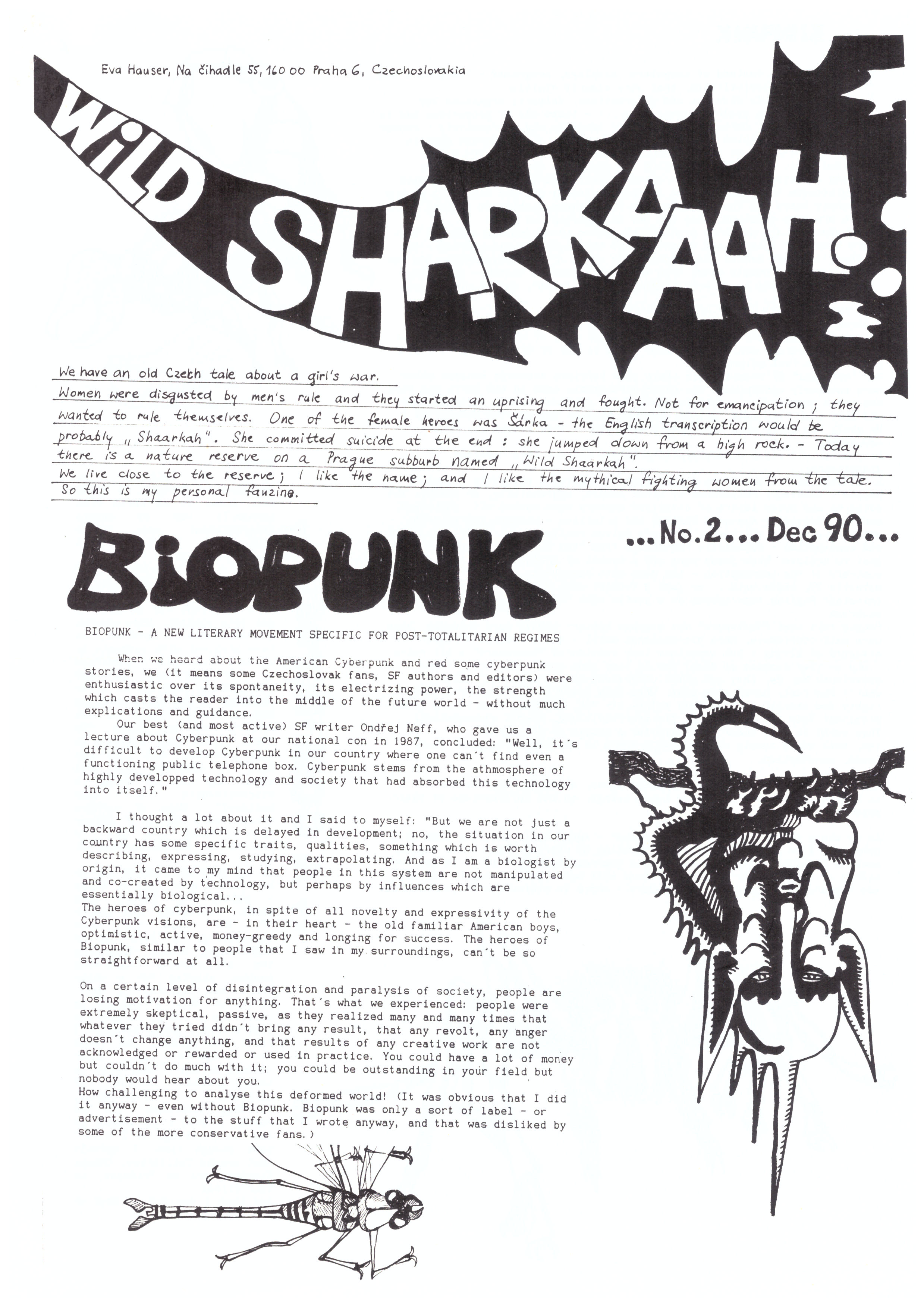
Because there is a catch – of course, there is – and in a European context, this neat timeline is disrupted by the Czech writer Eva Hauserová (1954-2023), also known as Eva Hauser, who in 1988 independently came up with a literary intervention she called “biopunk,” and her coinage pre-dates the American one. This sits uncomfortably with the official chronicle, making her something later critics have had to explain away, though there are also those who have simply ignored her. (For the former, see Schmeink, who will be discussed below; for the latter, a simple Google search will reveal any number of biopunk, or biopunk-adjacent websites that have no idea of Eva’s existence.)
Eva was living behind the Iron Curtain at the time she came up with the notion of “biopunk,” with limited access to American sources and no contact with her American contemporaries. However, like the American writers who later dreamt up their version of biopunk in the 1990s, her ideas were formed in reaction to cyberpunk – or rather, her vague impression of what she imagined cyberpunk to be, in the absence of any direct experience of the foundational texts – but with a change of focus to genetics and biology, rather than information technology and computer programming. (No doubt her educational background as a microbiologist played a role in that.) There are, then, some parallels between Eva’s initial impulse towards biopunk and that of the writers who later adopted the same term in America, though there are also significant differences.
In the 1980s, there was a common consensus in Czechoslovak fandom that cyberpunk was not really a viable literary genre in the conditions of latter-day Communism. As the Czech writer Ondřej Neff (1945-) argued in a classic lecture at Parcon, the Czechoslovak national sf convention, in June 1987: “It’s difficult to develop cyberpunk in a country, where one can’t even find a working telephone box.” (Neff 1987, cited from Hauser 1993, 15)
In devising her concept of biopunk, Eva took this insight one step further, arguing that the differences between East and West in relation to cyberpunk were not just a question of technology, but also of social conditioning:
The heroes of cyberpunk, in spite of all the novelty and colour of cyberpunk narrative, are at heart the same, familiar American boys – optimistic, active, greedy for money and longing for success. The heroes of biopunk, similarly to the people that I saw each day in my surroundings, couldn’t be nearly so straightforward.
When the disintegration and paralysis of society reaches a certain level, people lose their motivation to do anything at all. This is what we experienced in Czechoslovakia in the 1980s: people became extremely sceptical and passive as they realised, time and time again, that no matter what they tried, they couldn’t bring about any results, that no revolt, no expression of anger was capable of changing anything… (Hauser 1993, 15)
Worse, in Eva’s view, people living under totalitarianism become so accustomed to the limitations imposed on them that they come to consider them normal:
For example, the heroes of my stories often consider their situation to be marvellous and pleasant, even though by any rational analysis it is in actual fact frightening or utterly repulsive: this reflects totalitarian society with its grotesque voluntarism, its newspapers which continually declared that we, the people, were extremely happy, that we were living in a highly developed society, and that if we still had a few problems, they weren’t really so serious… (Hauser 1993, 15)2
Biopunk, then, was a literary device that allowed Eva to express the inner deformations of life under totalitarianism by externalising them into speculative biological traits. Her societies become the playground of “mutants, genetic diseases and deformations, chimaeric organisms,” (Hauser 1993, 15), and her protagonists are unable to imagine another state of being. Under the pressures of totalitarianism, her protagonists literally become monsters.
Eva Hauserová: Self-portrait (2020)
American biopunk clearly comes from a very different impulse: the exploration of how biotechnology is going to impact society in the framework of a more-or-less corporate future. Its extrapolated biotechnology is based on real science, not metaphor.3 Its social assumptions are those of capitalism, not the sunset years of Soviet-style Communism and the collapsing economy of a failed experiment in centrally-planned socialism, based on nineteenth-century notions of industrial development and twentieth-century surveillance technology.
There is no question that the “biopunk” of contemporary film and fiction is not the same animal as Eva’s, and that her coinage of an earlier Central-East European homonym is an inconvenience to the people who take the contemporary, “Western” variant seriously. It therefore makes perfect sense that they should seek to sideline Eva’s rogue intervention, though the ways they do so are sometimes quite problematic.
The most detailed attempt I have found to date is that of Lars Schmeink (1975-) in his article “Biopunk 101,” which was published in two slightly different versions in 2014 (Schmeink 2014a; Schmeink 2014b). Schmeink is today a respected independent scholar, based in Hamburg, with an impressive CV and a long publications list, but in 2014 he was just finishing his Ph.D. at Humboldt University Berlin , which two years later yielded his monograph Biopunk Dystopias: Genetic Engineering, Society and Science Fiction, published by Liverpool University Press (Schmeink 2016). The monograph itself makes no mention of Eva or her Czech biopunk – justifiably so, as it has no relevance to his argument – but one assumes that one of the reasons for his earlier essay was to tidy away this awkward forerunner, so as to avoid cluttering up his later book.
As far as I have been able to reconstruct the publishing history, the two versions of “Biopunk 101” appeared within a couple of months of each other. The first, longer version appeared on Schmeink’s personal blog in May 2014 and is now accessible only on the Wayback Machine; the second, more formal (and shorter) variant appeared as an essay in SFRA Review in Summer 2014 (Schmeink 2014a; Schmeink 2014b). The discussion of Eva’s work in both versions is based on a mini-feature about biopunk, which appeared in the BSFA’s critical journal Vector in 1993, and which was curated by the present author.
This comprised of three items:
1. A slightly edited and polished version of Eva’s English-language essay, “Biopunk: A New Literary Movement for Post-Totalitarian Regimes”, first published under a slightly variant title in her personal fanzine, Wild Sharkaah, in 1990 (Hauser 1990; Hauser 1993).
2. An English translation of “A Few Notes About Biopunk”, by Miroslav Fišer (1965-), first published in Czech in 1991, to illustrate how Eva’s biopunk had been received in Czech critical circles (Fišer 1993).
3. An introduction by myself to set the context (Simsa 1993).
Given the relatively late date of these publications (1991 for the first Czech appearance of Fišer, 1993 for Vector), both Fišer and I make the point that biopunk – which Eva herself declared to be a response to the experience of living under totalitarianism (see above) – was no longer a going concern by the time Vector appeared, because the fall of Communism had done away with the conditions that gave rise to it. This in turn leads Schmeink, whose account of Eva’s biopunk seems mostly intended to demonstrate its discontinuity from his own research, to base his discussion almost entirely on Fišer’s essay. We thus have the paradoxical situation, where Schmeink talks about biopunk as if it was some kind of impersonal movement from Eastern Europe, with Fišer as its spokesman, rather than the personal project of one individual (Eva Hauserová), supported by a couple of her acolytes (Simsa, Fišer), who essentially contributed nothing, except as a kind of all-singing, all-dancing team of bespoke fanboy cheer leaders.
Eva is cited by Schmeink only in support of Fišer’s arguments: “Eva Hauser, another writer of Czech biopunk, in a manifest[o] from 1990 […] translated into English in Vector, underlines some of Fišer’s statements and adds to the definition” (Schmeink 2014a, a passage that is found only in the web version of the article; it has been deleted from the abridged version published as Schmeink 2014b). In the longer version of the essay on his blog, Schmeink does at least quote a few words from Eva herself, but in the shorter (and more official) version in SFRA Review, he quotes only Fišer and myself. Eva is named, but not allowed to speak, and one can only conclude that Schmeink has completely misunderstood the distribution of roles between Eva, Fišer and the present author; and in particular, the fact that biopunk was Eva’s invention, not ours.
The original fanzine publication of “Biopunk: A New Literary Movement Specific for Post-Totalitarian Regimes”. Wild Sharkaaah, No.2, December 1990.
In fairness to Schmeink, Eva’s Wild Sharkaah was not available online at the time he was writing (it was not posted on efanzines.com till 2018), and paper copies would have been hard to find in 2014. It is therefore likely he had had no opportunity to verify the provenance of Eva’s article for himself, which might have helped clarify the pivotal nature of Eva’s contribution. The handwritten heading, the hand-drawn illustrations, and the way the article is integrated into the free-flowing text of Eva’s personal fanzine can leave little doubt about how individual this project was for her. Certainly, anyone who has read the original fanzine version of “Biopunk: A New Literary Movement for Post-Totalitarian Regimes” would find it hard to claim that “it remains unclear who originally coined the term,” as Schmeink does in both versions of his text (Schmeink 2014a; Schmeink 2014b, 33). That being said, I did include details of the article’s earlier publication in the bibliographic notes in Vector and a simple comparison of Eva’s author bio to Fišer’s should have been enough to show which of the two was the more significant writer. (By the time the Vector feature appeared, Eva had professionally published one novel and a short story collection, had been working as a professional editor for three years and her bio listed multiple publication credits. Fišer had gafiated. This is stated explicitly. Simsa 1993, 18.) One, therefore, cannot help wondering whether gender bias may also have played a role.
Another factor may have been how much time had elapsed since Eva first published her biopunk manifesto. In the early 1990s, immediately after the fall of Communism, the world was swept by a wave of interest in the post-Communist societies that had newly reopened to direct contacts with “the West,” and this was no less true of sf and sf fandom than it was of the rest of society. Eva was a known quantity in English-speaking fandom in the 1990s: she had worked as a professional editor at Ikárie magazine in Prague, which was newly publishing so many British and American writers, and had contributed stories and articles to a range of English-language publications, including a previous issue of Vector (Hauser 1992b). (Other English-language genre publications in which she appeared around this time included Matrix, BBR, Shards of Babel and Science-Fiction Studies: see Hauser 1991a, Hauser 1992a, Hauser 1992d, and Hauser 1994.) She was also publishing her own English-language fanzine; attending multiple international conventions, including the Chicago Worldcon in 1991, and Syncon 92 in Australia as the official European GUFF delegate, the first fan from post-Communist Central Europe to be selected for one of the major international fan funds (convention reports available in Hauser 1991b for Chicago and Hauser 1992c for Australia); and she had become one of the regular ports of call for Western writers visiting Prague, including Bruce Sterling, who wrote about her in a travelogue for Wired (Sterling 1995, 155-156 plus photo on 103).
In other words, at the time the Vector feature was published, anyone with at least a passing interest in European sf would have had an idea of who Eva was, and the editors did not see any need to emphasise this; but twenty years later, when Schmeink came to write his piece, this was evidently no longer the case and his discussion misses the context.
In his focus on contemporary forms of biopunk, Schmeink does his best to locate Eva’s Central-East European biopunk in the past, to contain it in a bubble of late-totalitarian DIY punk subculture that has long ceased to be of anything but historical interest. In essence, he tries to present it as something like a dead language, leaving her mutants and chimaeric organisms to wander the margins of the post-Communist genre landscape, like hopeful monsters – another species of the weird zombies of Communism that are still endemic to the culture over here…
The problem with all this is that contemporary genre scholarship is not the only possible frame of reference for studying Eva’s oeuvre, and if one takes a step back to look at her work in the framework of Gender Studies or Slavic Studies, she is still considered an appropriate topic of research. Indeed, there has been a marked upswing of interest in her work in recent years. University theses have been written about her sf of the 1980s and her involvement in fandom (Praženková 2007; Czechaczek 2015); essays have been published about the overlap between her science fiction and her involvement in the Czech women’s movement of the 1990s (Blažková 2025); at least one conference paper has been devoted specifically to her version of biopunk (Czechaczek 2018); and the Polish Scholar Joanna Czaplińska has drawn heavily on Eva’s stories in her recent study of gender aspects of Czech science fiction (Czaplińska 2022). The donation of Eva’s literary archive to the Czech Literature Museum (Muzeum literatury–Památník národního písemnictví), after her untimely death in 2023, has also opened up new opportunities for study, as detailed by her son in an upcoming essay for the journal, Literární archiv (Hauser J. 2026).
In short, Eva’s work is not going away and there are fields of scholarship in which it is her version of biopunk that is seen as the genuine article and the global version is the distraction. In fact, to be slightly provocative about this, from a Central European perspective, the globalised biopunk that has dominated cultural discourse for the last thirty-odd years looks increasingly like the vision of a dying corporate Utopia – a “localized referent” for a historically specific, culturally limited moment, to paraphrase Schmeink (Schmeink 2014b, 33) – while it is Eva’s biopunk and its raw engagement with the structures of totalitarianism that is once again becoming alarmingly relevant in the face of the new, post-democratic social order that seems to be sweeping our way from Airstrip Two, on the far side of the water.
“Dystopia is already here, it’s just unevenly distributed.”
~
FULL DISCLOSURE: Eva Hauserová was my partner. We lived together from 1994 until her death in 2023. We were not yet partners in 1991, at the time I prepared the biopunk feature that was eventually published in Vector.
Eva Hauserová (1954-2023)Eva Hauserová was born in Prague and originally planned to become a research scientist, receiving a Master’s degree in microbiology in 1978 and later starting an unfinished doctorate. However, in parallel to her scientific activities, she had always had an interest in creative writing and in the 1980s this began to dominate.
She discovered fandom in 1985 and rapidly began to produce the stories that became the basis of her idea of biopunk and her first short story collection, Hostina mutagenů [A Feast of Mutagens, 1992]. In 1988, she also won the prestigious Karel Čapek Award for her story “U nás v Agónii” [“Here, in Agony”, where Agony is the name of a planet].
She narrowly missed becoming one of the founding editors of the premier Czech sf magazine, Ikárie, in 1990, joining the editorial staff from the second issue. She went on to work as an editor for a range of Prague publishers, as well as a freelance translator, eventually producing somewhere in the region of a hundred book-length translations from English (she herself lost count), starting with The Vampire Tapestry by Suzy McKee Charnas in 1993. Her other translations included genre-adjacent work by Fay Weldon, Ruth Ozeki and Eve Ensler, and a host of Harlequin romances under various pseudonyms. Her last translation, Clive King’s classic children’s fantasy, Stig of the Dump, is being published in 2026.
In her own writing, she published an sf novel, Cvokyně [The Madwoman] in 1992, and continued to write genre-inflected stories throughout her career, such as those collected in Když se sudičky spletou [When the Fates Make a Mistake, 2000]. However, her later novels moved into the mainstream. She also wrote several volumes of non-fiction, initially in relation to her voluntary work at the Prague Gender Studies Center, perhaps most notably Na koštěti se dá i lítát aneb Nemožné ženy dokažou i nemožné [Broomsticks can also be Used for Flying, or Impossible Women can Achieve the Impossible, 1995], one of the very first attempts to provide an overview of what would today be called second-wave feminism for Czech readers. The book was an unexpected hit.
It was also around this time that she was most active internationally, attending multiple sf conventions, contributing to English-language publications (both within the genre and in Gender Studies), and publishing her own fanzine. Much of her English-language work from this period is signed Eva Hauser.
Later in life, her focus shifted to environmental issues. She was chair of the Czech Permaculture Association for several years and her last major publication was the gigantic three-volume Encyklopedie soběstačnosti pro 21. století [Encylopedia of Self-sufficiency for the 21st Century, 2016-2022], which she edited and co-wrote.
She died in 2023. Her final, posthumous novel, based on her experiences in the environmental movement, is forthcoming.
Cyril SimsaCyril Simsa is an Anglo-Czech writer (born in London to Czech parents, but now living in Prague), with stories and articles in a range of genre publications. His short story collection is Lost Cartographies: Tales of Another Europe (Invocations Press, 2014). A second collection, Starspawn and Other Stories, is forthcoming.
~
SOURCES
Blažková, Hana. 2025. “Pozapomenutá sci-fi tradice českého feminismu. Emancipace Evy Hauserové a Caroly Biedermannové v 80. a 90. letech 20. století”. Gender a výzkum/Gender and Research online: https://doi.org/10.13060/gav.2025.004 [accessed 29 Mar 2026].
Czaplińska, Joanna. 2022. “Does Czech Science Fiction Have a (Feminine) Gender?” Revista Hélice, 8 (1), whole no. 32, 9-20. Translated by Carleton Bulkin. Online at https://w ww.revistahelice.com/en/book/helice-32-2/ [accessed 29 Mar 2026]. Previously published in Czech in 2015.
Czechaczek, Jan. 2015. “Cena Karla Čapka ve fanzinech.” Master’s thesis, Masaryk University, Brno.
Czechaczek, Jan. 2018. “Biopunk Evy Hauserové.” Paper presented at the conference Fantasy and Myth in the Anthropocene/Fantastika a mýtus v antropocénu, Masaryk University, Brno, October 5, 2018. One-page abstract available at: https://ceska-literatura.phil.muni.cz/fantastika/en/fantasy-and-myth-in-the-anthropocene/conference-program [accessed 29 Mar 2026]
Di Filippo, Paul. 1990. “Ribofunk.” Boing-Boing, Winter 1990, 24. Republished online as “Ribofunk: the Manifesto”, currently at https://www.streettech.com/bcp/BCPtext/Manifestos/Ribofunk.html [accessed 29 Mar 2026]. Print version not seen.
Fišer, Miroslav. 1993. “A Few Notes about Biopunk.” Vector, 174, 17-18. Translated by Cyril Simsa. Online at https://fanac.org/fanzines/Vector/Vector174.pdf [accessed 29 Mar 2026]. Previously published in Czech in 1991.
Hauser, Eva. 1990. “Biopunk: A New Literary Movement Specific for Post-Totalitarian Regimes.” Wild Sharkaaah, 2, 1-2. Online at https://efanzines.com/WildSharkaah/WildSharkaah-02.pdf [accessed 29 Mar 2026]. The spelling of the fanzine title is inconsistent.
Hauser Eva. 1991a. “The Changing Face of Europe.” Matrix, 94, 23-24. Online at: https://www.fanac.org/fanzines/Matrix/Matrix94.pdf [accessed 29 Mar 2026].
Hauser, Eva. 1991b. “A Czech Fan in America: Chicago WorldCon Impressions.” Shards of Babel, 34, 6-7. Online at https://fanac.org/fanzines/Shards_of_Babel/Shards_of_Babel34-06.html [accessed 29 Mar 2026].
Hauser, Eva. 1992a. “Will People in Czechoslovakia Read SF in the Future?” Shards of Babel, 35, 7. Online at https://fanac.org/fanzines/Shards_of_Babel/Shards_of_Babel35-07.html [accessed 29 Mar 2026].
Hauser, Eva. 1992b. “The View from Olympus.” Vector, 166, 14-16. Translated by Cyril Simsa. Online at: https://fanac.org/fanzines/Vector/Vector166.pdf [accessed 29 Mar 2026]. Previously published in Czech in 1991.
Hauser, Eva. 1992c. “My Australian Diary: Syncon ’92 – and Something More.” Wild Shaarkah, 8, 1-12 [whole issue]. Online at https://efanzines.com/WildSharkaah/WildSharkaah-08.pdf [accessed 29 Mar 2026]. Reprinted with corrections in GUFF: The Incomplete Chronicles, edited by David Langford. Ansible Editions, 2025. Online at https://taff.org.uk/ebooks.php?x=guffanth [accessed 29 Mar 2026]. The spelling of the fanzine title is inconsistent.
Hauser, Eva. 1992d. “A Toothsome Smile, an Artificial Death.” Back Brain Recluse, 21, 21-23. Translated by Cyril Simsa. Online at: https://archive.org/details/back-brain-recluse-no.-21-1992 [accessed 29 Mar 2026]. Previously published in Czech in 1991.
Hauser, Eva, 1993. “Biopunk: A New Literary Movement for Post-Totalitarian Regimes.” Vector, 174, 15-16. Online at https://fanac.org/fanzines/Vector/Vector174.pdf [accessed 29 Mar 2026]. Slightly revised version of Hauser 1990.
Hauser, Eva. 1994. “Science Fiction in the Czech Republic and the Former Czechoslovakia: The Pleasures and the Disappointments of the New Cosmopolitanism.” Science-Fiction Studies 21 (2), whole no. 63, 133-140. https://doi.org/10.1525/sfs.21.2.0133
Hauser, Jakub. [2026]. “‘Svůj ženský úděl ponesu mužně.’ Zpráva o literární pozůstalosti Evy Hauserové (1954–2023) v Literárním archivu PNP.” Literární archiv, 58, 2026 [in press].
McHale, Brian. 1992. Constructing Postmodernism. Routledge. Cited from Schmeink 2014b. Original not seen.
Melly, George. 1970. Revolt into Style: the Pop Arts in Britain. Allen Lane. Cited from the Kindle edition: Faber, 2012.
Neff, Ondřej. 1987. “Nová vlná v SF a kyberpunk.” Lecture delivered at Parcon, the Czechoslovak national sf convention, June 13, 1987. Noted in the convention programme in Interkom, 6/1987 [online at https://interkom.vecnost.cz/1987/19870654.htm; accessed 29 Mar 2026], and commonly referenced by other writers of the period, but I have not been able to find a published text of the lecture itself.
Nicholls, Peter, and David Langford. [2025]. “Steampunk.” In The Encyclopedia of Science Fiction. 4th edn., edited by John Clute, David Langford et al. https://sf-encyclopedia.com/entry/steampunk [accessed 4 Apr 2026]. Entry last updated 7 Apr 2025.
Orwell, George. 1949. Nineteen Eighty-Four. Secker & Warburg. Cited from pdf e-book at https://www.fadedpage.com/showbook.php?pid=20120511 [accessed 4 Apr 2026].
Praženková, Monika. 2007. “Světy feministické fikce v díle Evy Hauserové.” Bachelor thesis, Masaryk University, Brno.
Prucher, Jeff, ed. 2007. Brave New Words: The Oxford Dictionary of Science Fiction. Oxford University Press.
Schmeink, Lars. 2014a. “Biopunk 101” [blog post], May 1, 2014, http://larsschmeink.de/?p=2548 [accessed 10 Nov 2016]. No longer available at this address but cached at https://web.archive.org/web/20150214054235/http:/larsschmeink.de/?p=2548 [accessed 29 Mar 2026].
Schmeink, Lars. 2014b. “Biopunk 101”, SFRA Review, 309, 31-36. Web version not accessible as of 29 Mar 2026.
Schmeink, Lars. 2016. Biopunk Dystopias: Genetic Engineering, Society and Science Fiction. (Liverpool Science Fiction Texts and Studies.) Liverpool University Press. Online at https://www.liverpooluniversitypress.co.uk/doi/book/10.3828/9781781383766 [accessed 29 Mar 2026].
Simsa, Cyril. 1993. “Two Short Articles about Biopunk.” Vector, 174, 12-14, 18. Online at https://fanac.org/fanzines/Vector/Vector174.pdf [accessed 29 Mar 2026].
Sterling, Bruce. 1995. “Triumph of the Plastic People”. Wired, 3.01, 100-107, 154-158. Plain text (minus photos) archived at https://www.wired.com/1995/01/prague/ [partially pay-walled] [accessed 29 Mar 2026].
- Prucher 2007, 16, attributes the first appearance to a Usenet post relating to the role-playing game GURPS on 17 May 1992; Schmeink 2014b, 33, cites the literary theorist Brian McHale (1952-2025), who uses the term in his monograph, Constructing Postmodernism (McHale 1992), 255. The two sources appeared in rapid succession, and the chances of them being related seem close to zero. ︎
- Cf. Winston Smith’s declaration at the end of Nineteen Eighty-Four: “[T]he struggle was finished. He had won the victory over himself. He loved Big Brother”. Orwell 1949, 361. ︎
- Cf. Di Filippo 1990: “Ribofunk is speculative fiction which acknowledges, is informed by and illustrates the tenet that the next revolution – the only one that really matters – will be in the field of biology.” ︎
Categories: Industry News
Rehabilitating Eva Hauserová’s Biopunk
By Cyril Simsa
Eva Hauserová promoting her non-fiction title Na koštěti se dá i lítat [Broomsticks can also be used for flying], 1995
Of the many contemporary subgenres of sf that can claim they originated as a reaction to the cyberpunk revolution of the 1980s, one of the oldest is certainly “biopunk”, especially if one counts the mini-genre of “ribofunk” – shouted into existence by the American writer Paul Di Filippo (1954-) in 1990, and just as quickly extinguished – as a legitimate precursor (Di Filippo 1990). Probably only “steampunk”, coined by K.W. Jeter (1950-) in 1987, is older (Nicholls and Langford 2025).
“Biopunk”, as it is used today, refers to a subgenre of sf that adopts many of the stylistic and narrative tropes of cyberpunk – a focus on stories built around an ensemble cast of petty criminals, (gene) hackers and chancers, urban subcultures, and a “revolt into style” (if the reader will pardon the throwback to the cultural criticism of an earlier era) (Melly 1970) – while sourcing its McGuffins from biotechnology, rather than cybernetics. In this contemporary sense, biopunk has its origins in the American genre writing of the 1990s, with the first documented use (from two different, and almost certainly unconnected sources) in 1992, and the subsequent attempt to identify precursors in earlier genre history.1
Di Filippo takes this as far back as H.G. Wells’ The Island of Doctor Moreau (1896); of more recent antecedents, Greg Bear’s Blood Music (1985) and Bruce Sterling’s Schismatrix (1985) are frequently cited (Di Filippo 1990; Schmeink 2014b, 32). From these American genre roots, biopunk has spread around the world and into other media, film and TV in particular. The hit TV show, Orphan Black (2013-2017), with its saga of a shadowy organisation trying to direct the future of human evolution through gene hacking and the complications that arise when some of its human clones escape, would be a good example. All of which makes a neat teleological narrative of exactly the kind that, in theory, every self-respecting punk of whatever persuasion is supposed to abhor; and none of which quite holds together when examined in a broader framework.
Because there is a catch – of course, there is – and in a European context, this neat timeline is disrupted by the Czech writer Eva Hauserová (1954-2023), also known as Eva Hauser, who in 1988 independently came up with a literary intervention she called “biopunk,” and her coinage pre-dates the American one. This sits uncomfortably with the official chronicle, making her something later critics have had to explain away, though there are also those who have simply ignored her. (For the former, see Schmeink, who will be discussed below; for the latter, a simple Google search will reveal any number of biopunk, or biopunk-adjacent websites that have no idea of Eva’s existence.)
Eva was living behind the Iron Curtain at the time she came up with the notion of “biopunk,” with limited access to American sources and no contact with her American contemporaries. However, like the American writers who later dreamt up their version of biopunk in the 1990s, her ideas were formed in reaction to cyberpunk – or rather, her vague impression of what she imagined cyberpunk to be, in the absence of any direct experience of the foundational texts – but with a change of focus to genetics and biology, rather than information technology and computer programming. (No doubt her educational background as a microbiologist played a role in that.) There are, then, some parallels between Eva’s initial impulse towards biopunk and that of the writers who later adopted the same term in America, though there are also significant differences.
In the 1980s, there was a common consensus in Czechoslovak fandom that cyberpunk was not really a viable literary genre in the conditions of latter-day Communism. As the Czech writer Ondřej Neff (1945-) argued in a classic lecture at Parcon, the Czechoslovak national sf convention, in June 1987: “It’s difficult to develop cyberpunk in a country, where one can’t even find a working telephone box.” (Neff 1987, cited from Hauser 1993, 15)
In devising her concept of biopunk, Eva took this insight one step further, arguing that the differences between East and West in relation to cyberpunk were not just a question of technology, but also of social conditioning:
The heroes of cyberpunk, in spite of all the novelty and colour of cyberpunk narrative, are at heart the same, familiar American boys – optimistic, active, greedy for money and longing for success. The heroes of biopunk, similarly to the people that I saw each day in my surroundings, couldn’t be nearly so straightforward.
When the disintegration and paralysis of society reaches a certain level, people lose their motivation to do anything at all. This is what we experienced in Czechoslovakia in the 1980s: people became extremely sceptical and passive as they realised, time and time again, that no matter what they tried, they couldn’t bring about any results, that no revolt, no expression of anger was capable of changing anything… (Hauser 1993, 15)
Worse, in Eva’s view, people living under totalitarianism become so accustomed to the limitations imposed on them that they come to consider them normal:
For example, the heroes of my stories often consider their situation to be marvellous and pleasant, even though by any rational analysis it is in actual fact frightening or utterly repulsive: this reflects totalitarian society with its grotesque voluntarism, its newspapers which continually declared that we, the people, were extremely happy, that we were living in a highly developed society, and that if we still had a few problems, they weren’t really so serious… (Hauser 1993, 15)2
Biopunk, then, was a literary device that allowed Eva to express the inner deformations of life under totalitarianism by externalising them into speculative biological traits. Her societies become the playground of “mutants, genetic diseases and deformations, chimaeric organisms,” (Hauser 1993, 15), and her protagonists are unable to imagine another state of being. Under the pressures of totalitarianism, her protagonists literally become monsters.
Eva Hauserová: Self-portrait (2020)
American biopunk clearly comes from a very different impulse: the exploration of how biotechnology is going to impact society in the framework of a more-or-less corporate future. Its extrapolated biotechnology is based on real science, not metaphor.3 Its social assumptions are those of capitalism, not the sunset years of Soviet-style Communism and the collapsing economy of a failed experiment in centrally-planned socialism, based on nineteenth-century notions of industrial development and twentieth-century surveillance technology.
There is no question that the “biopunk” of contemporary film and fiction is not the same animal as Eva’s, and that her coinage of an earlier Central-East European homonym is an inconvenience to the people who take the contemporary, “Western” variant seriously. It therefore makes perfect sense that they should seek to sideline Eva’s rogue intervention, though the ways they do so are sometimes quite problematic.
The most detailed attempt I have found to date is that of Lars Schmeink (1975-) in his article “Biopunk 101,” which was published in two slightly different versions in 2014 (Schmeink 2014a; Schmeink 2014b). Schmeink is today a respected independent scholar, based in Hamburg, with an impressive CV and a long publications list, but in 2014 he was just finishing his Ph.D. at Humboldt University Berlin , which two years later yielded his monograph Biopunk Dystopias: Genetic Engineering, Society and Science Fiction, published by Liverpool University Press (Schmeink 2016). The monograph itself makes no mention of Eva or her Czech biopunk – justifiably so, as it has no relevance to his argument – but one assumes that one of the reasons for his earlier essay was to tidy away this awkward forerunner, so as to avoid cluttering up his later book.
As far as I have been able to reconstruct the publishing history, the two versions of “Biopunk 101” appeared within a couple of months of each other. The first, longer version appeared on Schmeink’s personal blog in May 2014 and is now accessible only on the Wayback Machine; the second, more formal (and shorter) variant appeared as an essay in SFRA Review in Summer 2014 (Schmeink 2014a; Schmeink 2014b). The discussion of Eva’s work in both versions is based on a mini-feature about biopunk, which appeared in the BSFA’s critical journal Vector in 1993, and which was curated by the present author.
This comprised of three items:
1. A slightly edited and polished version of Eva’s English-language essay, “Biopunk: A New Literary Movement for Post-Totalitarian Regimes”, first published under a slightly variant title in her personal fanzine, Wild Sharkaah, in 1990 (Hauser 1990; Hauser 1993).
2. An English translation of “A Few Notes About Biopunk”, by Miroslav Fišer (1965-), first published in Czech in 1991, to illustrate how Eva’s biopunk had been received in Czech critical circles (Fišer 1993).
3. An introduction by myself to set the context (Simsa 1993).
Given the relatively late date of these publications (1991 for the first Czech appearance of Fišer, 1993 for Vector), both Fišer and I make the point that biopunk – which Eva herself declared to be a response to the experience of living under totalitarianism (see above) – was no longer a going concern by the time Vector appeared, because the fall of Communism had done away with the conditions that gave rise to it. This in turn leads Schmeink, whose account of Eva’s biopunk seems mostly intended to demonstrate its discontinuity from his own research, to base his discussion almost entirely on Fišer’s essay. We thus have the paradoxical situation, where Schmeink talks about biopunk as if it was some kind of impersonal movement from Eastern Europe, with Fišer as its spokesman, rather than the personal project of one individual (Eva Hauserová), supported by a couple of her acolytes (Simsa, Fišer), who essentially contributed nothing, except as a kind of all-singing, all-dancing team of bespoke fanboy cheer leaders.
Eva is cited by Schmeink only in support of Fišer’s arguments: “Eva Hauser, another writer of Czech biopunk, in a manifest[o] from 1990 […] translated into English in Vector, underlines some of Fišer’s statements and adds to the definition” (Schmeink 2014a, a passage that is found only in the web version of the article; it has been deleted from the abridged version published as Schmeink 2014b). In the longer version of the essay on his blog, Schmeink does at least quote a few words from Eva herself, but in the shorter (and more official) version in SFRA Review, he quotes only Fišer and myself. Eva is named, but not allowed to speak, and one can only conclude that Schmeink has completely misunderstood the distribution of roles between Eva, Fišer and the present author; and in particular, the fact that biopunk was Eva’s invention, not ours.
The original fanzine publication of “Biopunk: A New Literary Movement Specific for Post-Totalitarian Regimes”. Wild Sharkaaah, No.2, December 1990.
In fairness to Schmeink, Eva’s Wild Sharkaah was not available online at the time he was writing (it was not posted on efanzines.com till 2018), and paper copies would have been hard to find in 2014. It is therefore likely he had had no opportunity to verify the provenance of Eva’s article for himself, which might have helped clarify the pivotal nature of Eva’s contribution. The handwritten heading, the hand-drawn illustrations, and the way the article is integrated into the free-flowing text of Eva’s personal fanzine can leave little doubt about how individual this project was for her. Certainly, anyone who has read the original fanzine version of “Biopunk: A New Literary Movement for Post-Totalitarian Regimes” would find it hard to claim that “it remains unclear who originally coined the term,” as Schmeink does in both versions of his text (Schmeink 2014a; Schmeink 2014b, 33). That being said, I did include details of the article’s earlier publication in the bibliographic notes in Vector and a simple comparison of Eva’s author bio to Fišer’s should have been enough to show which of the two was the more significant writer. (By the time the Vector feature appeared, Eva had professionally published one novel and a short story collection, had been working as a professional editor for three years and her bio listed multiple publication credits. Fišer had gafiated. This is stated explicitly. Simsa 1993, 18.) One, therefore, cannot help wondering whether gender bias may also have played a role.
Another factor may have been how much time had elapsed since Eva first published her biopunk manifesto. In the early 1990s, immediately after the fall of Communism, the world was swept by a wave of interest in the post-Communist societies that had newly reopened to direct contacts with “the West,” and this was no less true of sf and sf fandom than it was of the rest of society. Eva was a known quantity in English-speaking fandom in the 1990s: she had worked as a professional editor at Ikárie magazine in Prague, which was newly publishing so many British and American writers, and had contributed stories and articles to a range of English-language publications, including a previous issue of Vector (Hauser 1992b). (Other English-language genre publications in which she appeared around this time included Matrix, BBR, Shards of Babel and Science-Fiction Studies: see Hauser 1991a, Hauser 1992a, Hauser 1992d, and Hauser 1994.) She was also publishing her own English-language fanzine; attending multiple international conventions, including the Chicago Worldcon in 1991, and Syncon 92 in Australia as the official European GUFF delegate, the first fan from post-Communist Central Europe to be selected for one of the major international fan funds (convention reports available in Hauser 1991b for Chicago and Hauser 1992c for Australia); and she had become one of the regular ports of call for Western writers visiting Prague, including Bruce Sterling, who wrote about her in a travelogue for Wired (Sterling 1995, 155-156 plus photo on 103).
In other words, at the time the Vector feature was published, anyone with at least a passing interest in European sf would have had an idea of who Eva was, and the editors did not see any need to emphasise this; but twenty years later, when Schmeink came to write his piece, this was evidently no longer the case and his discussion misses the context.
In his focus on contemporary forms of biopunk, Schmeink does his best to locate Eva’s Central-East European biopunk in the past, to contain it in a bubble of late-totalitarian DIY punk subculture that has long ceased to be of anything but historical interest. In essence, he tries to present it as something like a dead language, leaving her mutants and chimaeric organisms to wander the margins of the post-Communist genre landscape, like hopeful monsters – another species of the weird zombies of Communism that are still endemic to the culture over here…
The problem with all this is that contemporary genre scholarship is not the only possible frame of reference for studying Eva’s oeuvre, and if one takes a step back to look at her work in the framework of Gender Studies or Slavic Studies, she is still considered an appropriate topic of research. Indeed, there has been a marked upswing of interest in her work in recent years. University theses have been written about her sf of the 1980s and her involvement in fandom (Praženková 2007; Czechaczek 2015); essays have been published about the overlap between her science fiction and her involvement in the Czech women’s movement of the 1990s (Blažková 2025); at least one conference paper has been devoted specifically to her version of biopunk (Czechaczek 2018); and the Polish Scholar Joanna Czaplińska has drawn heavily on Eva’s stories in her recent study of gender aspects of Czech science fiction (Czaplińska 2022). The donation of Eva’s literary archive to the Czech Literature Museum (Muzeum literatury–Památník národního písemnictví), after her untimely death in 2023, has also opened up new opportunities for study, as detailed by her son in an upcoming essay for the journal, Literární archiv (Hauser J. 2026).
In short, Eva’s work is not going away and there are fields of scholarship in which it is her version of biopunk that is seen as the genuine article and the global version is the distraction. In fact, to be slightly provocative about this, from a Central European perspective, the globalised biopunk that has dominated cultural discourse for the last thirty-odd years looks increasingly like the vision of a dying corporate Utopia – a “localized referent” for a historically specific, culturally limited moment, to paraphrase Schmeink (Schmeink 2014b, 33) – while it is Eva’s biopunk and its raw engagement with the structures of totalitarianism that is once again becoming alarmingly relevant in the face of the new, post-democratic social order that seems to be sweeping our way from Airstrip Two, on the far side of the water.
“Dystopia is already here, it’s just unevenly distributed.”
~
FULL DISCLOSURE: Eva Hauserová was my partner. We lived together from 1994 until her death in 2023. We were not yet partners in 1991, at the time I prepared the biopunk feature that was eventually published in Vector.
Eva Hauserová (1954-2023)Eva Hauserová was born in Prague and originally planned to become a research scientist, receiving a Master’s degree in microbiology in 1978 and later starting an unfinished doctorate. However, in parallel to her scientific activities, she had always had an interest in creative writing and in the 1980s this began to dominate.
She discovered fandom in 1985 and rapidly began to produce the stories that became the basis of her idea of biopunk and her first short story collection, Hostina mutagenů [A Feast of Mutagens, 1992]. In 1988, she also won the prestigious Karel Čapek Award for her story “U nás v Agónii” [“Here, in Agony”, where Agony is the name of a planet].
She narrowly missed becoming one of the founding editors of the premier Czech sf magazine, Ikárie, in 1990, joining the editorial staff from the second issue. She went on to work as an editor for a range of Prague publishers, as well as a freelance translator, eventually producing somewhere in the region of a hundred book-length translations from English (she herself lost count), starting with The Vampire Tapestry by Suzy McKee Charnas in 1993. Her other translations included genre-adjacent work by Fay Weldon, Ruth Ozeki and Eve Ensler, and a host of Harlequin romances under various pseudonyms. Her last translation, Clive King’s classic children’s fantasy, Stig of the Dump, is being published in 2026.
In her own writing, she published an sf novel, Cvokyně [The Madwoman] in 1992, and continued to write genre-inflected stories throughout her career, such as those collected in Když se sudičky spletou [When the Fates Make a Mistake, 2000]. However, her later novels moved into the mainstream. She also wrote several volumes of non-fiction, initially in relation to her voluntary work at the Prague Gender Studies Center, perhaps most notably Na koštěti se dá i lítát aneb Nemožné ženy dokažou i nemožné [Broomsticks can also be Used for Flying, or Impossible Women can Achieve the Impossible, 1995], one of the very first attempts to provide an overview of what would today be called second-wave feminism for Czech readers. The book was an unexpected hit.
It was also around this time that she was most active internationally, attending multiple sf conventions, contributing to English-language publications (both within the genre and in Gender Studies), and publishing her own fanzine. Much of her English-language work from this period is signed Eva Hauser.
Later in life, her focus shifted to environmental issues. She was chair of the Czech Permaculture Association for several years and her last major publication was the gigantic three-volume Encyklopedie soběstačnosti pro 21. století [Encylopedia of Self-sufficiency for the 21st Century, 2016-2022], which she edited and co-wrote.
She died in 2023. Her final, posthumous novel, based on her experiences in the environmental movement, is forthcoming.
Cyril SimsaCyril Simsa is an Anglo-Czech writer (born in London to Czech parents, but now living in Prague), with stories and articles in a range of genre publications. His short story collection is Lost Cartographies: Tales of Another Europe (Invocations Press, 2014). A second collection, Starspawn and Other Stories, is forthcoming.
~
SOURCES
Blažková, Hana. 2025. “Pozapomenutá sci-fi tradice českého feminismu. Emancipace Evy Hauserové a Caroly Biedermannové v 80. a 90. letech 20. století”. Gender a výzkum/Gender and Research online: https://doi.org/10.13060/gav.2025.004 [accessed 29 Mar 2026].
Czaplińska, Joanna. 2022. “Does Czech Science Fiction Have a (Feminine) Gender?” Revista Hélice, 8 (1), whole no. 32, 9-20. Translated by Carleton Bulkin. Online at https://w ww.revistahelice.com/en/book/helice-32-2/ [accessed 29 Mar 2026]. Previously published in Czech in 2015.
Czechaczek, Jan. 2015. “Cena Karla Čapka ve fanzinech.” Master’s thesis, Masaryk University, Brno.
Czechaczek, Jan. 2018. “Biopunk Evy Hauserové.” Paper presented at the conference Fantasy and Myth in the Anthropocene/Fantastika a mýtus v antropocénu, Masaryk University, Brno, October 5, 2018. One-page abstract available at: https://ceska-literatura.phil.muni.cz/fantastika/en/fantasy-and-myth-in-the-anthropocene/conference-program [accessed 29 Mar 2026]
Di Filippo, Paul. 1990. “Ribofunk.” Boing-Boing, Winter 1990, 24. Republished online as “Ribofunk: the Manifesto”, currently at https://www.streettech.com/bcp/BCPtext/Manifestos/Ribofunk.html [accessed 29 Mar 2026]. Print version not seen.
Fišer, Miroslav. 1993. “A Few Notes about Biopunk.” Vector, 174, 17-18. Translated by Cyril Simsa. Online at https://fanac.org/fanzines/Vector/Vector174.pdf [accessed 29 Mar 2026]. Previously published in Czech in 1991.
Hauser, Eva. 1990. “Biopunk: A New Literary Movement Specific for Post-Totalitarian Regimes.” Wild Sharkaaah, 2, 1-2. Online at https://efanzines.com/WildSharkaah/WildSharkaah-02.pdf [accessed 29 Mar 2026]. The spelling of the fanzine title is inconsistent.
Hauser Eva. 1991a. “The Changing Face of Europe.” Matrix, 94, 23-24. Online at: https://www.fanac.org/fanzines/Matrix/Matrix94.pdf [accessed 29 Mar 2026].
Hauser, Eva. 1991b. “A Czech Fan in America: Chicago WorldCon Impressions.” Shards of Babel, 34, 6-7. Online at https://fanac.org/fanzines/Shards_of_Babel/Shards_of_Babel34-06.html [accessed 29 Mar 2026].
Hauser, Eva. 1992a. “Will People in Czechoslovakia Read SF in the Future?” Shards of Babel, 35, 7. Online at https://fanac.org/fanzines/Shards_of_Babel/Shards_of_Babel35-07.html [accessed 29 Mar 2026].
Hauser, Eva. 1992b. “The View from Olympus.” Vector, 166, 14-16. Translated by Cyril Simsa. Online at: https://fanac.org/fanzines/Vector/Vector166.pdf [accessed 29 Mar 2026]. Previously published in Czech in 1991.
Hauser, Eva. 1992c. “My Australian Diary: Syncon ’92 – and Something More.” Wild Shaarkah, 8, 1-12 [whole issue]. Online at https://efanzines.com/WildSharkaah/WildSharkaah-08.pdf [accessed 29 Mar 2026]. Reprinted with corrections in GUFF: The Incomplete Chronicles, edited by David Langford. Ansible Editions, 2025. Online at https://taff.org.uk/ebooks.php?x=guffanth [accessed 29 Mar 2026]. The spelling of the fanzine title is inconsistent.
Hauser, Eva. 1992d. “A Toothsome Smile, an Artificial Death.” Back Brain Recluse, 21, 21-23. Translated by Cyril Simsa. Online at: https://archive.org/details/back-brain-recluse-no.-21-1992 [accessed 29 Mar 2026]. Previously published in Czech in 1991.
Hauser, Eva, 1993. “Biopunk: A New Literary Movement for Post-Totalitarian Regimes.” Vector, 174, 15-16. Online at https://fanac.org/fanzines/Vector/Vector174.pdf [accessed 29 Mar 2026]. Slightly revised version of Hauser 1990.
Hauser, Eva. 1994. “Science Fiction in the Czech Republic and the Former Czechoslovakia: The Pleasures and the Disappointments of the New Cosmopolitanism.” Science-Fiction Studies 21 (2), whole no. 63, 133-140. https://doi.org/10.1525/sfs.21.2.0133
Hauser, Jakub. [2026]. “‘Svůj ženský úděl ponesu mužně.’ Zpráva o literární pozůstalosti Evy Hauserové (1954–2023) v Literárním archivu PNP.” Literární archiv, 58, 2026 [in press].
McHale, Brian. 1992. Constructing Postmodernism. Routledge. Cited from Schmeink 2014b. Original not seen.
Melly, George. 1970. Revolt into Style: the Pop Arts in Britain. Allen Lane. Cited from the Kindle edition: Faber, 2012.
Neff, Ondřej. 1987. “Nová vlná v SF a kyberpunk.” Lecture delivered at Parcon, the Czechoslovak national sf convention, June 13, 1987. Noted in the convention programme in Interkom, 6/1987 [online at https://interkom.vecnost.cz/1987/19870654.htm; accessed 29 Mar 2026], and commonly referenced by other writers of the period, but I have not been able to find a published text of the lecture itself.
Nicholls, Peter, and David Langford. [2025]. “Steampunk.” In The Encyclopedia of Science Fiction. 4th edn., edited by John Clute, David Langford et al. https://sf-encyclopedia.com/entry/steampunk [accessed 4 Apr 2026]. Entry last updated 7 Apr 2025.
Orwell, George. 1949. Nineteen Eighty-Four. Secker & Warburg. Cited from pdf e-book at https://www.fadedpage.com/showbook.php?pid=20120511 [accessed 4 Apr 2026].
Praženková, Monika. 2007. “Světy feministické fikce v díle Evy Hauserové.” Bachelor thesis, Masaryk University, Brno.
Prucher, Jeff, ed. 2007. Brave New Words: The Oxford Dictionary of Science Fiction. Oxford University Press.
Schmeink, Lars. 2014a. “Biopunk 101” [blog post], May 1, 2014, http://larsschmeink.de/?p=2548 [accessed 10 Nov 2016]. No longer available at this address but cached at https://web.archive.org/web/20150214054235/http:/larsschmeink.de/?p=2548 [accessed 29 Mar 2026].
Schmeink, Lars. 2014b. “Biopunk 101”, SFRA Review, 309, 31-36. Web version not accessible as of 29 Mar 2026.
Schmeink, Lars. 2016. Biopunk Dystopias: Genetic Engineering, Society and Science Fiction. (Liverpool Science Fiction Texts and Studies.) Liverpool University Press. Online at https://www.liverpooluniversitypress.co.uk/doi/book/10.3828/9781781383766 [accessed 29 Mar 2026].
Simsa, Cyril. 1993. “Two Short Articles about Biopunk.” Vector, 174, 12-14, 18. Online at https://fanac.org/fanzines/Vector/Vector174.pdf [accessed 29 Mar 2026].
Sterling, Bruce. 1995. “Triumph of the Plastic People”. Wired, 3.01, 100-107, 154-158. Plain text (minus photos) archived at https://www.wired.com/1995/01/prague/ [partially pay-walled] [accessed 29 Mar 2026].
- Prucher 2007, 16, attributes the first appearance to a Usenet post relating to the role-playing game GURPS on 17 May 1992; Schmeink 2014b, 33, cites the literary theorist Brian McHale (1952-2025), who uses the term in his monograph, Constructing Postmodernism (McHale 1992), 255. The two sources appeared in rapid succession, and the chances of them being related seem close to zero. ︎
- Cf. Winston Smith’s declaration at the end of Nineteen Eighty-Four: “[T]he struggle was finished. He had won the victory over himself. He loved Big Brother”. Orwell 1949, 361. ︎
- Cf. Di Filippo 1990: “Ribofunk is speculative fiction which acknowledges, is informed by and illustrates the tenet that the next revolution – the only one that really matters – will be in the field of biology.” ︎
Categories: Industry News
Mark J. McGarry (1958-2026)
Author and editor Mark J. McGarry, 68, died in May 2026 in Paris, France.
McGarry was born February 6, 1958 in Albany NY. He wrote Sun Dogs (1981) and Blank Slate (1984) as well as several genre works of short fiction published in magazines including Asimov's, Analog, Stellar, Amazing Stories, and F&SF, including Nebula Award nominee The Mercy Gate (1998). He was the original editor of SF magazine Empire and …Read More
The post Mark J. McGarry (1958-2026) appeared first on Locus.
Categories: Industry News, Industry News Home